
The show States of Exchange: Artists from Cuba ended its run on March 22, 2008. For three months, in the galleries inside its avant-garde Rivington Place headquarters, London’s Institute of International Visual Arts (INIVA) hosted works by six Cuban artists, all of them based in Havana: Diana Fonseca, Jeanette Chávez, Wilfredo Prieto, Iván Capote, Yoan Capote, and Lázaro Saavedra. Another thirteen were grouped in a video program: Raychel Carrión, Javier Castro, Alexis de la O Joya, Laimir Fano, Adonis Flores, Alex Hernández, Jesús Hernández, Luis o Miguel, Gustavo Pérez, Renier Quer, Alina Rodríguez, Lázaro Saavedra, Asori Soto, and Manuel Zayas. Accompanied by a complete program of artist presentations, lectures, and roundtable discussions, States of Exchange—conceived by Cylena Simonds and developed in collaboration with Gerardo Mosquera—explored a very concrete set of issues and put a virtual finger to the pulse of contemporary art as it is practiced in Cuba today.
The concept for this exhibition originated two years ago when Simonds visited the Havana Biennial for the first time. There, she encountered a pluralistic Cuba unmoored from stereotypes of static collective imaginations and in a continuous process of change and contradiction. With Mosquera’s inestimable contributions, and over several trips between London and Havana, Simonds generated an exhibition that explored an ungraspable Cuba, one dominated by dynamic exchange, movement, and transformation. Aware that the island has transcended all possible limits to establish itself firmly in the minds of intellectuals as a moral dilemma, the curators disassembled monolithic fictional systems and presented a reality fragmented into multiple narratives that are sometimes complementary and sometimes contradictory. The metaphor of the mirror—as a tool that reflects as much as it refracts—was the show’s theoretical frame.
Three generations of artists came together in the exhibition. Lázaro Saavedra broke onto the scene in the second half of the 1980s, Wilfredo Prieto and the Capote brothers emerged in the late 1990s, and Diana Fonseca and Jeannette Chávez did so in the new millennium. Despite the generational differences, the show emanated a spiritual camaraderie and a unity of style, perfectly concordant with international trends of the moment. In spite of individual discourses, the works engaged a unified, highly politicized, critical, historical, and social dialog. The style of the works was primarily “post-conceptual,” aligned with the interests of the first generation of artists, who were active in Cuba in the 1980s, a moment when artists were abandoning brushes and carving instruments as well as the notion of the autonomous art object in order to embrace new materials and conceptual foundations.
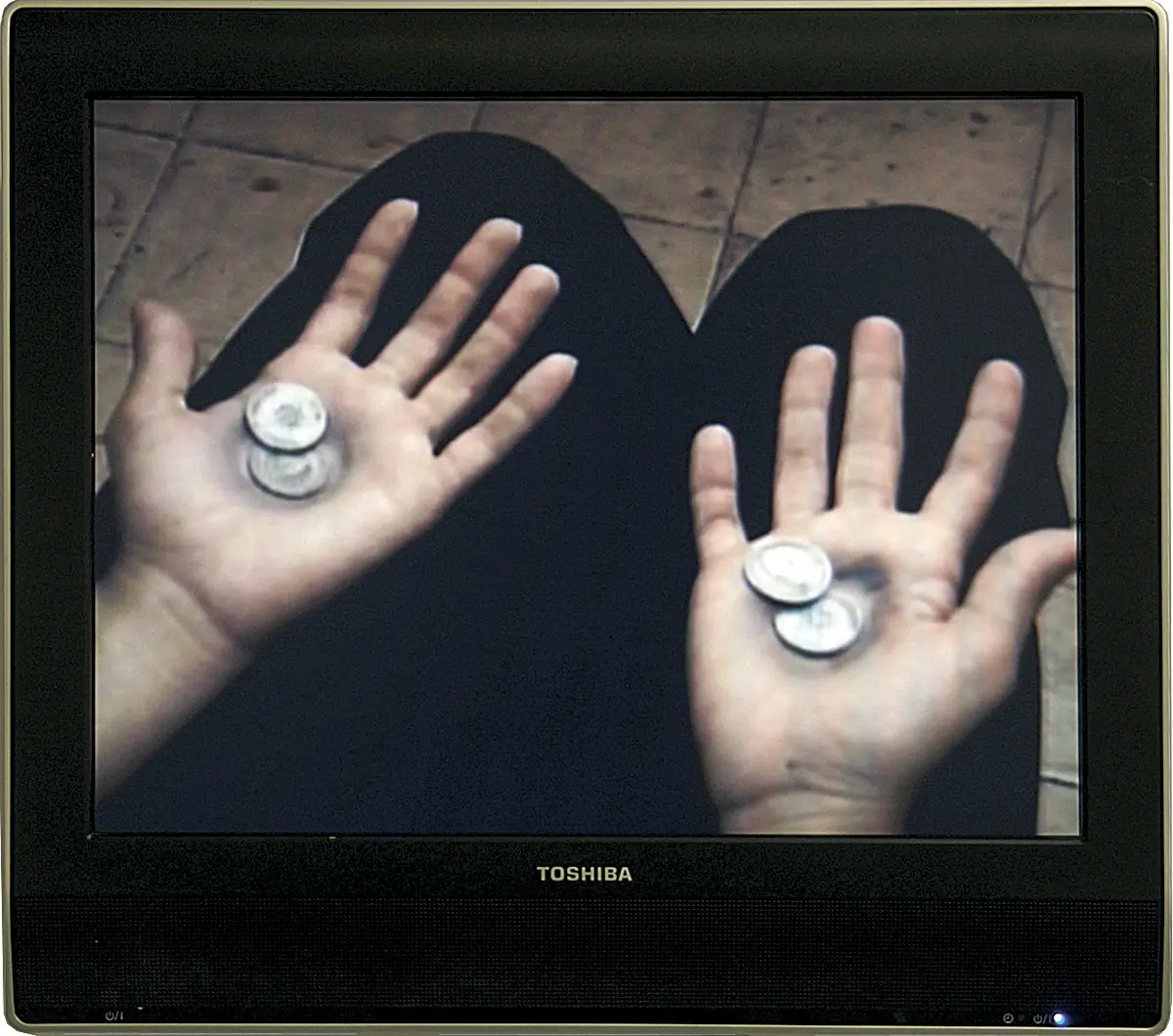
Something that cannot go unnoticed in an exhibition of this nature is the schizoid character of the Cuban monetary system. In the work Dinero bilingüe (2005), by Yoan Capote, two bastardized coins that merged twenty Cuban pesos and one American dollar appeared as the ideal artifacts to handle the monetary confrontation—a coin that is the fruit of the growth of foreign investment and tourism on the island and that reflects the multiple contradictions of Cuban economic sustainability. The coins were perhaps also symbols of socialism’s congenital dysfunctions and those of its dominant class, which hides its capitalist-lion nature under a socialist-lamb disguise.
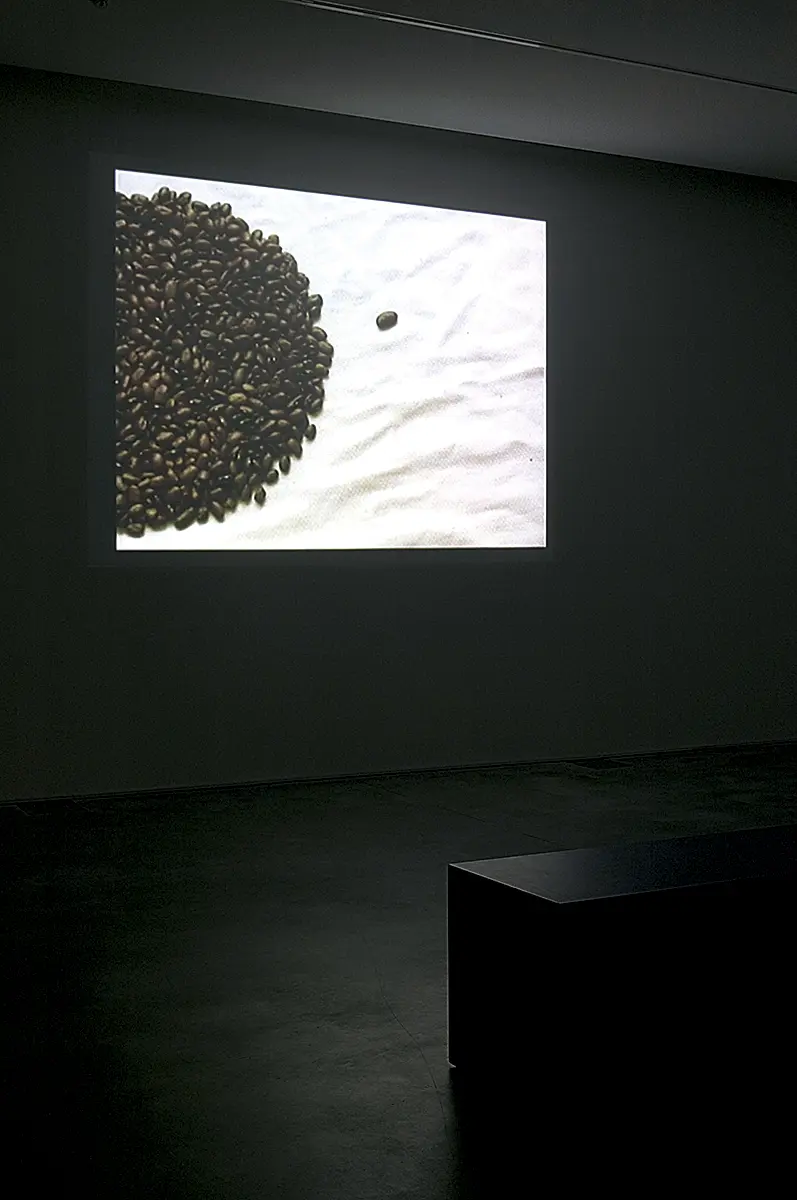
Economic penury and scarcity lead to an inflation of the desire for material things. Diana Fonseca uses strategies such as magical realism, dreams, and fantasy to temporarily suspend the imperatives of the adult world and give free rein to her imagination. Her video series Pasatiempo comprised a sequence of perverse games, a conscious mix of the fictions of a child’s world and the real experiences of an adult’s world. Fonseca appropriated the games of her own childhood to reflect on core issues of adult human behavior: voracious consumerism, material desires, and the experience of excess that engulfs society in general and the art world with it.
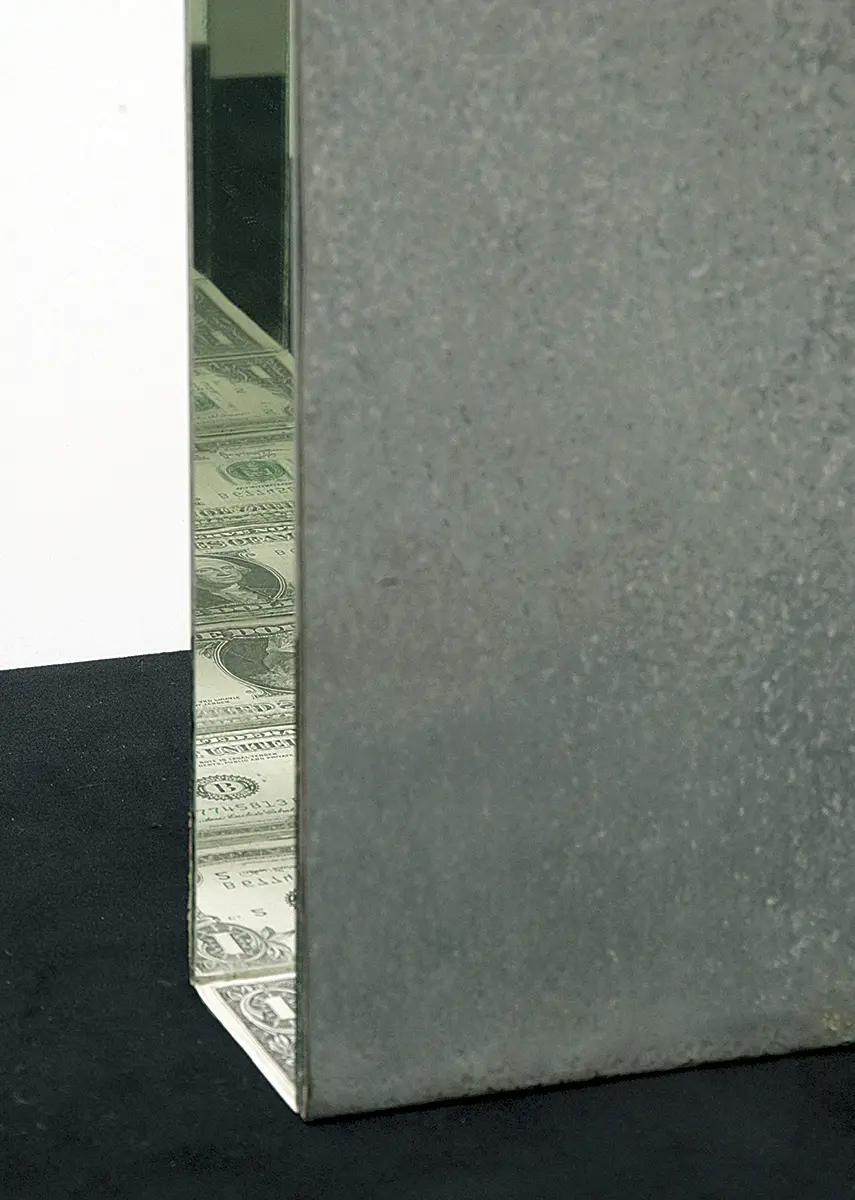
Wilfredo Prieto’s One Million Dollars (2002) also reflected matters of money, accumulation, abundance, and the materialism of our opulent societies. With an evident minimalist sensibility, which he has cultivated throughout his career, Prieto installed a one-dollar bill between two mirrors within a vitrine, thus creating multiple reflections. Viewed at the right angle, viewers saw the bill virtually multiplied to infinity—a playful, lucid view of the world, in which the obsessive minimalist idea of repetition and succession connected with a critical social commentary.
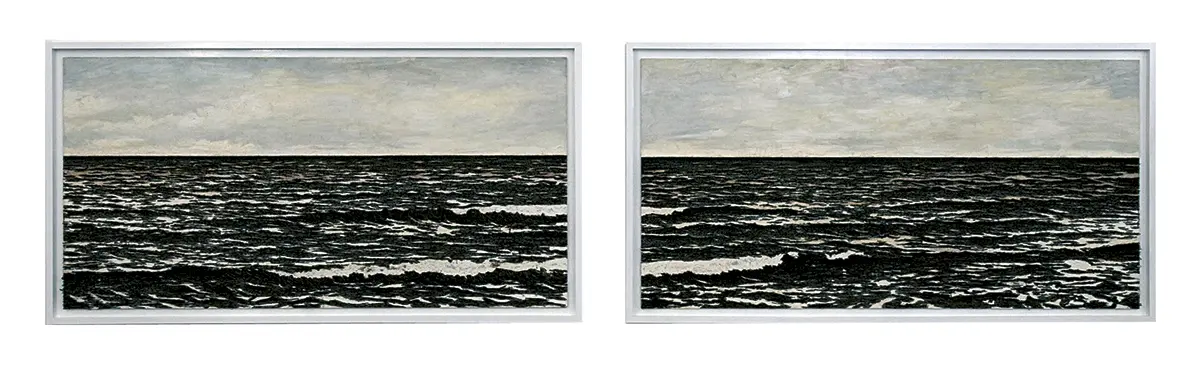
Yoan Capote’s imposing diptych Isla (2007) was a post-pictorial exploration that salvaged the classical format and relocated it to the immediate present. The viewer was lured by what appeared to be the bucolic beauty of a seascape, but a disturbing reality became increasingly apparent as one moved closer to the work. What appeared to be brushstrokes were actually hundreds of fishing hooks of different sizes, attached to the support with nails. Isla had many levels of meaning and presented the precarious position of the subject, trapped within incongruous physical and mental coordinates.
Although censorship does exist in today’s Cuba and is exercised on that which is deemed ideologically “diversionist,” artists and intellectuals are able to skirt around it with varying degrees of success.1
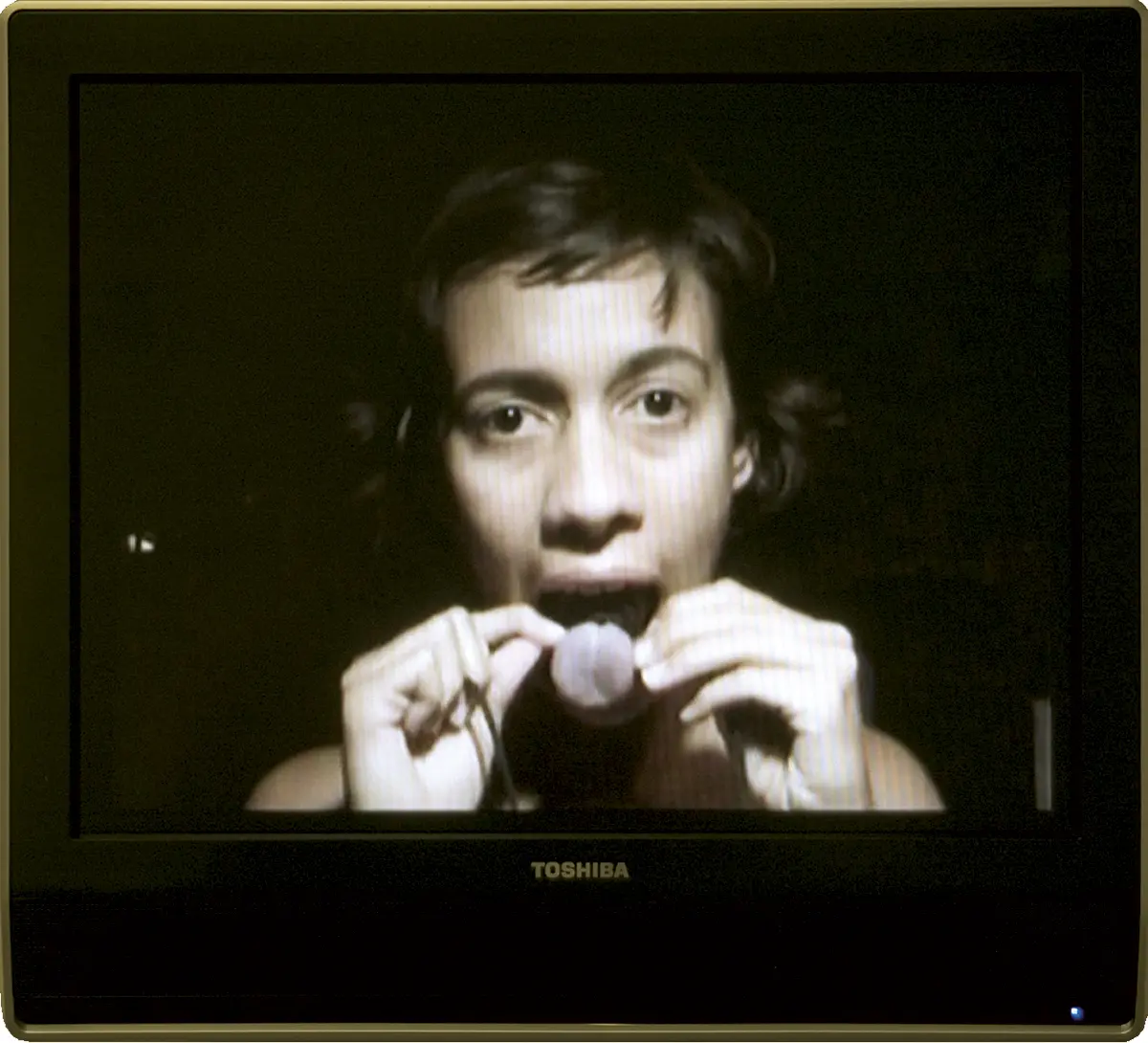
The youngest artist in the show, and perhaps more drastic in her premises because of it, Jeannette Chávez offered herself to the viewer in an act of self-torture. Her video Autocensura (Self-censorship) showed the artist tying her tongue with string and constricting it until it became purple for lack of blood circulation. Without conceit or words but with great effect, Chávez’s work denounced the dangers inherent in self-imposed discipline for both the individual and society.
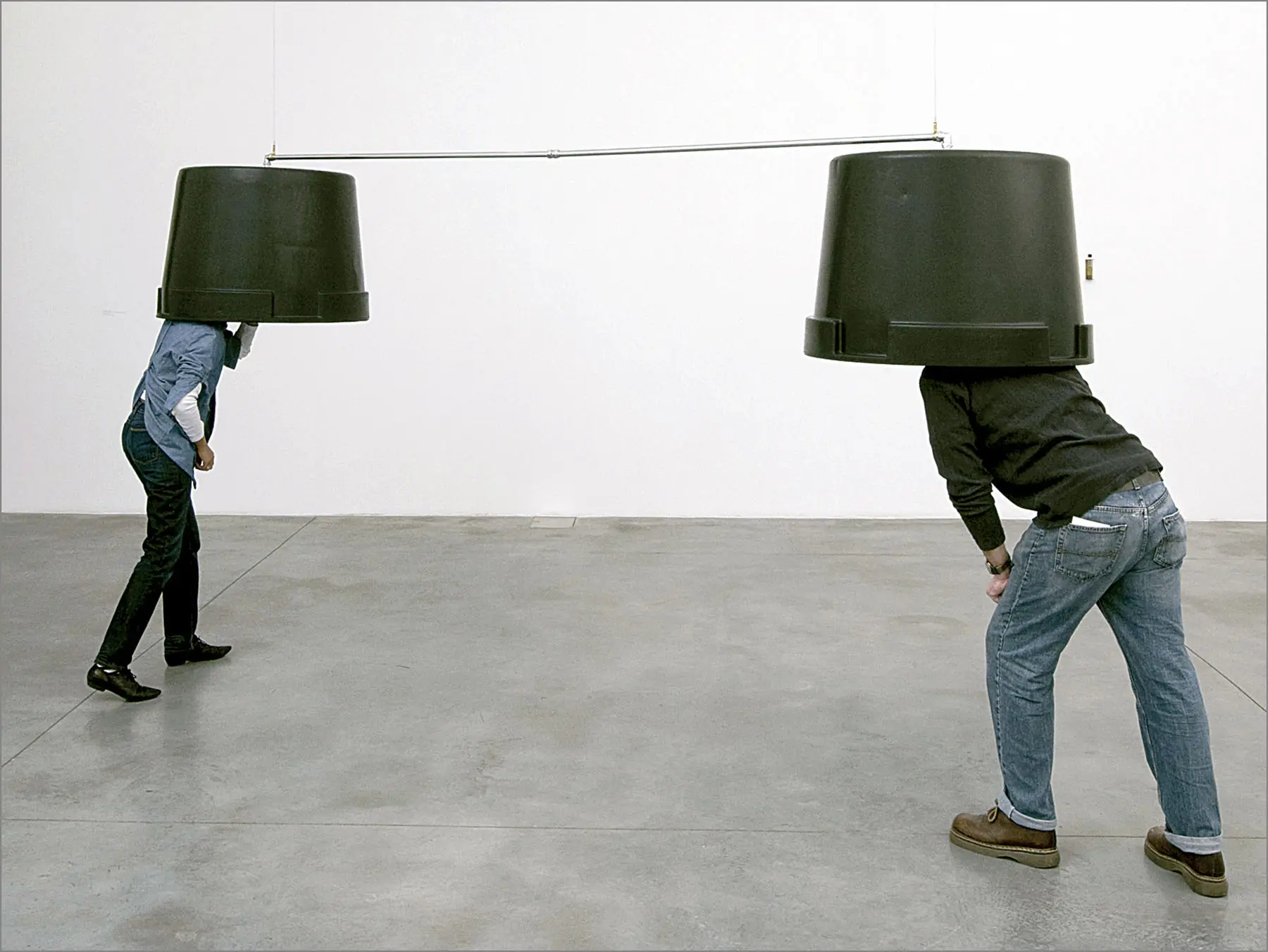
In their installation Secreter, Iván and Yoan Capote improvised ironically with the possibility of new private scenes in the context of the public. The work comprised two suspended trashcans that viewers could stand under. Joined by a plastic tube and a metal rod and with two amplifiers placed inside, the cans emulated the childhood game of telephone, an improvised device of two plastic cups and a string, which children use to play at sending each other secret messages.
The work of Lázaro Saavedra, an artist of the 1980s generation who has never left the island is considered some of the most directly critical against the system. With a simple and immediate style indebted to the genres of illustration and political caricature, Saavedra explores the grave consequences of intolerance and surveillance as official policies as well as their social internalization. In this exhibition, La gloria borra la memoria (2006) and El que no sabe es como el que no ve (2006) were videos in which fable-like narratives broke a veneer of tragicomic humor to criticize the state and reveal the complete manipulation to which the individual is subjected.
Wilfredo Prieto’s installation Speech recreated the space of a public latrine, in which the artist replaced the usual toilet paper roll with one made of pages from Gramma, Cuba’s national newspaper. Toilet paper is often hard to find on the island and reaches exorbitant prices well beyond the grasp of the majority of the population. In addition to its symbolic extrapolation and the humorous commentary that resulted, Speech was also a reality-based document.
With a marked conceptual character and making few aesthetic compromises, Iván Capote’s “pseudo-platonic” works achieve a perfect balance of scientific and socially critical content. Historian (2001) was a kind of Hegelian perpetual-movement clock in which “nothing changes and everything remains.” The work comprised an assemblage of glass, wood, and an electric motor, in which the circular traces made by a marker tied to the end of a handle disappeared in the path of a piece of felt attached to the other end. It was a precise, expanded-time work in which cold and calculated analysis were expressed alongside a philosophical reflection about the archaeology of the human, historical memory, and cyclical processes.
Móvil perpetuo (2001), also by Iván Capote, was an installation composed of a black-and-white photographic series and a test tube filled with metal shavings and the artist’s sweat. The photographs recorded the artist’s hands in the mechanical process of shaving a one-dollar coin through its complete disintegration. The metal shavings and sweat collected in the test tube were proof of the action that took place in the past, an exquisite metaphor of the true value of work and money. In his work, Iván Capote exploits to the utmost the possibilities of a “conceptual” aesthetic in search of the social reality from where all questions emerge.
The possibility of living in a better world, reinventing alternative realities apart from any homogenizing stasis in the service of power, was the topic of Jeannette Chávez’s site-specific installation Cambio de estado (2005). Hanging from the ceiling, a large number of military epaulets from old Revolutionary Armed Forces uniforms formed a striking sky. Its black and yellow stars against a military green background described the actual constellations that can be observed from London. In this way, Chávez posited a “change of state” in two directions: one in which the earth-bound reached the celestial and another in which different military ranks were leveled onto a single, metaphysical, non-hierarchical plane.
Far from simplistic or Manichean readings, States of Exchange was an exhibition of “dissident” works of art—with respect to a monolithic image of the State—in which semiotic displacements opened the works to personal readings. Observant, critical, and opposed to authority and repression, the artists assess what is positive and negative in their social and political reality. Their works explore the knowledge of the individual: its representations, its habits, and the mechanisms that give it direction. In a continuous dialog where the private becomes public and the local becomes global, art is what allows these artists to think out loud, shape their questions, assimilate a learning process, and give all of this back to the society of which they are an active part.
NOTE
1. In March of 1974, Cuba’s Ministry of Culture and the State Security Agency organized an Exhibition on Ideological Diversionism in Havana. At the time, Raúl Castro said: “Ideological diversionism is a subtle weapon wielded by the enemies of the Revolution.” See Lázaro Saavedra’s Communicating Dissent, a presentation of the artist’s work, January 24th, 2008, INIVA, London.
MÓNICA SÁNCHEZ