
Regarded as one of the most refined
exponents of Venezuelan conceptualism, Héctor Fuenmayor (born 1949, Caracas)
proposed a fresh alternative in his most recent solo show titled Buddy Tree
(La escuela de los coincidentes), on display at Periférico Caracas/Arte
Contemporáneo. A skillful juggler in the art of words and images, and a creator
of contradicting but always intelligent meanings, Fuenmayor reasoned critically
around the idea of what is modern in vernacular art through recomposed
landscapes evaded by abstract and constructivist traditions. During this
prolonged struggle, reason took precedence over the natural scenes of moist
vegetation and prominent mountains that appeared in the paintings of the
landscape master artists of the first half of the twentieth century.
Buddy Tree referred to the allegorical Sacred Fig or ficus religiosa. Seen in the Botanical Garden at the Central The University of Venezuela, the ficus religiosa belongs to a low-growing tree family. It is said that, under this tree, the Buddha achieved his state of illumination more than 2,500 years ago. This reference is not unfamiliar to Fuenmayor, who was ordained a Buddhist monk in 1983 by the Abbot Eido Tai Shimano and who has practiced traditional Japanese fencing for many years. Thus, the artist’s perpetual search for the spiritual touches on the meaning of the sacred in Oriental culture but does not eschew allusions to Western religious tradition as embodied by Christianity.
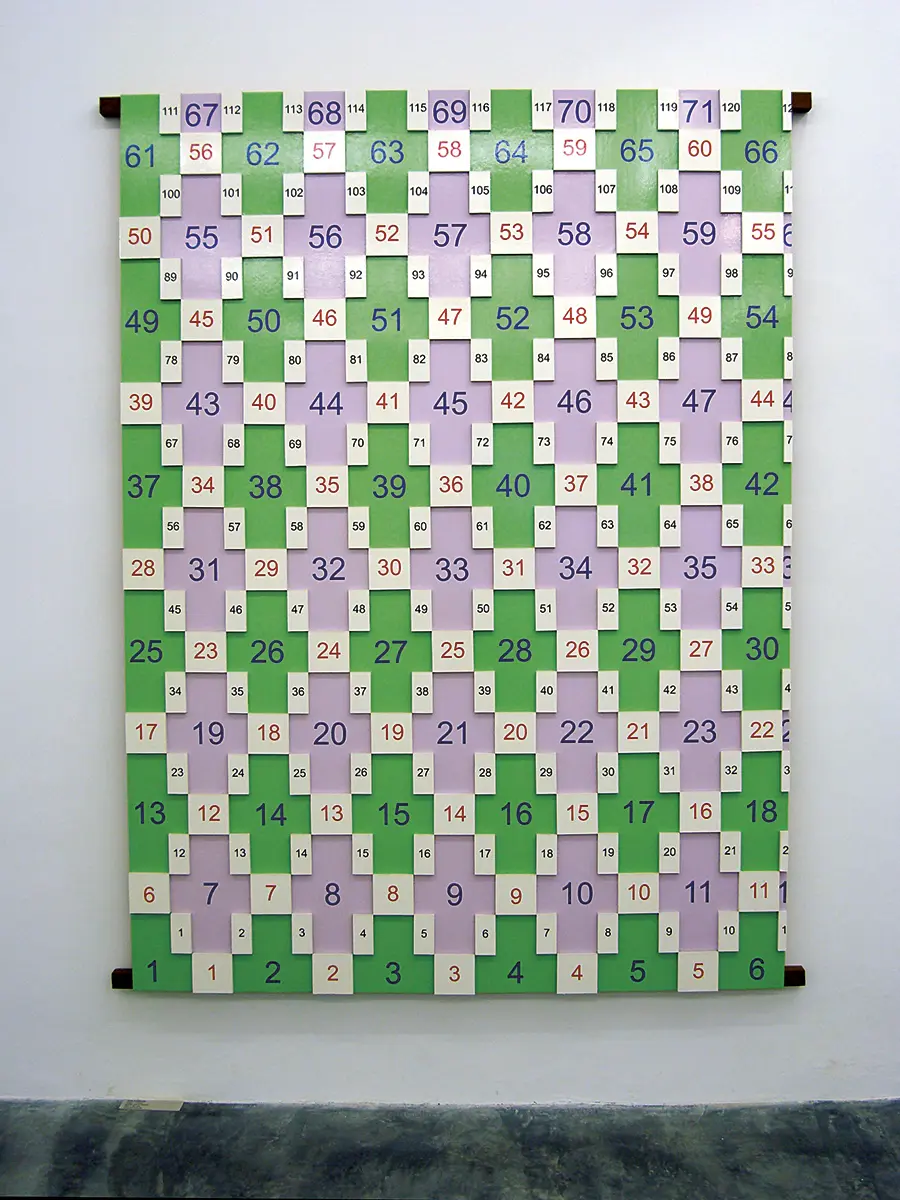
“If is not coincident, it is not contemporary” was spoken by Claudio Perna of the 1991 installation Venezuela y Sus Detalles (Venezuela and Its Details). This phrase could very well label the epistemological strategy by Fuenmayor in Buddy Tree, an exhibit that postulated a paradoxical encounter between nature and abstraction, one that was sprinkled with philosophical allusions, holistic pretensions, and references to biology and mathematics. Thus, the contemporary was presented as a puzzle: a dilemma of overcoming dogmatism and certain artistic ideologies—anchored in the notion of purity and in promoting the reasoned interaction among diverse elements—to unmask meaning.
The fifteen works that made up the exhibit were executed in giclee prints on wood or canvas. They were ambiguous in form, located between the limits of painting, photography, and installation. This group of works revealed a controlled tension, the confrontation of fragmented images and geometric voids. Occasionally, the segmented parts replaced the natural references with ornaments or perfectly delimited areas of color. Both the omitted areas and those that remained visible were subjected to an alternating pattern of organic, rhythmic colors—a perhaps unconscious, veiled tribute to Alejandro Otero.
Sin Título (Untitled, 1972–2007) was a photographic giclee print adhered to the canvas in which a monochromatic picture appeared amid the branches of a tree; this image marked one of the points of departure in the artist’s quest. Here, the work and landscape were superimposed, exchanging their respective structures and properties. The strict regularity of the red canvas acted as a receptacle of pierced shadows whose contours resembled the arabesques of the foliage. There was a clear attempt of “naturalization” in an attempt to erase the distinction between reason and nature.
In Raíz Cuadrada (Square Root, 2007), Fuenmayor’s proposal reached its most austere expression because it was reduced to a geometric and numeric diagram in which a cross (an element that appeared in other works) could be seen. The visible was in a state of suspense, while the naked work revealed the analytic matrix that controlled it.
The work Yidan en Curso de Colisión (Yidan on a Collision Course, 2007) reached the scale of a mural and demonstrated the organic exuberance of the Sacred Fig. It measured more than ten meters in width, and the figure eventually lost its outline near the borders. Expansively structured, the work became progressively fragmented—similar to over-enlarged digital images—and provoked a centrifugal, pixilated effect that demanded that the viewer move a certain distance from it.
These works described the discursive genealogy from which the exhibit was articulated, in that they touched on several aspects that collide in Fuenmayor’s art. Sensibility and reason, meditation and reflection, entropy, and order: these antithetical conditions were abandoned to suggest an ecumenical space of heteroglossia in which unity was formed by the interaction of difference.
Before the vegetal musculature of the ficus religiosa, the viewer beheld the multiple references that constituted the totality of the image, from its faraway foundation in the world of the living to its potent meaning in the representational universe. On contemplating the vastness of the unfinished weave, the viewer’s eye traveled unbiased over the pathways presented, at times stopping to see the details, leaps, and redundancies that distinguished these works by Fuenmayor.
FÉLIX SUAZO