
Hernan Bas is an enfant terrible:
eccentric, carefree, controversial, and sometimes even profane. Just
twenty-nine years old, Bas has become one of the Miami art world’s most
pampered figures—a sort of enfant gâté, a spoiled child.
In possession of the largest collection of works by this artist, The Rubell Family Collection offers an insight into Bas’s prolific artistic trajectory in which non-prejudicial experimentation is prominent. Titled Hernán Bas: Works from The Rubell Family Collection, the current exhibit brings together thirty-eight pieces that illustrate the scope of the artist’s work of the current decade.
Bas’s work covers several mediums, from drawing, painting, photography, and installation to even experimentation with new mediums, where concocting stories and borrowing from others are profusely notable. Bas loves flirting and is particularly talented at turning us into participants—or even accomplices—in a flirtation that eludes us at the end. Even as he incites us until we are seduced into his lurid yet fascinating trip, in the end, he never commits, thrusting us to the sea and leaving us adrift.
Bas’s work is an amalgam of styles, mediums, and themes that manage to co-exist in harmony. His approach, at times nostalgic, at others idyllic, takes us by the hand to a place of stories and dreams. The works brought together under the heading Once Upon a Time are examples of this. The bucolic environment achieved in the photographic sequences that compose A Fairy’s Tale and Fleeting Moments is persuasively innocent. The fact that an adult—the artist himself, in this instance—plays the central role in the story, combined with the formal treatment of the series of images, allows a new reading of the work to emerge: lost innocence, the end of childhood, the romance left behind. This idea is reaffirmed by the playful, child-like element of the kite in Fleeting Moments or by the paper crown in A Fairy’s Tale.
If one needs a term to summarize Bas’s artistic production, it would be “borrowing” in the inclusive sense. The artist has stated that during his formative years, he absorbed everything that came his way. He would spend hours at the public library with a friend, digging here and there like a taxidermist, dissecting every art book he could find; he would break it apart, and ingest and digest it to the point that the original concept and pristine style of the work under study would no longer belong to the recently discovered artist but would then be owned by Hernán Bas. This background is essential to understand what later would become Bas’s most important work, formally and conceptually speaking. Bas is a conjurer, a sort of capricious goblin that knows how to fascinate. Unaffected by the bias of influence and quintessentially heterogeneous, his works bring to light all sorts of characters: buffoons, harlequins, swans, mermaids, Mephistopheles, adolescents in magnified solitude, the devoted immersed in self-reflection, and pathetic puritans. These characters appear associated with rarified environments in which the apparent external calm contains an interior turmoil barely beneath the skin. The Burden (I Shall Leave No Memoirs) of 2006 is an unavoidable colophon. In this self-portrait, Bas sits exhausted, overwhelmed by the rigid costume of a courtier. The exaggerated height of his neck ruffle highlights an idea of asphyxia and rigidity that halts the individual in search of the stooge.
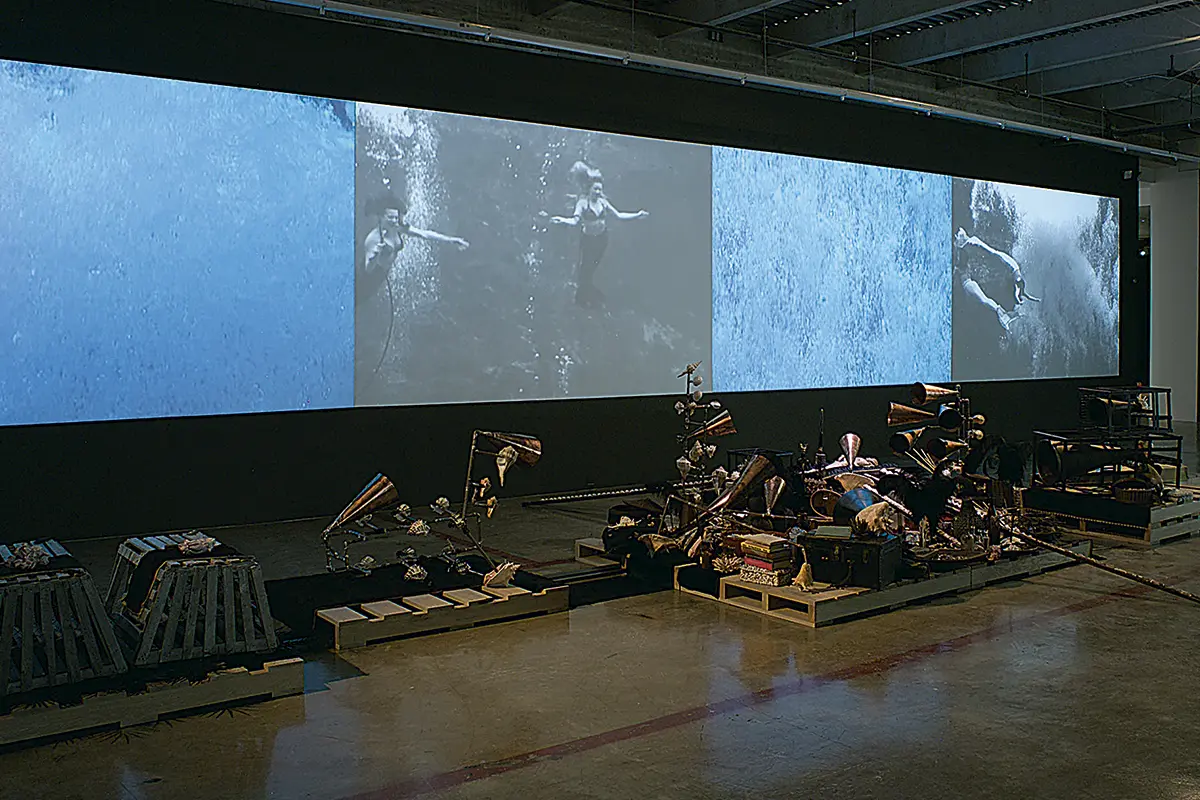
The installation Ocean’s Symphony (Dirge for the Fiji Mermaid) of 2007 signals the artist’s maturity while summarizing his approach. Curiously, it is one of Bas’s rare works where the artist appears in a female role. The installation oscillates between storytelling and archeology. The darkened room projects a cadenced zigzag of mermaids dancing deep in the ocean amid seashells, castles, and bubbles. At the center of the room and unmistakably supporting the work, there are objects representing found treasures to verify the existence of the mythical figures. Musical instruments are brought to the viewer’s attention: these are medieval instruments constructed of copper and large shells. Also displayed in translucent receptacles are books and manuscripts that probably supported or incited the artist’s curiosity and research. As if to prove that these creatures are real, tangible beings, the delicate fossil of a mermaid is visible. From this work, Bas appears to summon life into all his characters as if the already fine line between reality and fiction had been forever erased. Nevertheless, always a restless character, Bas does not try to conceal the trickery behind his magic, and now and then the viewer sees that his mermaids are refueled with oxygen tanks.
JANET BATET