
En passant is the title and communicating
thread of the most recent solo exhibition of works by Iran do Espírito Santo
(Mococa, São Paulo, Brazil, 1963 at the Fortes Villaça gallery, comprised of a
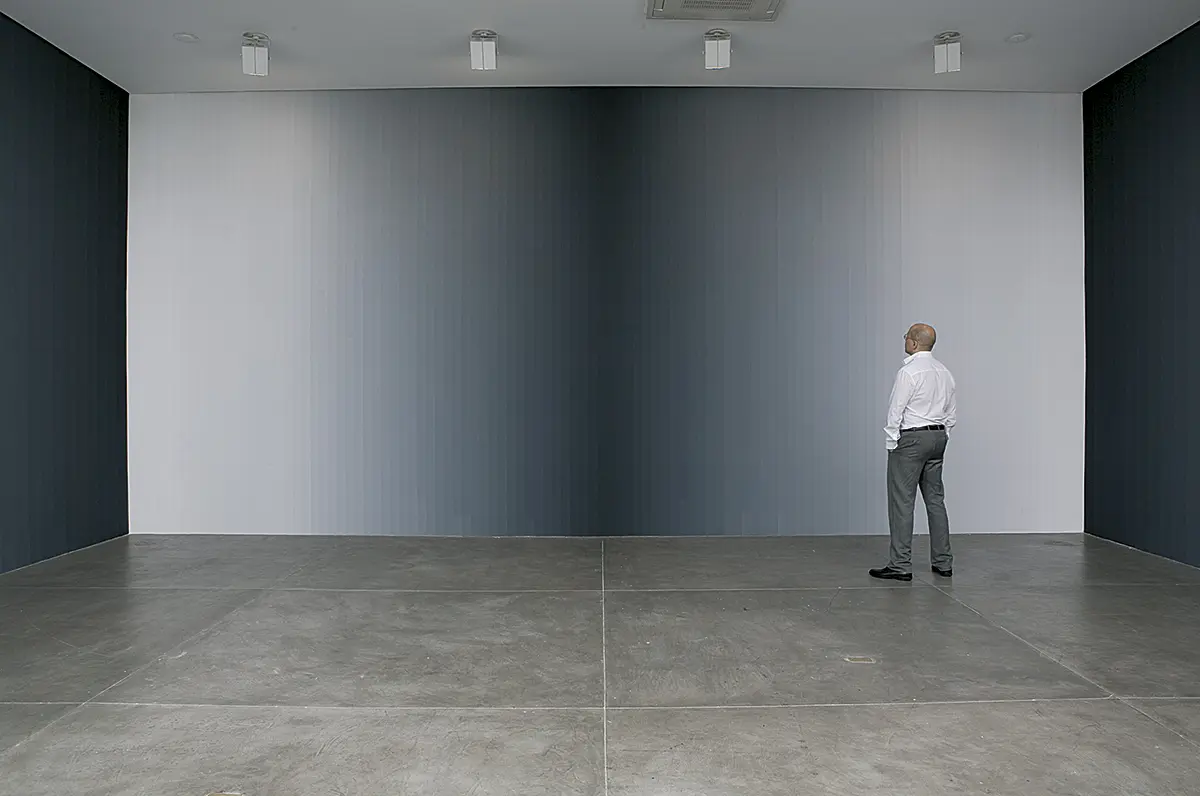
single, giant, all-enveloping total work, site-specific in character, that took
shape all around and across the exhibition space between February 26th
and March 20th.
A corrosive wit and a wise sense of humor are the conceptual axis of this eloquent rearticulation of the surrounding space that the artist was able to materialize, showing us the inhuman and the glamorous world of easy and digestible, low-cal, spasmodic consumerism that dominates the majority of events in the international art circuit, be it art fairs, biennials —more than 200 of the latter nowadays— of exhibitions, where viewers generally circulate en passant and en voyant, possessed by a gaze and a sensoriality that is channeled through a “bird’s eye” view, without “registering” the subtleties of form and meaning that contemporary artists impress in their works. this is due to the fact that the work of art has become a consumer good, easily digestible, assuming the glamour of money and turning itself into a fetish object.
Against this current in the international scene, Iran do Espírito Santo’s new opus sibtiliter invites us to critical reflection, to a kind of interpretative exegesis whose purpose is to exceed a certain purely aestheticist and virtuosic visual economy.
With a work in the expanded field, intentionally rigorous, self-restricted to 53 shades of gray, from the highest to the lowest values, Iran evidently celebrates the empire of achromy, as can be seen in the ground-floor space, where the artist intervened the walls with infra-light, utterly subtle vertical tracings from the floor to the ceiling.
Later, on the first floor, the operative modality was inverted: the traces were horizontal, fine gray lines that ended up in pure white as they reached the edge of the ceiling.
Iran’s interest in achromy and an infinite range of grays comes from his close links to the language of photography.
En passant is an exasperating monotonous painting that, nevertheless, never overstepped its own prescriptions. It’s a macro-scale project of two wall drawings joined into a single pictorial body. Concept and precept join hands in this kind of opus, with an unmistakable neoconceptual undertone. It can almost be inferred that it presented itself to us, in the course of the show, as a veritable “dry painting,” monosyllabic, devoid of adornments or superfluous elements.
Like all topo-specific works of art, thought and conceived for the space that holds it, except when it is in a museum of a (public or private) collection, En passant also pointed towards, in a self-referential key, to its own final destiny, this is to say, to its intrinsic ephemeral character and its inherent datedness, once the show closed. The transparency of the large-scale painting and its need to become an extreme phenomenon of communicability and hermeneutic reception made evident the process of their realization, making it “readable” for the visitor but, in exchange for that, demanding the “time of the work,” which, as we know, is not simple delectation of the senses or aesthetic enjoyment, much less sensual delight for dilettantes.
It is important to note that, before this large scale exhibition at Fortes Villaça, Iran exhibited a series of works on paper that was the antecedent for this painting in expanded field. Indeed, at New York’s Sean Kelly Gallery, the Brazilian artist presented a series of 28 x 36 cm works that contained the same delicate vibrations and gradations of grays based on the indelible marker on paper, filled with very fine bands of high, low, and medium grays, as if they were the result of fieldwork or of a project laboratory, which he later took to a monumental dimension in his recent exhibition in Brazil.
The issue of achromy appears, here as well, as the result of a process of deepening the legacy of modern and late-modern artists, from different perspectives and approaches. Evident here is a posthumous tribute to the series Der Graue Bilder by Gerhard Richter, the first to pulverize all styles. Similarly, there are erudite quotations of Piero Manzoni’s Acromos, Malevitch’s suprematism in its latest phase, Mark Rothko’s black and gray paintings, Lucio Fontana’s spatialist tagli on white canvases, and many other undergirding referents that are not made explicit or literal in this work, but remain underground, “connoted,” as they should. The essential thing here is that the white or black canvas became a work of art starting with the abstract movement.
This total work is an allegory of transformation: both of the producer and of the receptor, an austere staging of what we have left behind as we ascend to the level of discursive meta-language needed to disentangle any contemporary artistic creation. In that sense, let us remember that today, all works of art are the object (language-object) plus the sum of interpretative planes through which it is transformed into knowledge-carrying (gnosis) art.
Iran do Espírito Santo’s works are part of prominent private and public collections, international in character, such as New York’s Museum of Modern Art (MOMA,) The Museum of Modern Art, San Francisco, and the Museum of Contemporary Art, San Diego, among others.
The artist has represented Brazil in the 48th and 52nd editions of the Venice Biennale, and has participated as an invited artist in the 6th Istanbul Biennial, the 19th São Paulo Biennial, and the 5th Mercosur Biennial, in Porto Alegre.
His work has been displayed in retrospectives and exhibitions in institutional spaces: in 2006-2007 the Museo Nazionale Delle Arti del XXI Secolo (Rome) gave him a large anthology show. Other standouts are the shows presented at the Irish Museum of Modern Art (Dublin) and the Pinacoteca Station (São Paulo.)
CLAUDIA LAUDANNO