
When Jac Leirner turned thirty, her native
Brazil was enduring one of the worst periods of hyperinflation in its modern
history. At the time, as the saying goes, money was not worth the paper on
which it was printed. Leirner used cruzeiros, the devalued Brazilian currency,
to produce an installation that addressed runaway inflation. It consisted of a
string of cruzeiro bills snaking across the floor and down a flight of stairs.
In Leirner’s recent exhibit at Sonja Roesch Gallery, a collage titled All the
One-Hundreds featured devalued 100 and 100,000 cruzeiro bills painted over and
mounted together to make an Albers-like square. By artistic fiat, Leirner put
value back into the devalued currency: the price of the work was US$50,000.
One of the most visceral and compelling works in this exhibit was titled Lung. Like many other works by Leirner, it was minimalist in the sense of Duchamp’s readymades: objects found by the artist and minimally altered, if at all. Lung was made of a dozen transparent cellophane wrappers from cigarette packs (Leirner is or was a smoker). They have stacked together inside a transparent plastic box: lungs within an X-rayed body. One guessed that the association of the work was with a healthy lung but somehow a smoker’s unhealthy, polluted lung was implied.
A series of works by Leirner titled Corpus delicti—Latin for “body of an offense” and legalese for “collection of evidence for a crime”—originated in acts of alleged petty thievery. There were two works with this title in the exhibit. The first one consisted of airline ashtrays and silverware chained together with boarding passes. One might take this unlikely necklace as a sociological comment on the widespread theft of cutlery (and blankets) as an integral part of the air travel experience. In fact, as a result of cancer prevention measures, those airplane ashtrays have almost become rare gems. The second of the Corpus delicti was at once more aerial and weightier: a collection of eighteen airsickness bags opened up, strung together, and hung from the ceiling to suggest the path of an airplane in flight. This work was more poetic, more international, and more physiological than the first Corpus. The bags came from airlines of different nations. They are normally used by passengers who experience nausea due to sickness and/or revulsion. Taking airsickness bags is not necessarily an act of illicit appropriation but rather of partial fulfillment of their purpose. They are placed in the seat pockets to be used, as are the crossword puzzles in the travel magazines. Using them as materials for art, Leirner found for them a better use than holding vomit, a true transformation of the commonplace.
This was not the first time that Leirner collected bags that she later used as material for art. In 2006, she produced 144 Museum Bags. It is unlikely that Leirner stole these museum shopping bags; more likely, she received them after buying a museum souvenir. She once spoke about her “appreciation of the commonplace”; thus, the bags “come out of the museum as garbage and go back as art.”
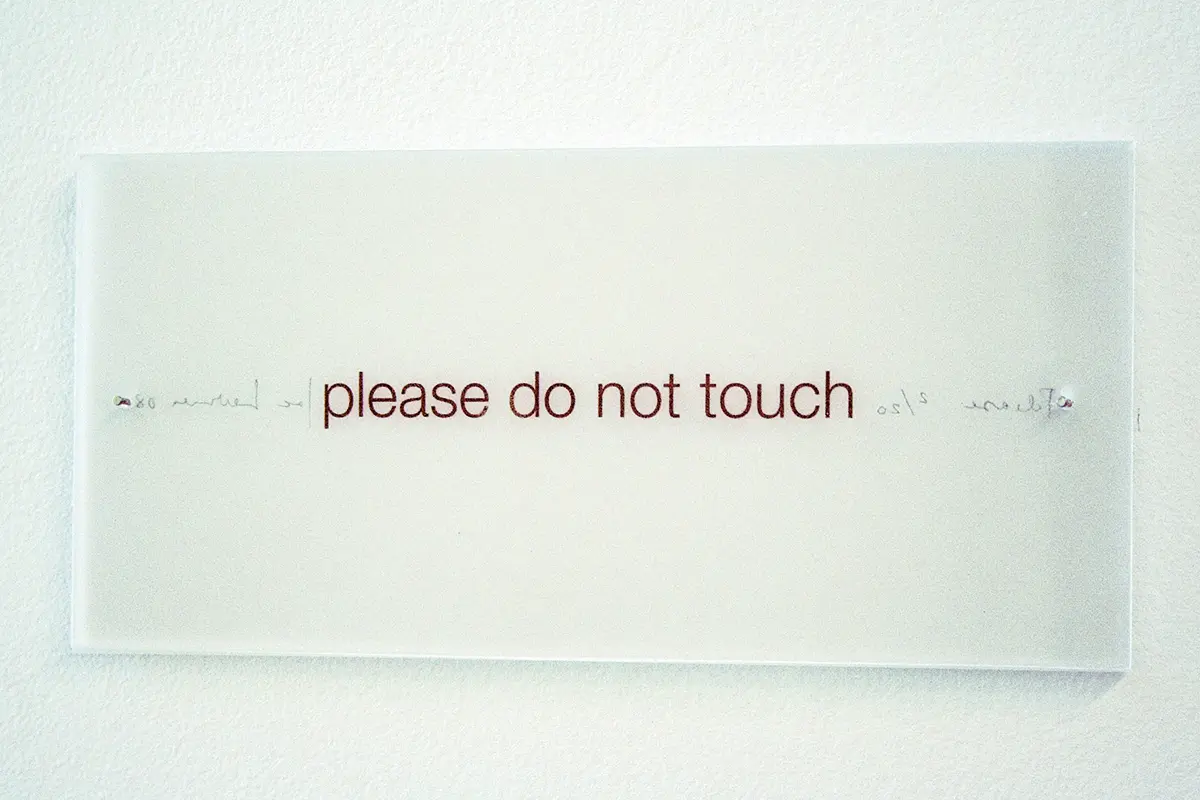
Another work by Leirner explicitly addresses the possibility that someone may steal her works. The work is often missed because it masquerades as part of an art space. It is a small sign: “Please do not touch.”1. In her exhibit at Sonja Roesch’s gallery, Leirner placed two such signs at opposite ends of the room, a doubling that nevertheless made them less visible. Of course, the phrase could also be urging visitors not to fondle themselves, but that would be an extremely un-Brazilian request.
NOTE
1. Jac Leirner pays homage to Marcel Duchamp, who in 1947 made Prière de toucher (Please Touch), a woman’s breast made of foam on black velvet displayed behind glass. The work was boxed for the luxury edition of the catalog of the exhibition Le surréalisme en 1947.
FERNANDO CASTRO R.