
Juan-Sí González has been making performance
art for twenty-five years, a long time from that explosive year, 1988, when a
young current of Cuban visual art advocated challenging works filled with the
implications of a cultural movement that confronted the bureaucratic ideology
of the island. Initiated by González, the Imán Project became an essential part
of this movement, together with the Art-De group, at G Avenue and 23rd
Street Park in Havana. These works were structured with controversial language
and artistic content that sparked as much interest in passersby as it caused
great dismay in the authorities. In this park, González began his long creative
career as a street performance artist, producing works charged with social
commentary and non-conformist reflections. More recently, the artist has
relocated his work to the U.S., where he has raised a family and has expanded
his artistic career, working with Paloma Dallas as the duo JPparalelos in
Yellow Springs, Ohio.
González has also continued to work as a solo artist, presenting inquisitive and thoughtful works that alchemically fuse verbal language and visual metaphor and are characterized by both object-based and performance qualities. The most recent of these performances was titled In the Name of God: Odios, Oh Dios, presented at the inaugurations of the “Objecthood” group exhibition at the Hardcore Art Contemporary Space and the Scope Miami Art Fair, held during the same week as the Art Basel Miami Beach fair. With this new work, González continued his analysis of the so-called War Against Terror and of Christian fundamentalism as the counterpart of Islamic fundamentalism, with which he dealt previously in Patriotic Games and the Domino Effect at The Frost Art Museum at Florida International University, in 2006, and in Facing the Enemy (a public, patriotic action to get in touch with feelings of paranoia, fear, and hate against the other) during the performance section of the Killing Time group show at Exit Art, New York, in 2007.
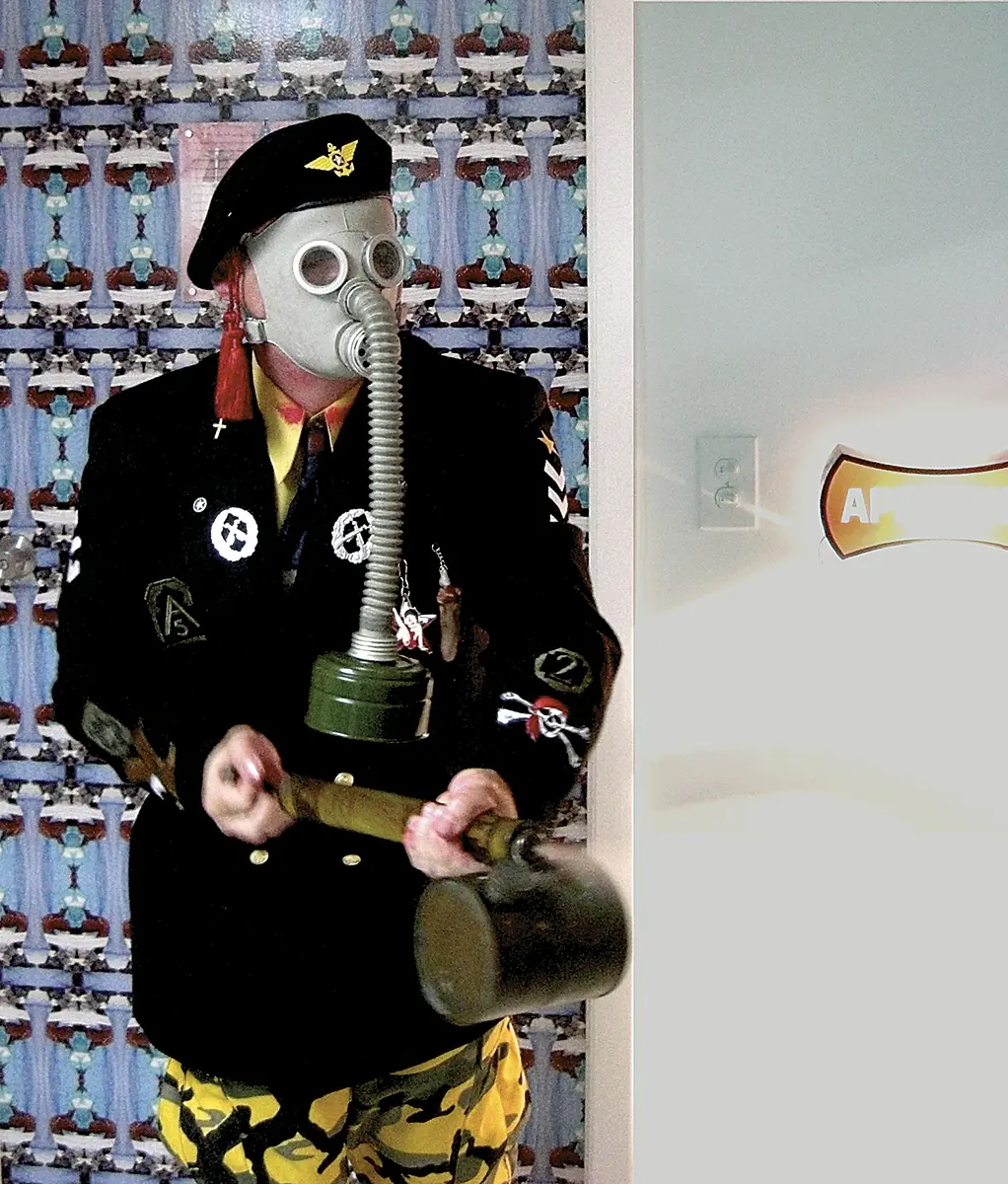
In the Name of God took a stance against far-reaching global warmongering by relying on the symbols and objects used as wardrobe and props: a beret from the Russian army with pompoms from the Turkish army; antique masks from the Japanese military; a yellow shirt and a tie decorated with images of Jesus and a lamb; a black Calvin Klein blazer covered with religious and corporate logos and several badges from different armies; a military belt; a pair of camouflage pants and combat boots. Nevertheless, the reference to the U.S. was central and tangible throughout the work. Here, González attempted to evoke the spirit of an aggressive ideological campaign that merges patriotism and religion, which the artist has witnessed first-hand in the American heartland where he has lived for the past seven years. The artist, in character, began the performance by shaving in front of a mirror-covered cross hanging on a wall, with an iPod and speakers attached to its lower part. After the character finished shaving, he turned the cross into a backpack and the iPod began to play Catholic and Muslim liturgical chants mixed with voices pronouncing phrases in English and Spanish such as: “En nombre de Dios puedes vivir. In God’s name, you can live. En nombre de Dios puedes sentir. In God’s name, you can die. En nombre de Dios puedes decir. In God’s name, you can feel.”
Performance art is essentially a creative process that presents the artist’s self and body to bring forth themes that are sometimes too dense or frightful to be inhabited by any one person. González is an artist who assumes performance from a conceptual framework verging on activism, an approach akin to the performance work of Guillermo Gómez-Peña. In recent years, Gómez-Peña has also adopted the theme of “collateral damage” and its effect on the culture and the society-at-large, as it relates to censorship and self-censorship (for patriotic reasons), paranoia, xenophobia, hopelessness, and fear as generated by the war (and the psychology of warfare) of the post-9/11 era.
If Marina Abramovic dedicated her Seven Easy Pieces (in 2005, at the Guggenheim Museum) to acknowledge the work of seminal performance artists who have left indelible marks on visual art since the 1960s, then González acknowledged object-based works by other artists that were exhibited at the Hardcore space—and “appropriated” these to a certain extent by interacting with them; In the Name of God coincided thematically with Abramovíc’s performance. González also interacted with the spectators as he simulated masturbation while inflating blue, red, and white balloons, which he then offered to the public.
During his stay in Miami, González carried out versions of this performance at several public spaces—Mall of the Americas, The Fall, the café in the Versailles Restaurant, and near the monument to the 2506 Brigade—in the search for the direct contact with the public that he so dearly cherishes.
RAFAEL LÓPEZ-RAMOS