
The needed anthology exhibition devoted to
the work of Argentine artist Liliana Maresca (Avellaneda, Buenos Aires
Province, 1951 — Buenos Aires, 1994,) titled Transmutaciones, inaugurated its
itinerary at the Fine Arts Museum in Rosario on February 7th, to
continue at the Recoleta Cultural Center in Buenos Aires on May 20th,
and then move to the Caraffa Museum in Cordoba. Its curator, Adriana Lauria,
did an intelligent job of researching and cataloging the work of this artist,
a key figure in contemporary Argentine art with an openly borderless,
excessively visceral poetics, whose protean activity included the production of
objects, theater sets, installations, sculptures, performances, and
photo-performances.
The beautiful, the sublime, an unmediated auto-referentiality, the vital impulse, as well as physical deterioration, fleetingness, blood, and spurious substances are all present in this memorable show, devoid of aestheticist compromises, that reassesses a neo-Dada spirit and non-dematerialized neo-conceptual quests that are so necessary in order to interpret art in the country in the 1990s and today.
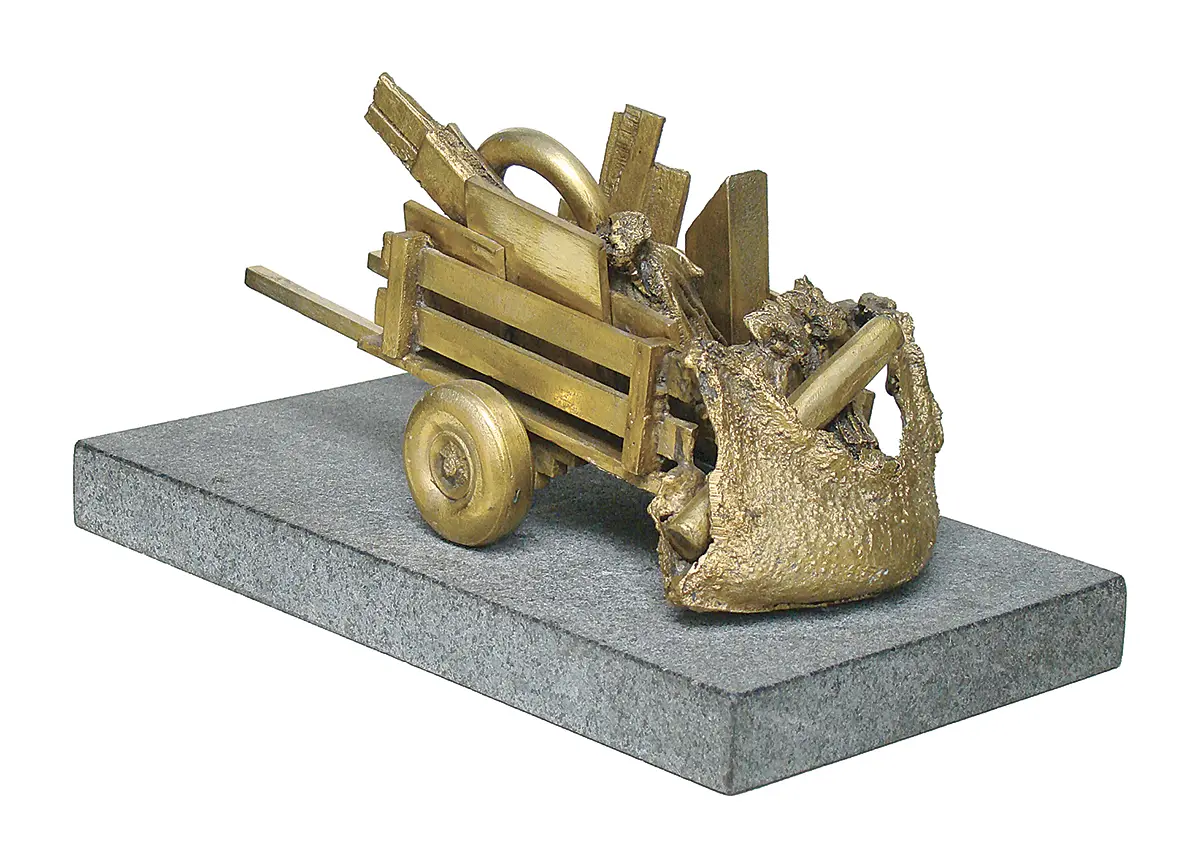
In some way, exclusion and ethical-social and anthropological marginality are evident in the unsettling objectual installation titled La Recolecta (1990,) while devastation and generalized death is present, in metonymical key, in Wotan-Vulcano (1991,) pseudo-intellectualisms and indecipherable jargon, like “idiolects,” in Ouroboros (1991,) and the growing inflation of the art market in works like Espacio disponible (1992) and Maresca se entrega a todo destino (1993).
Until 1994, the phenomenon of using the body to make art was called, in the international scene, body art. This term was legitimized by the Italian art historian Lea Vergine in her famous book Il corpo como linguaggio.
From a post-avantgarde, post-utopian point of view, all the paradoxical, body- and object-based photo-performances with which Liliana Maresca was associated with and obsessed with since the 1980s and through her death in 1994, can be included within this field. The impulse to show and exhibit herself (overexposure) fort the register of the other’s gaze had to do with a strongly existential content: to “show herself” in order to “be.” In that sense, the use of the body as an alternative surface to the sheet of paper of the canvas was equivalent to a new neo-romantic strategy intended to get her engaged, through different means, with the surrounding world. This is why Maresca’s photo-performances exhibited in the anthology show at the Castagnino Fine Arts Museum is not marked by sobriety but by the intoxication of a body that is beautiful and sick at the same time. In her actions and performances, Maresca laid bare the monstrous organization of the real and of all infirmities, miseries, and suffering. In truth, we perceive that, like any good body artist, she never conceived a prior argument about the life of her characters: they became characters and stories by themselves. In this last respect, like many of her colleagues —and I cite, just as examples, the mandatory references to Alberto Greco, Federico Peralta Ramos, Ana Mendieta and the Yeguas del Apocalipsis, among others— she always sought to re-signify neo-humanism, which was, it was assumed, was yet to be neutered by the functionalist excesses of post-industrial societies, this is to say,, those creatures that fled from the concept of profit. With these kinds of attitudes, the forces of the subconscious started to unblock, unfolding through a game of dramatizations, life and death impulses, destructive and cathartic fantasies, in sum, an elliptical trajectory from the erotic to the thanatic. Within this beautifully sinister opus, the highlights are the works in the series Liliana Maresca con su obra (1983,) comprised of a series of photo-performances from an objectual matrix, in which the artist poses nude with some of her sculptoric objects like prostheses or post-organic bodies; Liliana Maresca frente al Museo Nacional de Bellas Artes, Buenos Aires, dated 1984; Liliana Maresca: Imagen pública – Altas esferas, 1993; and Maresca se entrega a todo destino, also dated 1993. Hers is a “speaking body” of art that changes in different spaces and situations, generating a strong disturbance in the spirit of her viewers. What Maresca might have foreseen, entering the 1990s, was that contemporary society itself had become inorganic, which is to say much more comprehensible and permeable to the perverse and convulsive effects of this new type of performance executed through projecting subjects, as was her case. She gave body, carnality, substance, sensuality, and skin to a mainstream, de-territorializing it of its predictable pathways. The body in construction, as a fantastic hybrid of the organic and the inorganic appears in most of the work of this Argentine artists insufficiently recognized in her time. Such batches of alterations to which she subjected her own body and her sculptoric and objectual works bespeak of a mutating subjectivity, where metamorphosis reinvents a different and diversified availability of being in perpetual motion.
It must be noted that the catalog of this retrospective, created with the invaluable support of Malba-Constantini Foundation includes an important iconographic repertoire of works on exhibit and others that are lost but were documented in historiographic form. This is complemented by a critical essay by the curator, a biographical and contextual chronology, and an updated bibliography.
CLAUDIA LAUDANNO