
Los Carpinteros is composed of two
Havana-based artists, Marco Castillo, and Dagoberto Rodriguez; the third
original member Alexandre Arrechea left the group in 2003. Although Castillo
and Rodriguez have been working together as a duo for a few years, the recent
show at Sean Kelly Gallery was only their second solo exhibition in the United
States, and it showed to great advantage their rich inventiveness and visual
panache.
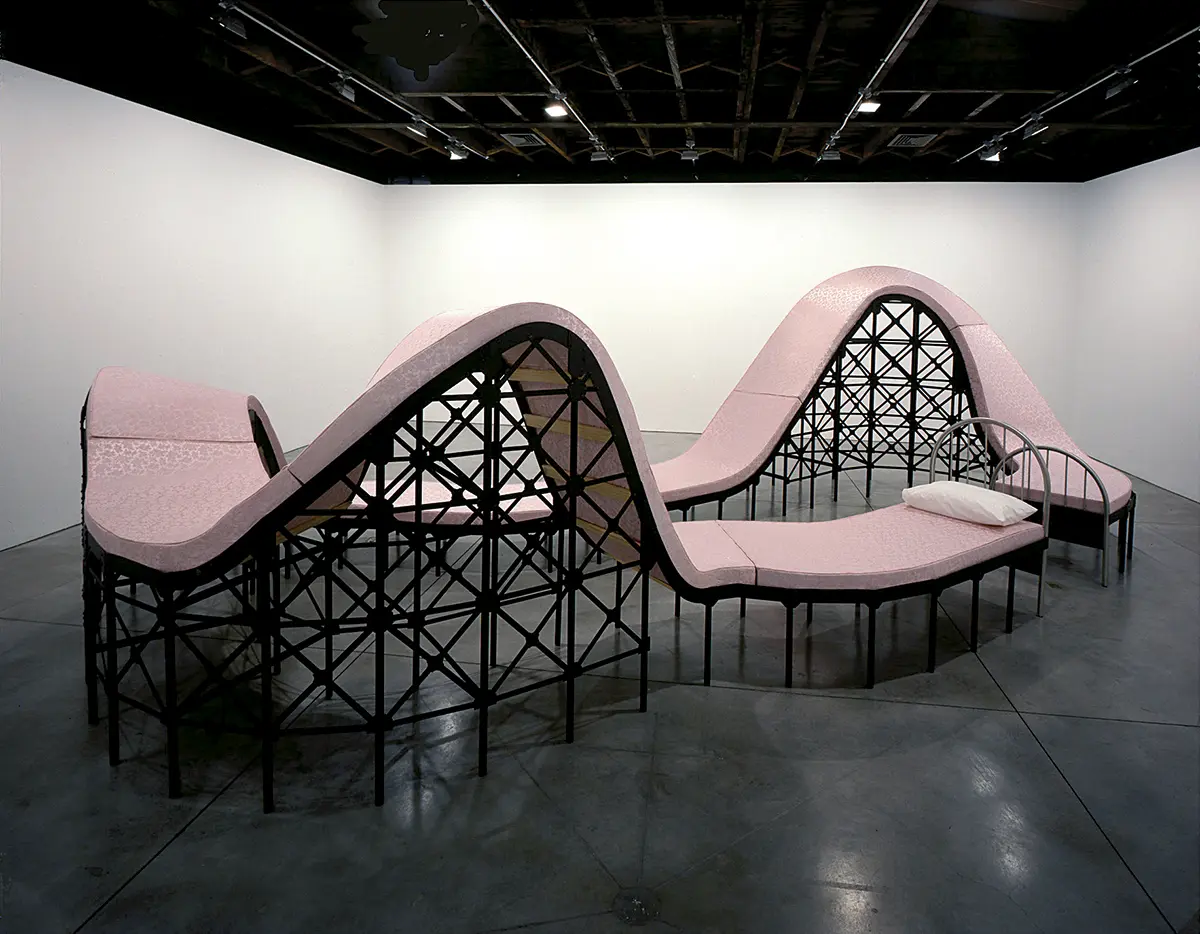
La Montaña Rusa was the name of the exhibition, but it also referred to the largest work in the show. While many people, especially in the U.S., might initially seize upon the “Russian” of the title as a reference to Soviet-style Communism, in fact, this phrase is Spanish for a roller coaster, which was what the large sculpture resembled. Further examination revealed that this particular roller coaster was actually a series of twin beds attached end to end that rose, dipped, undulated, and curved throughout the space. The bed frames were topped by pink jacquard mattresses and the effect was simultaneously monumental and intimate, industrial and sensual. Visually, the dialogue between the sculptural and the domestic, and the artistic and the functional was both playful and poignant. The dual metaphors of the bed and the roller coaster—each one thoroughly associated with the crucial moments of the life cycle and its many vicissitudes—were so perfectly compatible that one wondered how it was that they had not been married long before. In addition to its sculptural presence, the work read very graphically, with the gridded understructure playing off the curves on the top. The black bars of the structure also closely resembled Mondrian’s series of black-lined, neo-plastic paintings.
This idea of sculpture versus function and the grid subverted by the curve was also played out to frankly charming effect with a set of wood bookshelves that were large, quite solid, and substantial. In these works, too, large ellipses and rounded forms that emerged in sections warped the regularity of the rectangular units. The artists have indicated that these pieces are meant to be used, despite their obvious irregularities, and it was provocative to consider them domesticated in such a manner.
Finally, there was a scale model of an elaborate pool—complete with chrome ladders and blue tiles and filled with filtered water—composed like a three-dimensional floor plan of an apartment or house. Once again, the overlapping associations helped elevate this piece from merely clever to something more compelling. Like the roller coaster and the bookcases, one saw a three-dimensional work whose origins as a drawing were fully evident.
One interesting aspect of these works was that they avoided obvious references to Cuba yet still shared a very Cuban sensibility. Many people immediately seek to place Cuban art in a political/propagandistic frame of reference and tend to rely upon the same figures and signs. In the case of La Montaña Rusa, one could make connections to the uncertainty not only of life in general but also of the future of a Cuba that is now under new leadership. The emphasis on the craftsmanship of each piece could hark back to Communist or folk traditions. There were subtler connections as well. To begin with, all these works were connected by the use of wave-like curves or even actual water, which reminded the viewer that Cuba is an island nation and that water has played a crucial role in Cuban art, religion, and even politics. There were also connective references to domesticity, architecture, and the home, which seems to be a sensibility shared by many Cuban artists from Emilio Sánchez to Maria Elena González.
One can hope that, with the dawn of a new political age in Cuba, the cultural exchange between Cuba and the U.S. will become ever more fluid, allowing greater mobility for Los Carpinteros and their compatriots in the years to come.
JOHN ANGELINE