
Words such as “deconstruction” have lost
their true meaning for us, as they are used for all kinds of rhetorical
justifications. It is one thing is to rethink the reach of painting as support
from within a visual process, as Bran Van Velde did, and another thing to
reread the work of an artist to reframe a metalanguage or context. Examples
abound: Picasso is a good one. Why do I make reference to this? For a very
simple reason: the most recent exhibit by Mario Vélez, characterized by his
coloristic and structural austerity was before anything else an example of
balanced self-criticism, acknowledging that certain objectives had been reached
and that it was necessary to ascertain the direction and boundaries of new
formal pursuits.
The creative display Vélez has demonstrated during this last decade and the milestones he has achieved have served to clarify such a pursuit and have freed him from the “young artist” label, a pernicious qualifier that may hide an artist’s early maturity. To focus from the outset on the premises of color—on the properties and attributes of color without qualification—is to avoid gestural histrionics. As Morris Louis presents it, the color simply inhabits the space and is imprisoned by the limits imposed on it by the tactile sense; a chromatic scale is deprived of the possibility for significance. Sonia Delaunay’s color circles overcome these servitudes. The circle imposes a vision of absolute purity of color. This overcoming the tactile, or the material is also the direction toward which modern art points out a new spirituality.
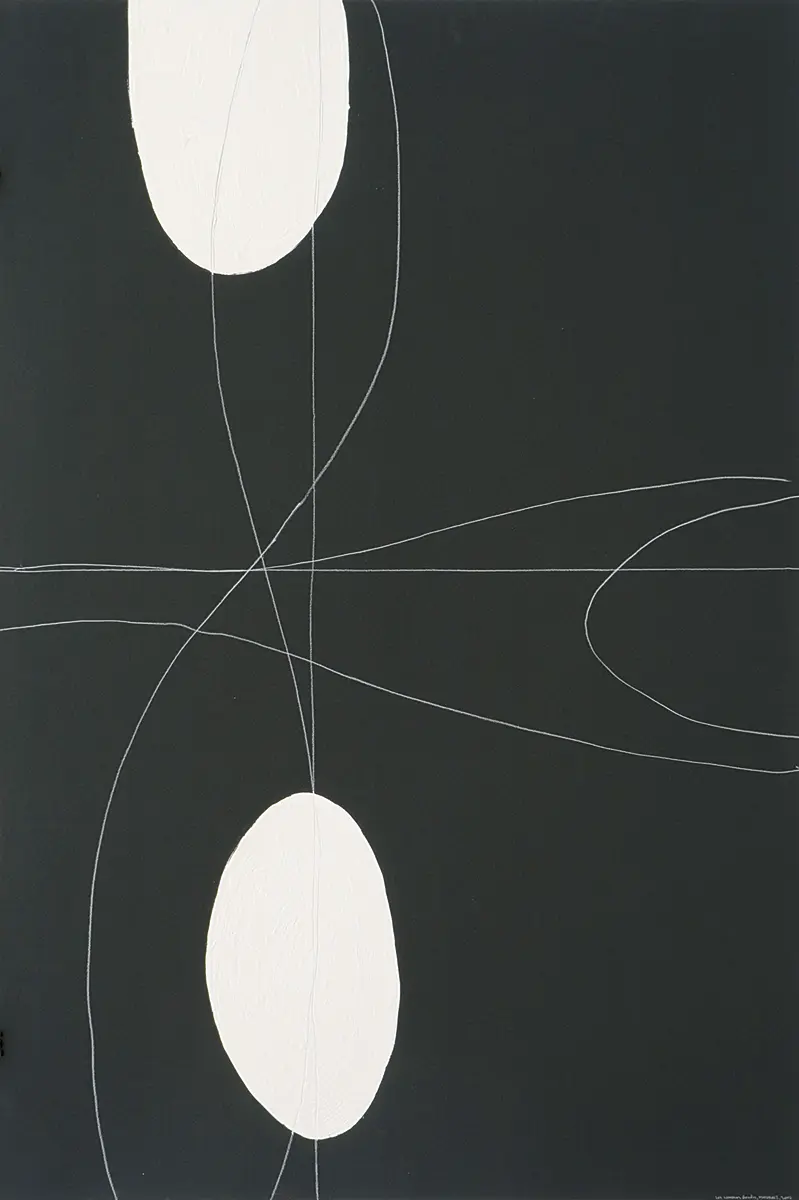
This color, in its traces, undulations, and simplicity—its unwillingness to follow any type of chromatic scale—arrives at the threshold of a pure order devoid of any inkling of suspicious sentimentality: white on white, black on black, an opening to another possible visual reality. Is color abstract? Or is it in itself a reality that must be accepted as such? In the presentation based on the supposed metaphor of “the lands of legends,” there is a contradiction between emphatic literary affirmations and that which supposes the presence of this self-critical equilibrium—brought forward by its chromatic asceticism—as a starting point toward other premises and instances determined by their visual quest. It is clear that today, in the realm of color, the earthly myth and old legends no longer constitute a departure point, nor are they an epiphany: the myth verified through a personal process is a crossroads without precise limits; it is the opportunity to listen to the primordial rumors and voices, to rescue color from when it embodied the significance of things. Let us remember that Jean Arp patented this methodology of searching for primordial forms by placing color and latent form within a poetic perspective that was not reduced to experimentalism but that instead attempted to instill life into any given geometry serving any given function.
It is not that spirituality sends us to an sterile world but rather, as Michel Seuphor said when referring to Arp: “It is there, in the tranquility of innocence, where the life-sustaining natural treasures hide; every human being must ultimately resort to these. They are known as kindness, detachment, and attentive patience.”
Historic crises tend to exacerbate life and impose a tension that leads many artists to make dishonest decisions. Today, color faces the gravest of complexities: the visual as a field of action, yet to be determined. Does it concern surpassing the plastic to arrive at the visual? Let us remember that plastic as an occidental aesthetic legacy occurs within laws and norms that reflect the understanding of an unmovable reality. To make the contemporary hurdle into the visual is to leap into cyberspace assaulted by lights and mechanized specters, which are the reflections of yet other ghosts, etc. We are situated in what Gaëtan Picon termed “a captured and transmitted jolt,” a state that even Picon defines as “a person’s nostalgia, the need for color.” One arrives at these aphorisms when a rational purification has taken place, as in the case of Mario Vélez. The aphorism, then, comprises the crossroads of conscience able to rationalize a formal search and to renovate aesthetic objectives from a tranquil state of innocence, and insist upon generating new creative paths.
DARÍO RUIZ