
Although animator and filmmaker Norman McLaren’s
prestige remains intact twenty years after his death, the theater, and dance
production presented by the Canadian group lemieux.pilon 4d art renovates the
perspective of this inexhaustible creative force associated with abstract
expressionism in painting, to non-film cinema, to minimalism, to renewed
relationships of color, image, and sound, to political emphasis, and to dance
as a strong poetics to transcend gestures and to give them new meanings.
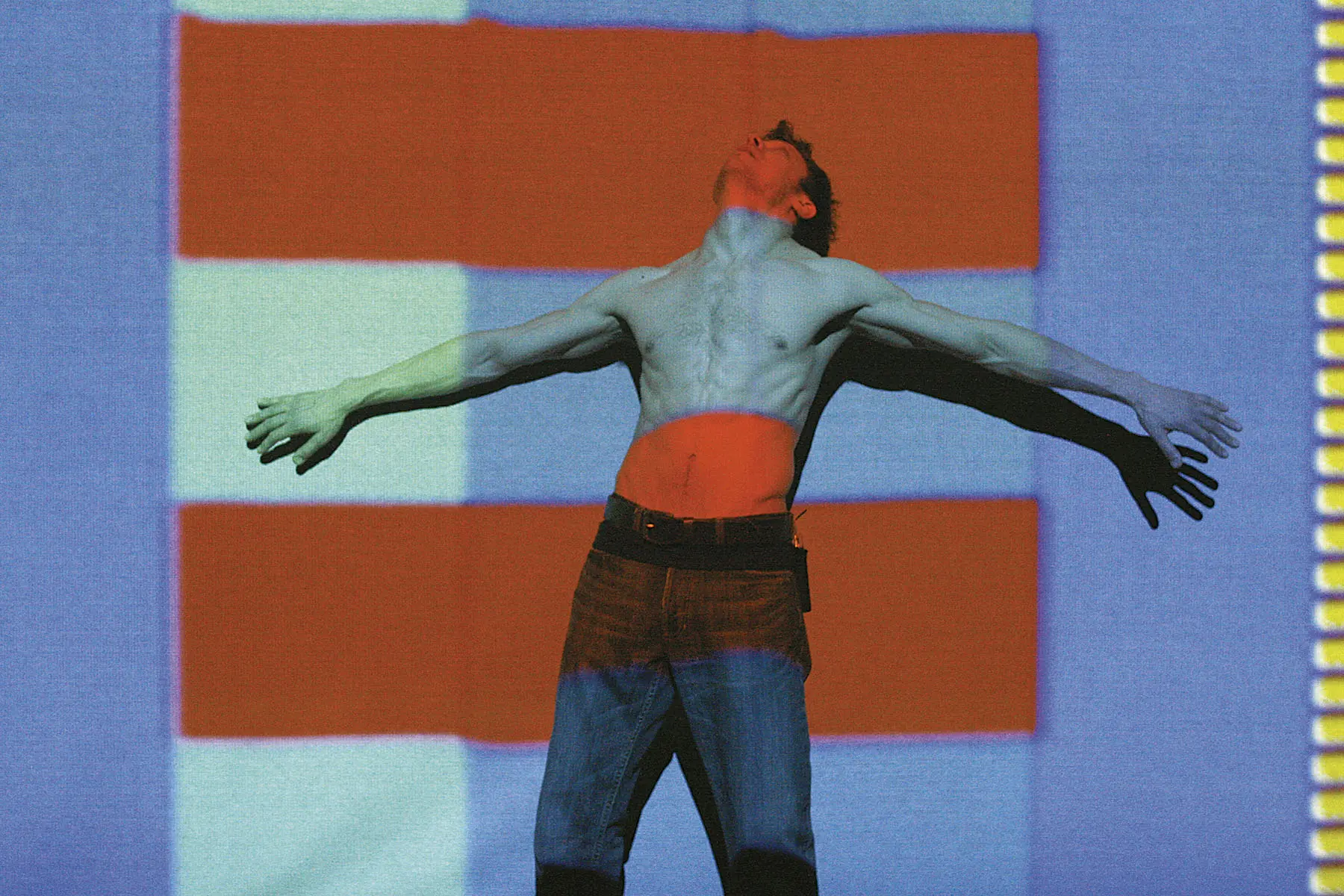
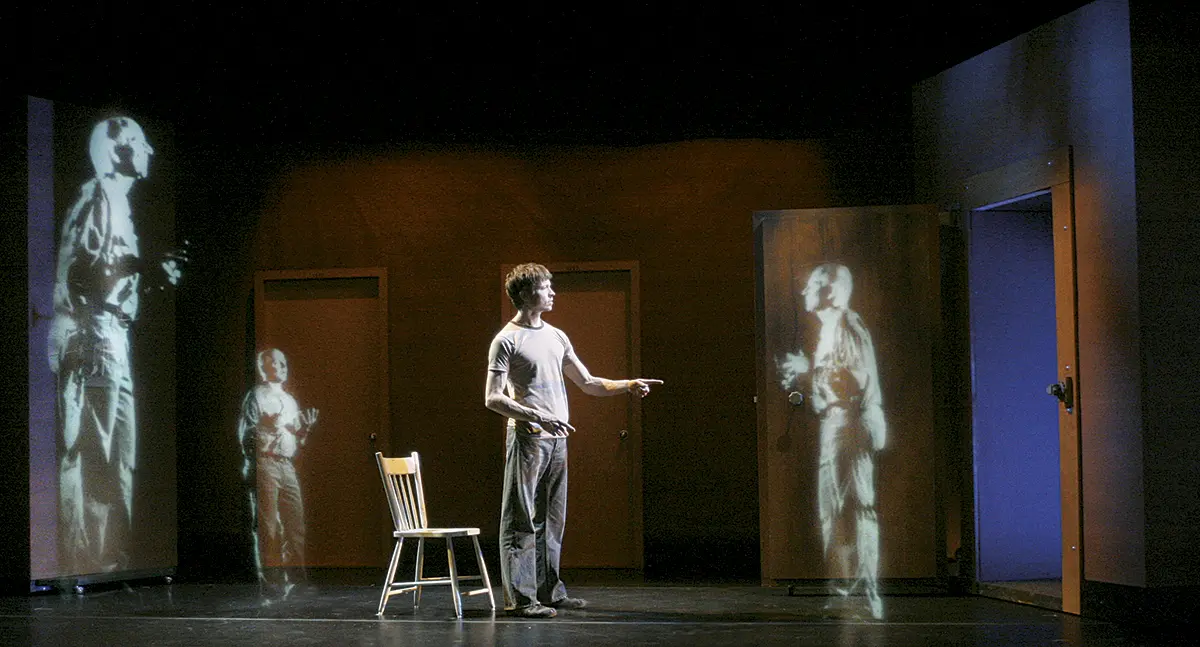
The show is titled Norman1 and was the result of a collaboration between Michel Lemieux, the multidisciplinary artist who founded the troupe in 1983; Victor Pilon, who joined as co-director in 1990, and dancer and choreographer Peter Trosztner, protagonist of the work. The latter narrates his personal experience studying McLaren’s work and contributions, and projects films throughout the show while using characters, plots, and spaces to interact with them on stage. He films interviews and testimonies from 15 people who evaluate McLaren’s work and his contributions. These people appear in the show to give their testimony by means of holograms. 2 The stage proposal is a good example of hybridization between film, music, dance, animation, virtual technology, and objects. As in Prague’s Magic Lantern, the different resources of illusion, the real and the illusory fuse not only to narrate an event and highlight the historical contributions of the character in question, but to construct a poetic proposal.
The gamble here centers on actor/dancer Peter Trosztner, who guides the action through paths of light, gestures, sound, projections. He tells us his own story and experience, and narrates McLaren’s personality, in a re-reading that achieves its goals by offering McLaren as an indispensable creative force in film and also in the contributing effort of visual experimentation and reflection.
Normal McLaren was born in 1914 in Stirling, Scotland. His first vocation was designed, which he studied at Glasgow University, finishing in 1932. He joined the Glasgow Film Society and developed an abiding enthusiasm for the cinema based especially on the works of Russian directors Eisenstein and Pudovkin, and of German animator Oskar Fischinger. McLaren was seduced by this discipline and understood that it was a powerful means of expression. His innovations encompass camera-less animations, achieved by painting directly on the negative or scratching the emulsion. The latter, the abstract result of controlled gestures that are then synchronized to the music, have been not unreasonably linked to Jackson Pollock’s paintings.
McLaren’s career started in 1934. In 1935 two of his works were recognized at the Scottish Amateur Film Festival. John Grierson was a jury member and offered McLaren a job in London with the Pot Office Film Unit. In1936 he was a cameraman in the Spanish Civil War, an experience that drove him to him repudiate war. In 1939 he emigrated to the United States, fleeing World War II; his most abstract films are from that period, including Stars and bar and Dots, both from 1940. In 1941 he reunited with John Grierson in Canada, where the latter had founded the National Film Board under a government commission. The films made in Montreal were, however, based on war themes: V for Victory, Five for Five, Dollar Dance, and Keep your Mouth Shut. The animation was a constant in his career, and he experimented with it not only in terms of the image but also in terms of the phenomenon of time. Music played a protagonistic role in his projects; he was able to produce soundtracks by scratching the celluloid in the optical sound section. A special camera and projector system had been built at the NFB to allow McLaren to carry out his experiments comfortably In 1951 he made the three-dimensional films Around is around and Now is the time.
Norman is a stage production that explores a universe of form, sounds, imagination, and experimentation. It is a way of doing biography beyond historical data, although these are also included. This theatrical show gives McLaren’s life and visual production as much as his consciousness and desires. It attempts to discover his personality by uncovering his sensibility and taste. It acknowledges history as an event and referent. It presents it as a pertinent datum, offering up an author and the result of his projects, asserting his undisputed place in the story of the image and of film as vision, emotion, meaning, and reach.
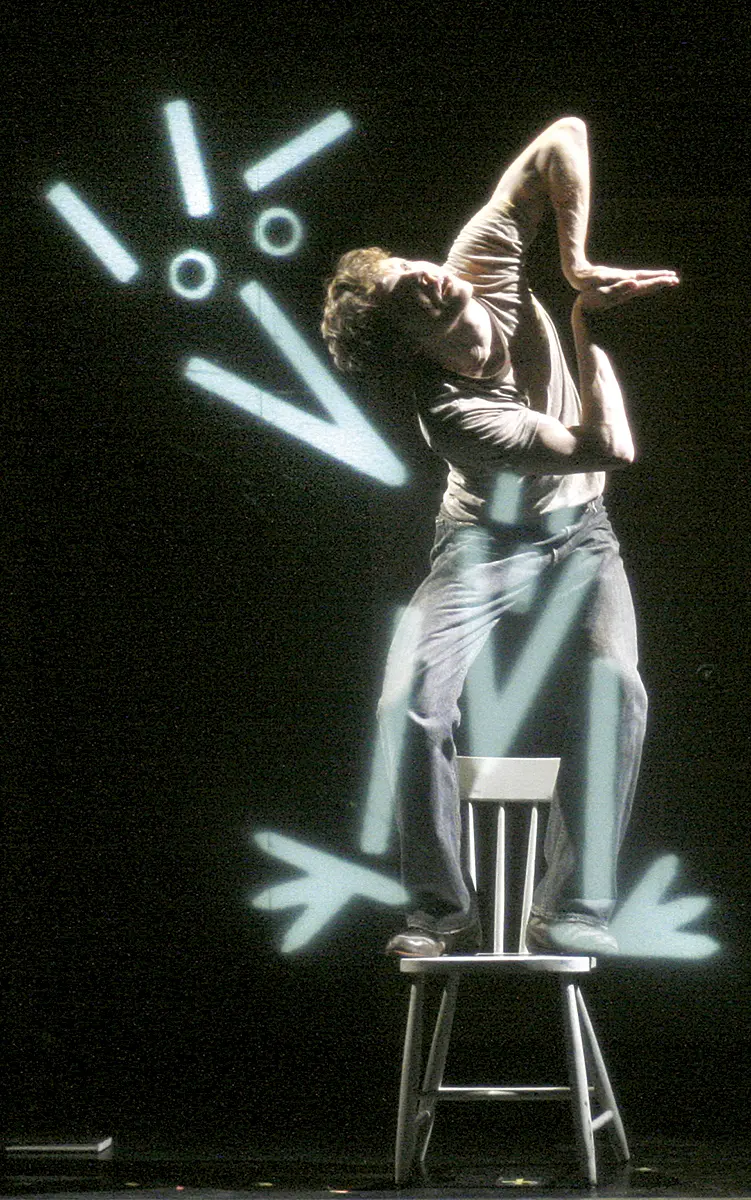
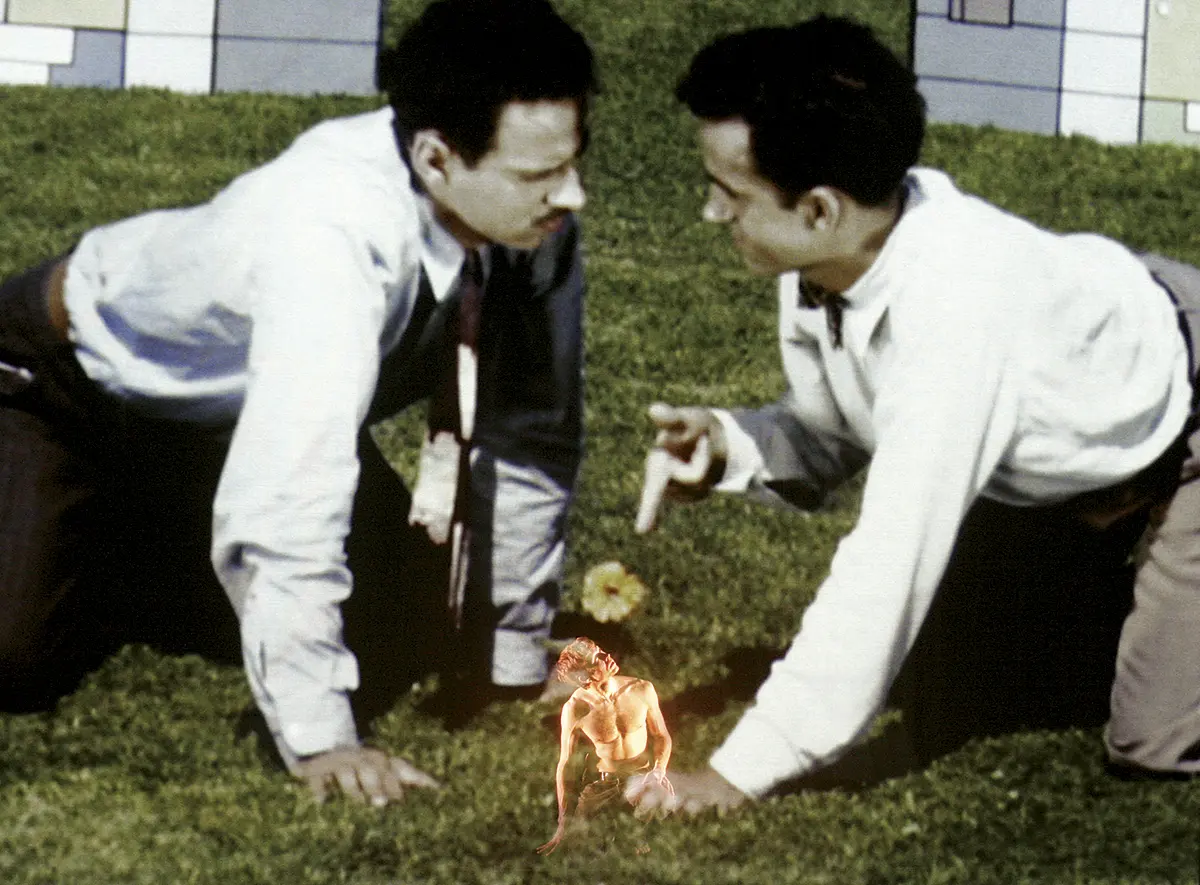
Naturally, Canada’s National Film Board authorized the use of McLaren’s images. Some thirty of these are projected used individually in the show. Among them is his famous cut-up paper animation Le Merle, from 1958, where an abstracted bird integrates into the stage. The famous A Chairy Tale, from 1957, becomes the theme for a dance solo by Trosztner, who naturally dances with a chair identical to that in the film, integrating into turn episodes from it. After projecting in its entirety the celebrated Neighbours, from 1952, which won McLaren an Oscar for animation that same year, the dancer/actor comes out to tell viewers that as a child, he thought the movie was a comedy. But his perspective has changed and now he understands the totality of the message. Two men in the garden read the newspaper sitting in folding chairs, stand up, and kill to mothers carrying children in their arms; two graves appear, and all that remains is a cemetery demarcated by hundreds of white crosses. The strange sense of humor, the sarcasm, the violence, the garden as a place for reading, murder, and the graveyard, are a response to the Theater of the Absurd à la Ionesco and the existentialist humor current at the time. This masterwork, however, has retained its youth and pertinence. As Borges commented about Oscar Wilde, this work seems to have been produced only this morning. 3
McLaren not only won an Oscar but also the Palme d’Or in Cannes in 1955 for Blinkity Blank. The permanent flickering of interests drove him to use the possibilities of the image in a boundless way: fades, pixelations, collages, drawing, and print, superposition, modification, are among the technical resources he used to highlight the humanism of the Surrealist aesthetic, generate humor, and make variations.
Norman is also a dance-theater spectacle, an appropriate medium to pay homage to McLaren, who at one point declared that, if he hadn’t become a filmmaker, he would have loved to be a choreographer. Similarly, some of his films paid attention to ballet. There is Pax de deux, from 1972, 4 which has a special presence within this show. That same year, Ballet Adagio. Interestingly, his last proposal, dated 1983, was Narcissus, where the classical concept of beauty based on the principles of harmony and balance is recreated. Narcissus naturally goes back to Greco-Roman mythology and is evoked by the dancer who is torn between clashing feelings, and who closes the show and also McLaren’s filmography, 5 as he died in 1987 in Montreal. Two years later, the headquarters of the NFB was renamed after him.
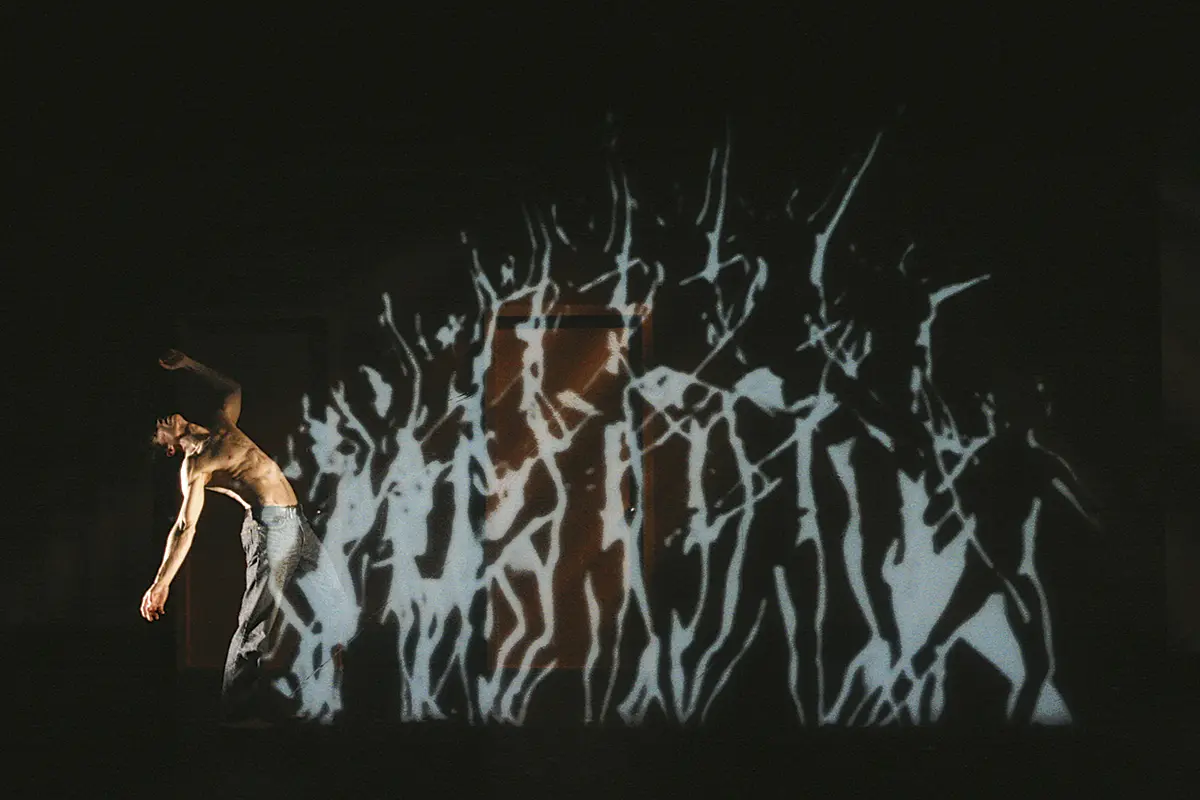
Several works at the 11th Ibero-American festival used video, film, projection, and digital images as a resource, and even this same Canadian troupe presented Shakespeare's The Tempest using a combination of holograms and real actors. But where the use of technology as an instrument in the production of meaning was better appreciated was in Norman, since McLaren’s own body of work was felicitously incorporated and the interviewees were present like judicious ghosts to generate the “great illusion.” McLaren, assumed by Trosztner, was able to reincarnate finally the filmmaker's desire to be a dancer and choreographer. To become a dance. To be a momentary mirage.
Bogotá’s Ibero-American Theater Festival has reached its twentieth year of memorable life, 6 growing each time not only in quality and number of stage and street performances but also in workshops, meetings, exhibitions, and in the diffusion and promotion of Colombian theater in its widest diversity. In the last editions, VIA, Ventana Internacional de las Artes, a business table for national productions and Latin American stage proposals has acquired great force.
Today, this is the largest and most ambitious theater festival. The presence of all continents and the cultural and conceptual diversity it encompasses has made this event a first-rate, multicultural and pluriethnic meeting point. The festival has attracted works by the most prestigious group around the world, and has been able to present shows by the most renowned directors: Peter Brook, Tadashi, Suzuki, Roberto Cuilli, Yuri Liubinov, Giorgio Strehler, Theodoros Terzopoulos, Susanne Linke, Declan Denellan, Salvador Tavora, Robert Wilson, Andrzej Wajda, Tomaz Pandur, Lindsay Kemp, Philippe Genty, Paolo Magelli, Nicolás Stemann, Ismael Ivo, Heiner Goebbels, Jan Fabre, Jan Louvers, Kama Ginkas, Omar Porras, or Lluis Pasqual, to name a group of well-recognized figures who have presented shows.
The festival has included an ample selection from the great tradition of Text-Based Theater that goes from Greek tragedies to Heiner Müller, and touches Dante, Cervantes, Calderón, Goethe, Goldoni, Chéjov, Pushkin, Dostoievski, Lorca, Valle-Inclán, Buchner, Jarry, Genet, Sartre, Beckett, Koltés, and contemporary authors, many of whom have been in charge of their own productions. It has been a window on the genre in Latin America and to authors from different periods, and it has presented Colombian theater from Enrique Buenaventura and Santiago García and their respective groups, to today’s new playwrights, directors, and troupes.
The text-based theater has been resented with the same intensity as visual spectacles supported on film, video, holograms, contemporary dance, theater dance, puppets, and circus. Also, proposals coming from Africa and Asia that have revealed the potency of ancestral traditions.
The festival’s continuity has made it possible to gradually build a tradition and articulate the level of demand. It has been possible to re-read the classics, to redefine concepts of dramaturgy and mise-en-scene, and to verify how the different disciplines collaborate in the generation of levels of signifieds and signifiers. Massive publics have formed that attend these events in different scenarios and circumstances. It has been an influential event and the referent it generated has become a propitiatory magisterium. The festival is also a great feast, an awesome carnival for our senses, intelligence, and jouissance. Its ecumenical character makes it inclusive, and the consequences emanating from it, which we perceive now, will certainly be localized in the medium and long terms.
Interestingly, the theater arts, which are reflection, critical sense, alternatives of thinking, and of vision, are convoked to Colombia, one of the contemporary world’s most convulsed locations. A bloodied territory always ready to reinvent the most varied and atrocious forms of violence. Our great national stage resembles quite often the Atridae family, the aristocrats in Titus Andronicus, those in Richard III, or Roberto Zucco’s circle. The theater tells of many lives, all different but similar at the bottom; it also shows us many agonies and deaths. Any similarity is coincidental.
NOTES
1. Teatro La Castellana, Bogotá. April 20th thru 23rd, 2008.
2. The interviewees are Robert Verral, Marcel Jean, Pierre Hébert, Michelle Cournoyer, Marc Bertrand, Jacques Droin, Jacques Bensimon, Frédéric Back, Vincent Warren, Marie-Josée Saint-Pierre, Chris Hinton, Shira Avni, Tom Waugh, Mira Falardeau, Elizabeth Langley.
3. Jorge Luis Borges, Biblioteca Personal, Bogotá: Alianza, 1988, p. 58.
4. David and Anna Marie Holmes, interpreters. Music: Albinoni’s Adagio.
5. McLaren’s total production encompasses 59 films in a period between 1934 and 1983.
6. There have been editions every two years: 1990, 1992, 1994, 1996, 1998, 2000, 2002, 2004, 2006, and el 2008. Since its inception, it has been led by the Argentinean-born, naturalized Colombian actress and cultural promoter Fanny Mikey.
MIGUEL GONZÁLEZ
Curator, Museo de Arte Moderno La Tertulia, Cali, Colombia. Art critic and AICA member.