
In Greek mythology, Hephaestus was the god of the forge, working on red-hot metals. Atchugarry (Montevideo, 1954, based in Lecco, Italy, for almost three decades) forges his marble, you could say, “soul-hot,” with a serene passion, since choosing in 1979 his first block in the Carrara quarries. The result: sculptures chiseled out of the classical statuary material that, at first blush, is not in the least marble-like in their shape: visually weightless, they create, as a group, the effect of an order of flaming bodies. Lumière, the first work, Promethean in more than one sense, was a fulfilled promise. His entire work has been and is sculpted in light.
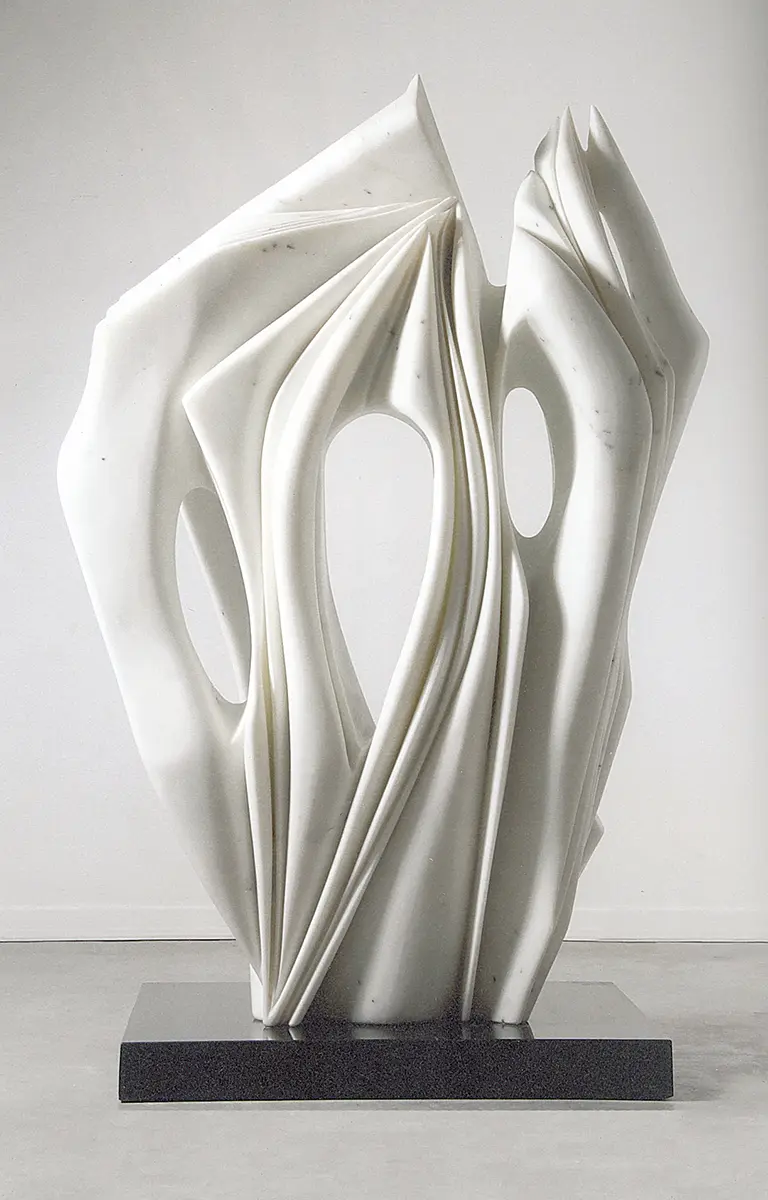
The Museo Nacional’s two large lower-level galleries display part of Pablo Atchugarry’s unmistakable oeuvre. It is the last stop of an itinerant show —its opening attracted 2,200 visitors— that was previously seen in Curitiba, Brazil. Around a hundred marble works, mostly white but also pink (from Portugal) and some black (from Belgium) reveal art that, like the refraction of light on the crystals of the chiseled, hollowed-out, polished stone, projects multiple temporalities and condensation of productive traditions that impregnate the viewer and mobilize the images. That forest of flaming stone —Encuentro infinito is 252 cm tall— disquiets and, at the same time, becalms visual and tactile threshold in the viewer. These are “sculptures to be touched,” works that incite caressing like —the artist's comments— “children do instinctively.” But their primary and original gesture, “liberated by the hand of the artist,” as Michelangelo, Atchugarry’s ideal master, put it, also imposes distance to the gaze that admires it. To admire mediates the gaze, or suspends it. “E gli occhi non ardiscon di guardare,” to say it in the terms of Dante’s sonnet. The forcefulness of this show motivates us to recuperate context and interpretative keys. “My concept of art is linked to the classical with a different presentation,” has said the artist, who by the way possesses a veritable physique du rôle, being almost a giant. He rejects the standards of contemporary art: “At a certain moment I thought that roles would be inverted: in the midst of the uniformity of languages the most avant-garde one could perhaps be mine, as it lives precisely of its being contrarian, of its dissonance.” It is almost inevitable to establish affinities with the thirst for the infinite that characterizes the Gothic period, Also, at the border between Baroque and Mannerist art, with the contrast between the impulse towards distance and the veiled vision, the “principle of the curtain.” The attractive verticality of its folds, whose visual effect of empty bellows intercuts the light and produces surfaces that vibrate in different ways from those where light slides, ambushes, and captures the gaze. Perhaps the vision of the postmodern world is not too far from that which, according to Arnold Hauser, permeated the Cinquecento (2): “A vision characterized by fluid and inconstant forms of being, with an ontic substratum in flux, in permanent transformation.”
Paolo Frasson (3) evokes Ovid’s Metamorphoses in regards to the work of a sculptor who moves aside in order to let “the voice of marble to speak through him.” Impossible not to remember that the paradigm of transmutation brings to the fore a kind of stone that, unlike marble, us not found in the quarries visited by Atchugarry’s guiding spirits —“Michelangelo, Canova, Brancusi, Isamu Noguchi, Henry Moore, Gonzalo Fonseca”—, but in the long dream of the alchemists: the philosopher’s stone. “Like fire,” St. Juan de la Cruz wrote in his Comentarios to Llama de amor viva, “have what we have a deep center. (…)And the center of the soul is God.” In the conception of art promoted by this monumental work, which marks the symbolic “return” of that prodigal son that is Atchugarry, there are notes of mysticism. His translucent cathedral-like, ascending spires are, he said, “nothing but a questioning, going out to see the stars, feeling that they are part of our life, like a prayer, an invocation of the infinite.” But his spirituality eludes hierarchical configurations based on a center Each work is supported on a system of forms in tension: often a set of folds —a kind of origami in stone and filtered light— confronted with a different, more settled or whole form, and these in turn in tension with one or several holes, empty and communicating forms. A plural interplay of oppositions and compensations. In the best works, an indefatigable dialectic of debate and dialog —indefatigable like the artist himself, whose next work is trapped in a still intact 56,000-kg, 8-meter-plus tall block.
What is art? I asked him. “Humanity’s most sublime flame,” he paused, and then added, “which as it burns no longer belongs to the artist.”
NOTES
1. Museo Nacional de Artes Visuales, Montevideo, Uruguay.
2. Literatura y manierismo, Guadarrama, Madrid, 1965.
3. Pablo Atchugarry: 282-285 (Catalog.) (From “Nel giardino di Pomona. Pablo Atchugarry e la voce del marmo,” Venice, 1997.)
4. Interview with the author, Museum garden, 3/23/08.
TATIANA OROÑO