
Throughout the past decade contemporary
Cuban art has flooded U.S. galleries and museums, yet it still remains rare to
see a solo exhibition of a Cuban artist’s work. The small, but comprehensive,
exhibition of Pedro Álvarez’s (1967-2004) oeuvre at the University of California,
Riverside’s Sweeney Art Gallery provided such an unusual opportunity. The
exhibition featured 30 of Álvarez’s paintings and collages, produced between
1993 and 2003, and was accompanied by the first substantial monograph on the
artist.
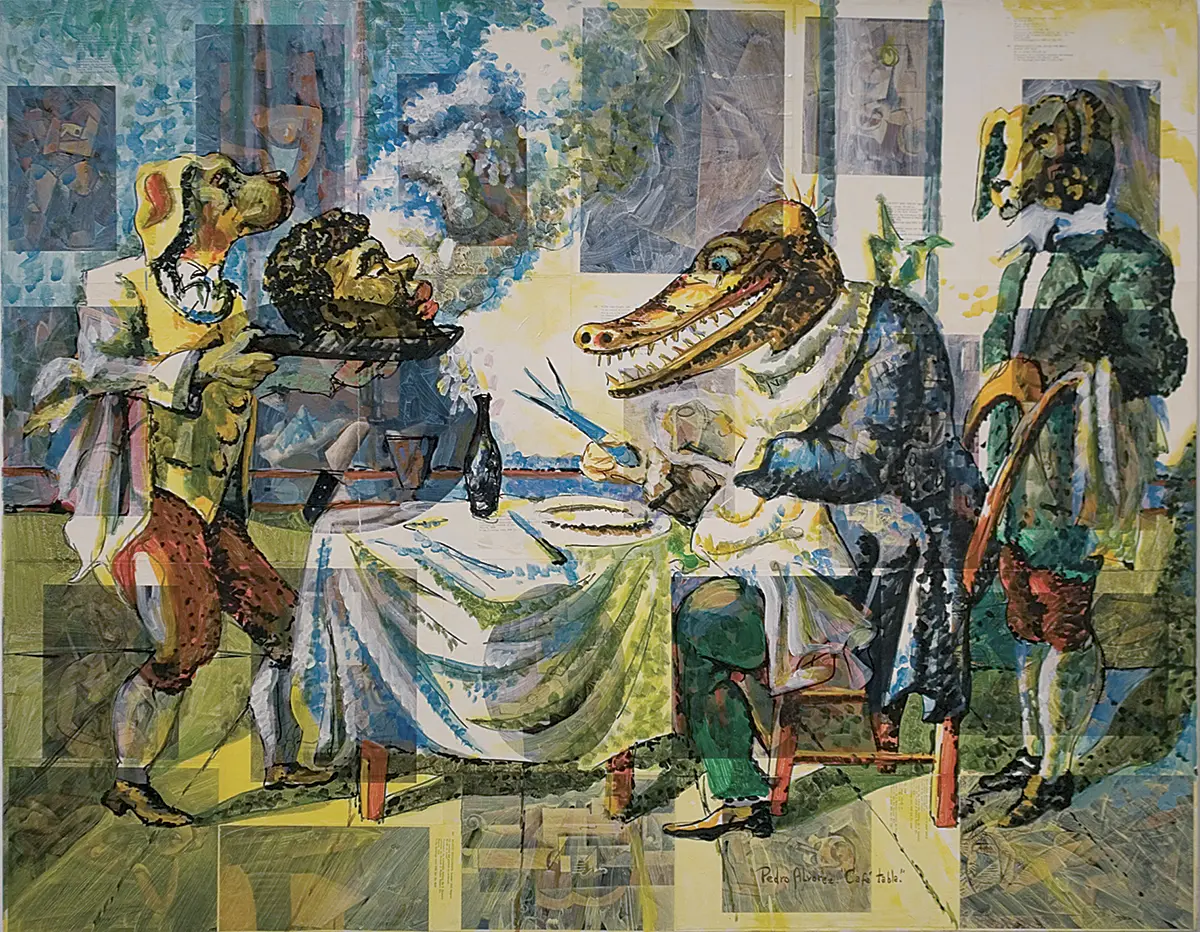
The exhibition opened with two large collage works, “Café Table” (1998) and The Triumph of Spanish Art, Homenage a Ortega y Gasset (2003). Both pieces exemplify Álvarez’s collage technique, which is not solely a material process, but also an intellectual strategy used to examine Cuba’s complex historical and cultural identity and engage in art-historical debates. In nearly all of his collages and paintings, Álvarez combines a number of fragmented images taken from different disciplines, cultural practices, historical periods, and nations in order to mount a critique of colonialism, racism, and the changes to the Cuban (and global) economy, among other pressing issues. In these two works Álvarez affixes pages taken from Western art catalogs to canvases in horizontal rows, on top of which he paints scenes using transparent pigments. In the piece from 1998, an anthropomorphic dog dressed in colonial European dress offers the head of a man to an anthropomorphic alligator. The alligator, often used as an allegory of Cuba, as the shape of the large reptile oddly resembles the shape of the island, wears colonial European garb and is awaiting his meal, with a fork in hand and a bib around his neck. The dark skin and exaggerated features on the head are based on colonial depictions of Afro-Cubans. Álvarez has appropriated the image to invert the reference. This is not a caricature of an Afro-Cuban, but rather a commentary on the European dependency on African and Afro-Cuban labor for survival. The work from 2003 depicts a progression of scenes from a Spanish bullfight, with the brave Toreador killing the feral bull, and then wooing a woman in the final scene. This piece acknowledges the prominence of European history and culture on the island.
Another collage featured in the exhibition, A Brief History of Cuban Painting (1999), again addresses Cuba’s socio-cultural background, while also presenting an interesting reversal of artistic media. Two collaged canvases are displayed side by side, each featuring a hand-painted scene of Afro-Cuban women tending to Hispano-Cuban women. These hand-painted scenes are appropriated from mechanically reproduced lithographs found on Cuban cigar boxes and appear painted on top of collaged reproductions of famous Western paintings. Alvarez’s sly technique inverts the formats that the referenced works were originally created in, allowing him to comment on the history of painting, Cuban painting, and colonialism.
One of Álvarez’s most iconic paintings, on view, The End of the U.S. Embargo, Version III (1999), reproduces Spanish colonial artist Victor Patricio Landaluze’s painting of an Afro-Cuban street festival, Día de Reyes (1878). To it, Álvarez adds a 1950s looking Norman Rockwell-esque Coca-Cola delivery man and a child driving a toy car filled with Coke bottles. This serves to depict the contamination of Cuban culture by the U.S. capitalism and consumer culture. By including a reference to the 1950s Álvarez is able to safely comment on Cuba’s more recent economic changes, without being censored. In other paintings, he includes Walt Disney imagery and the classic U.S. cars to similarly assess the influence of U.S. culture on Cuban culture.
The End of the U.S. Embargo, Version III appears in a room alongside the artists’ “dollarscapes,” which also reveal changes to the Cuban economy while echoing the more traditional landscape genre. The “dollarscapes” were a reaction to the legalization of the United States dollar in 1993, which followed the economic destitution that came about during the “Special Period,” following the collapse of the Soviet Union. Álvarez began the series in 1995, however, the exhibition only included four paintings from his 2003 Romantic Dollarscape Series. These monochromatic (green) works, aptly called “Twenty,” One Hundred, Fifty, and One combine imagery found on both sides of the U.S. dollar bill it is named for, along with colonial-era symbols and clichéd imagery, such as the 1950s U.S. cars. Here, Álvarez does not conceal the relationship between colonialism and wealth, and art and the market, especially as a new Cuban art market developed following resolutions allowing Cuban artists to sell their work for U.S. dollars.
Cuban artists’ resulting wealth allowed them to establish residencies abroad; Álvarez moved to Spain in 2000. The exhibition concluded with El Dulce Verano del Poeta Dadaista (2000), depicting a young man rowing a woman in a small boat, away from the Havana shoreline. This perhaps alludes to Álvarez’s farewell to the island and the broadening of his interests from the local to the global.
BETH ROSENBLUM