
Tres arenas, the title of the recent
exhibition of works by Ricardo Wiesse (Lima, 1954,) reveals the multifaceted
nature of this artist’s visual language: assemblages, abstractions, and
landscapes converge with the purpose of articulating a visual/matteric
discourse about Peru’s coastal desert and its cultural trajectory. Known for
his abstract language, dominated by linear rhythms and open to the
incorporation of matter that evokes the desert, Wiesse went back in the late 1990s to the practice of easel-painting, using traditional means such as oil.
Indeed, since his show Pachacámac pintado (Lima, 201,) the artist displayed the
results of his pictorial exercise on-site devoted to documenting the Pachacámac
archaeological group, a major ceremonial center and oracle whose authority was
sustained over fifteen centuries of pre-Hispanic development. Since that show,
Wiesse has persisted in the enterprise of calling his country’s attention to
the needed material and symbolic restoration of a centuries-old legacy now
threatened by official mismanagement and social underappreciation, derived from
ignorance and exclusion. The figurative exercise, nevertheless, has coexisted
with abstract explorations, which, as seen in Tres arenas, involves the use of
a variety of materials (oil, distemper, pigments, imitation marble) and
supports that can be two-dimensional or assemblages anchored to the wall.
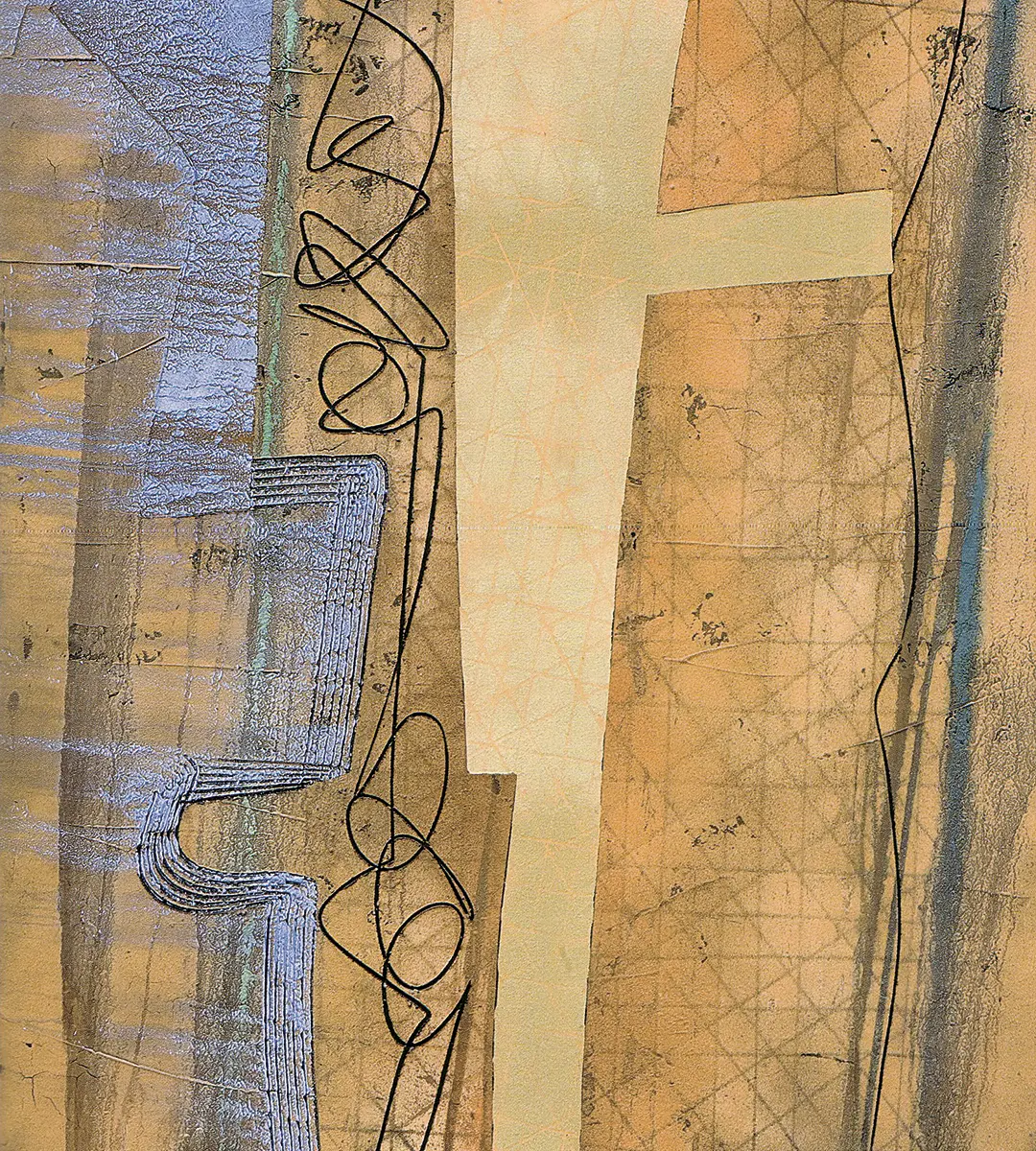
A tour of the ample gallery space confronts the viewer, first, with Wiesse’s abstract works on canvas. In general, these are square-shaped, large-format works, more than twenty of which are on exhibit, where Wiesse intervenes the support by tracing lines and incisions, superimposing planes, contrasting textures, grading or counterpointing colors. Among the latter, ochre-earthen and blue tones are predominant, in reference to the paradoxical proximity of the coastal band’s radical dryness and the sea. Wiesse’s abstract proposal seems derived from a perspective angled from on high, an aerial, zenith-like view of the landscape. The line describes curves and angles; paths that are stable or broken by severe inflections; elongated trajectories or brief segments. It suggests a degree of altitude, pathways, watercourses, the parallel traces of the wind as it blows over the burning sand. And the sand is physically transferred to the densely textured works: the desert is then metaphorically contained in a two-dimensional plane.
This inscription of the essence of the landscape into rectangles (or in the outstanding background in various shades of blue) is complemented by the investigation of irregular formats, assemblages or cut-ups. In this way, the show’s second section presents Wiesse in an even more experimental facet, questioning the opposition between plane and volumetry, liberating forms that are no longer circumscribed to the boundaries provided by the format, but invade the gallery freely. Textured like his two-dimensional works, these assemblages emphasize the use of intense colors, in consonance with the tenor of freedom and even the playful sense of this intermezzo between the show’s two main chapters.
Finally, Tres arenas present a representative selection of Wiesse’s actions in his direct observation of Pachacámac, a project that continues and has no defined timeline. The mature artist, solidly grounded in his education as a painter, sticks now his easel in the sand so that his view from on high is replaced by a horizontal confrontation, focused on one aspect of the construction or embracing a wide panoramic. The point of view shifts, but the show is coherent: the thematic unity, the basso continuo supports the rhetorical turn from abstraction to figuration. At the same time, the rigor of the representation does not imply the sacrifice of gesturality or of matteric forcefulness: the free brushstroke and the generous impasto (of oil, acrylic, or pastel) connect this tribute to the geographic environment as the stage of culture and mysticism, with Wiesse’s abstract production. The architectural remains rise with a dignity that resists oblivion, under the gaze of an artist, committed to their recovery and revalorization, as can be seen in Wiesse’s self-portrait, one of the final works in this show of almost fifty items created mostly in 2007.
Consistent in the intentional substratum that impels him to create (decidedly political yet devoid of literal stridencies, and at the same time loaded with subjectivity,) faithful to the maintenance of the thematic axis and solvent as a craftsman intent on testing materials and supports, Ricardo Wiesse rounds up a show that is representative of the vitality of his current efforts, and singularly possessed of a certain anthology-like feel. Tres arenas are, in sum, an opportunity to appreciate, globally, the work of the central figures in contemporary Peruvian art.
LUIS AUGUSTI