
Schweiz Über Alles meaning Switzerland above all, front and center, better than any other nation: such is the title of the exhibition curated by Michel Blancsubé for the Jumex Collection. Six artists connected only by their nationality and a certain contemporaneity have been brought together in the very ample gallery of the main exhibition warehouse, with results that are uneven and unconvincing as a whole, even as one recognizes each artist’s individual value. Like never before, today’s critics, curators, artists, and collectors enjoy what seems like boundless freedom; it would appear that the participants in the production of visual arts in the international arena are liberated from older, inhibiting ties. In the 1990s, curators, rather than critics, began to impose subjective readings of art on viewers, who realized they were confronted with the conceptual imperatives of the theoretician-in-chief. On the present occasion, the exhibition design and space does not help the show because they determine a linear trajectory that offers no alternative to seeing the works on exhibit from a different perspective from that which has been programmed.
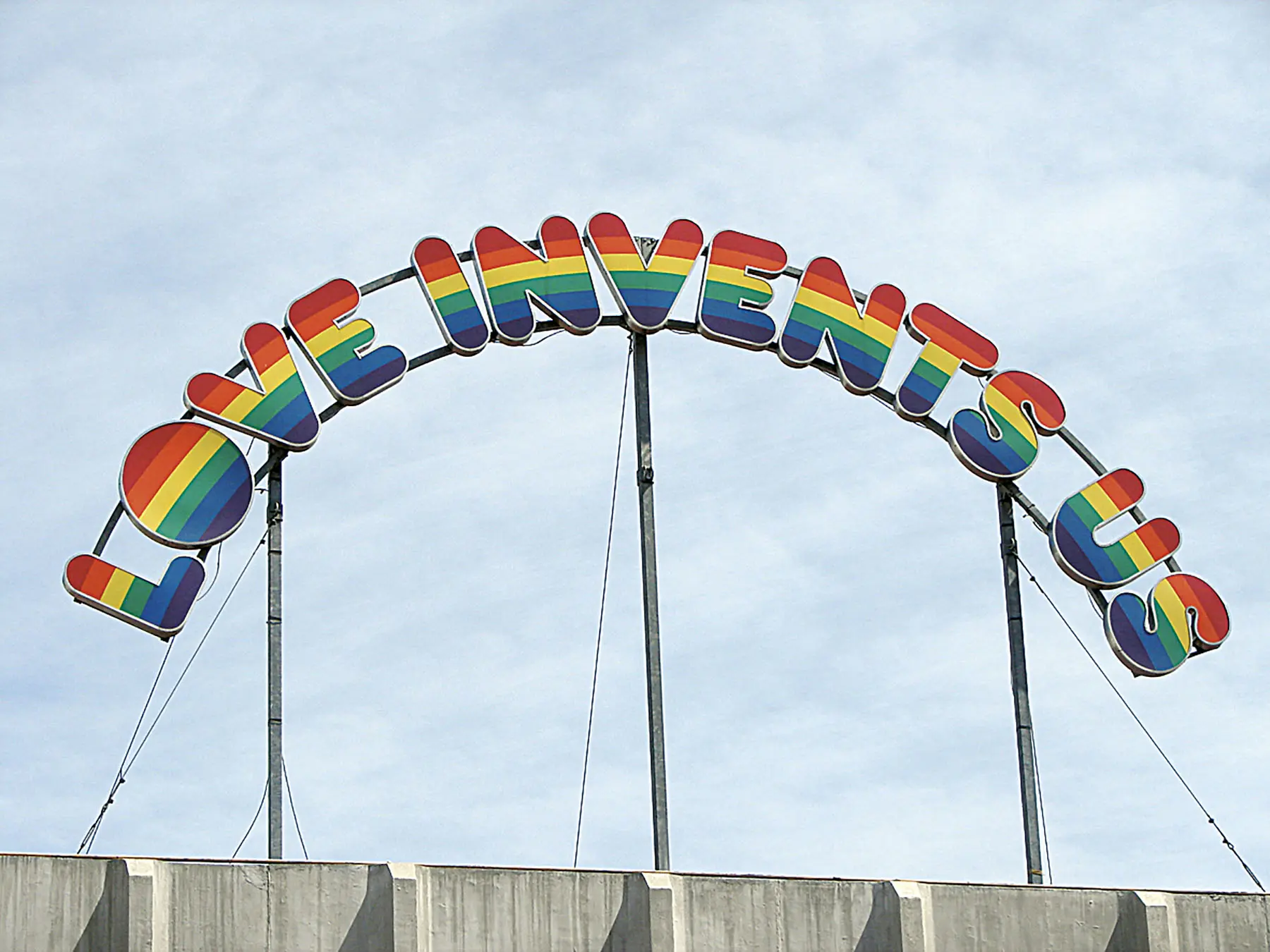
Ugo Rondinone, the cornerstone of the show, welcomes visitors with his well-known 1999 lighted sign that reads Love Invents Us, projected in front of a clean, clear, luminous, and strangely blue Mexico City sky. Under the sign, before one enters the main gallery, is a monumental sculpture by Urs Fischer. Reminiscent of 1980s-style “found object” works, Bad Timing, Lamb Chop (2004–05) is placed on the factory’s scant garden and seems to suggest the Surrealist, coitus-like coupling of a giant wooden chair and an equally outsized cigarette pack.
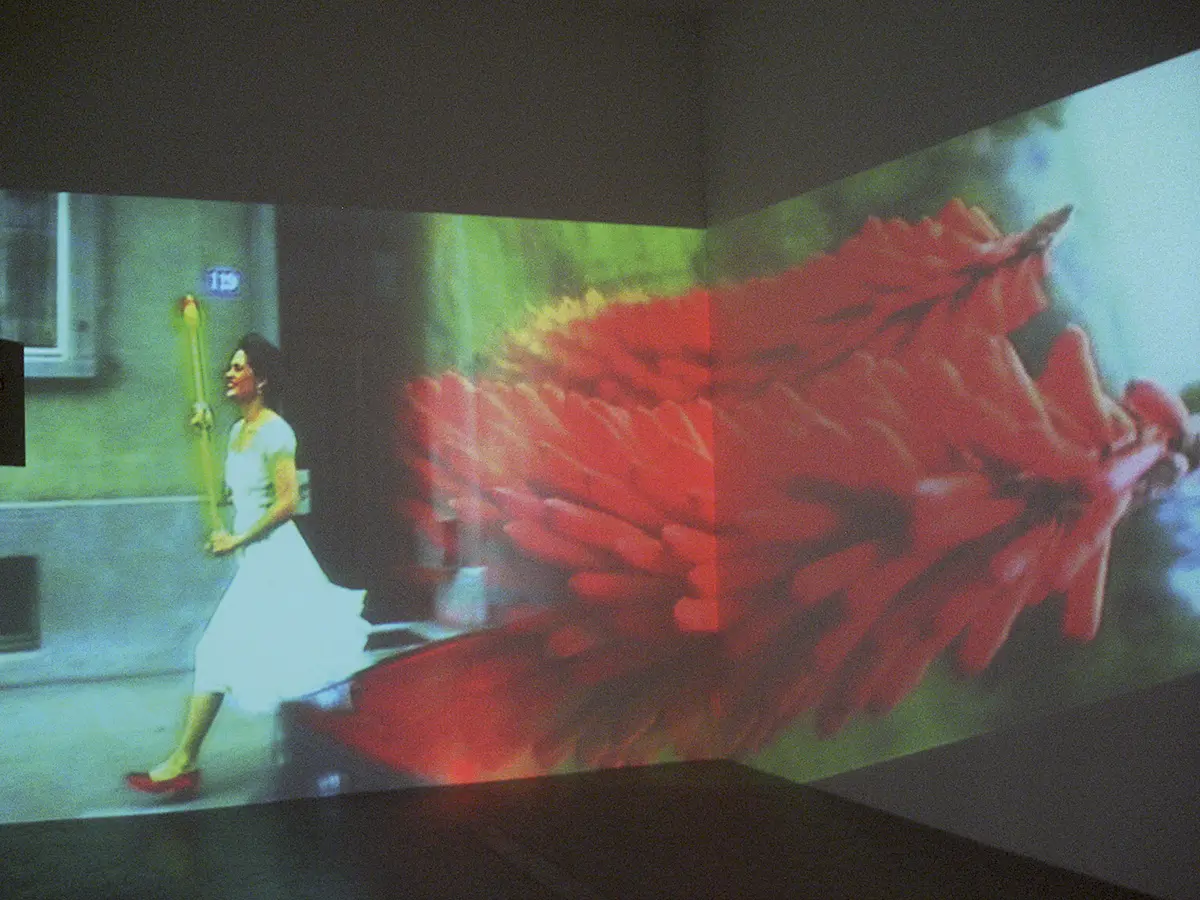
Once inside the gallery, one encounters the show’s logo, in vinyl, printed on the wall, and a seemingly unrelated series of Swiss ritual masks from the early twentieth century. These have little to do with the rest of the exhibition and nothing to do with the contemporary appropriation, reconstruction, or simulation of reality that is evident in the rest of the works presented. The only connection could be with Rondinone’s Moonrise, from 2003, a polyurethane mold of a dog’s mask, which hangs from the wall without reference or connection whatsoever with the next room, where Pipilotti Rist’s 1997 video loop Ever is Over All is presented. Poetic and sublime in her previous works, Rist here portrays herself as a hooligan: she walks in slow motion on the streets of a First World city that could be Zurich or Geneva and breaks the windows of parked cars to smithereens with what appears to be a heavy mallet but is actually a long-stemmed flower. Superimposed on the video are images of flowering fields that render the scene of the good-girl-gone-bad in her summer dress breaking the Helvetian peace and tranquility even more unreal, while a policewoman salutes her without noticing her terrorist-like actions.
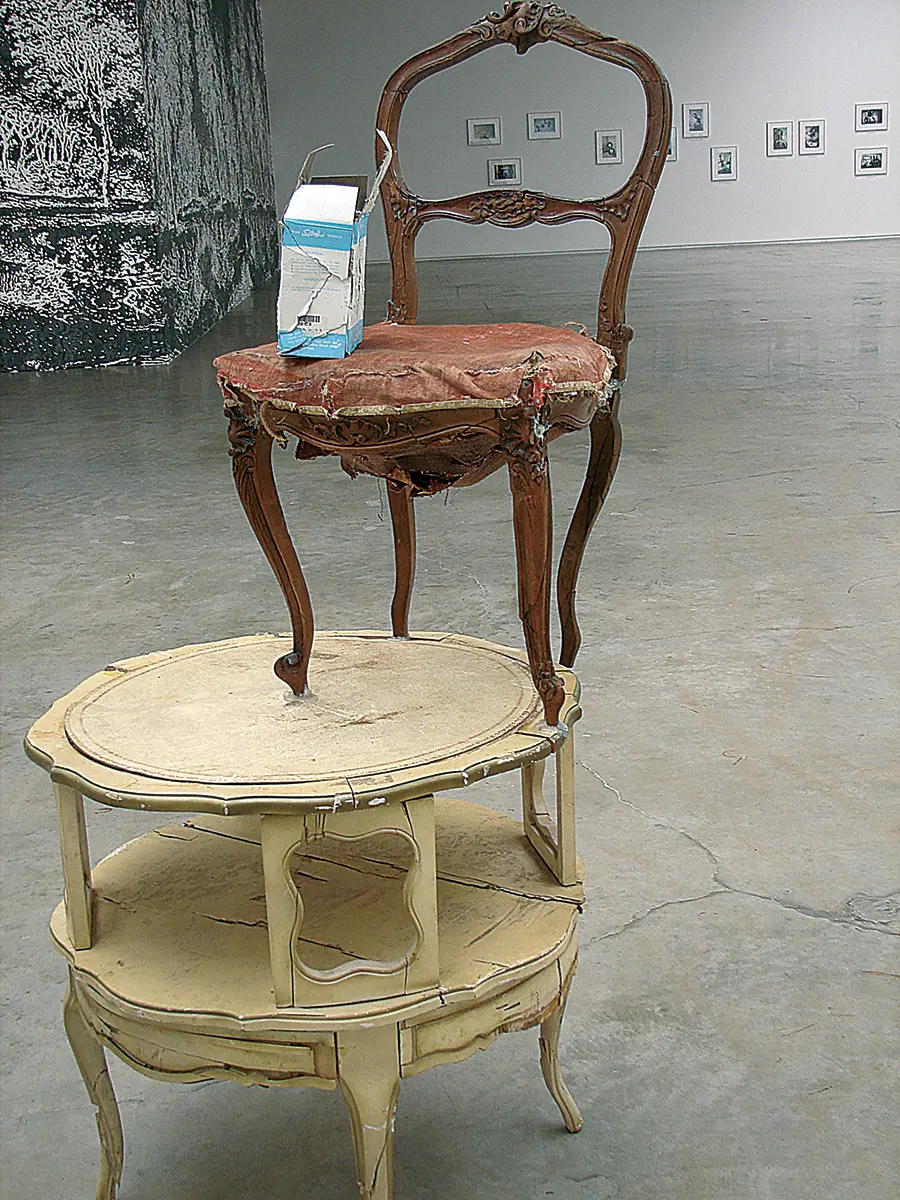
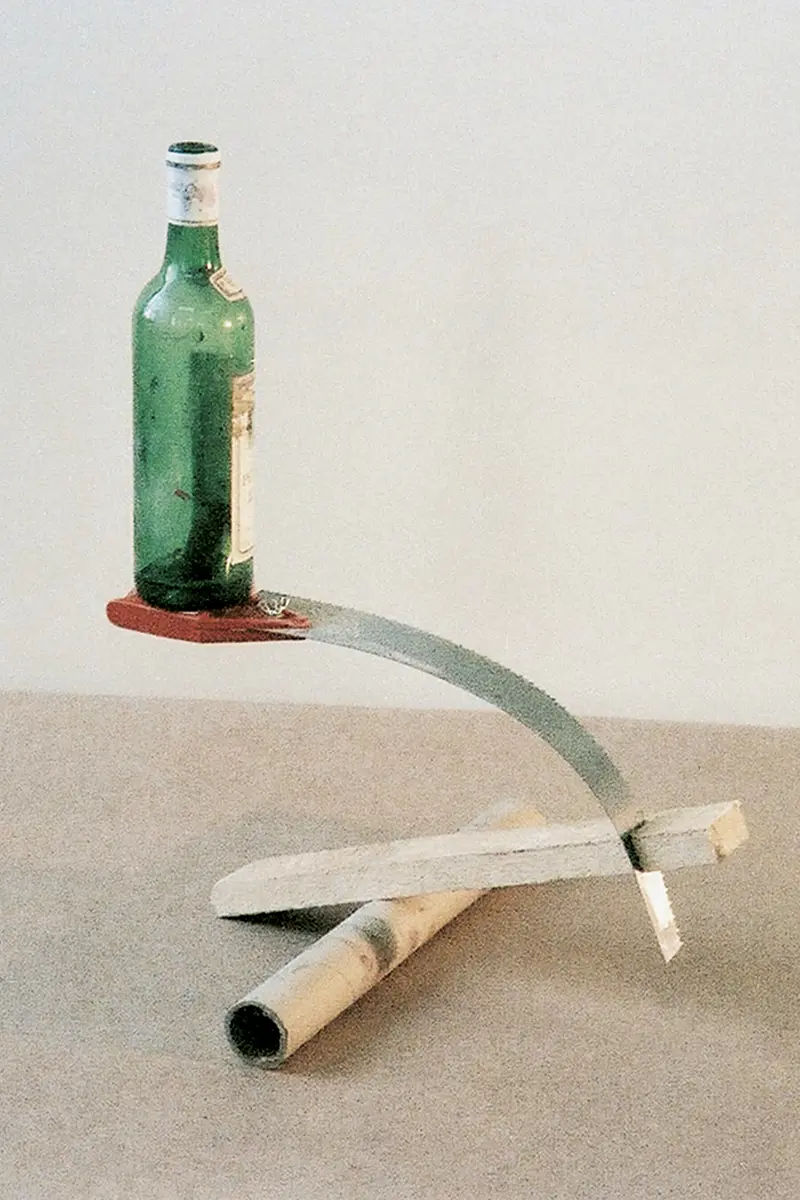
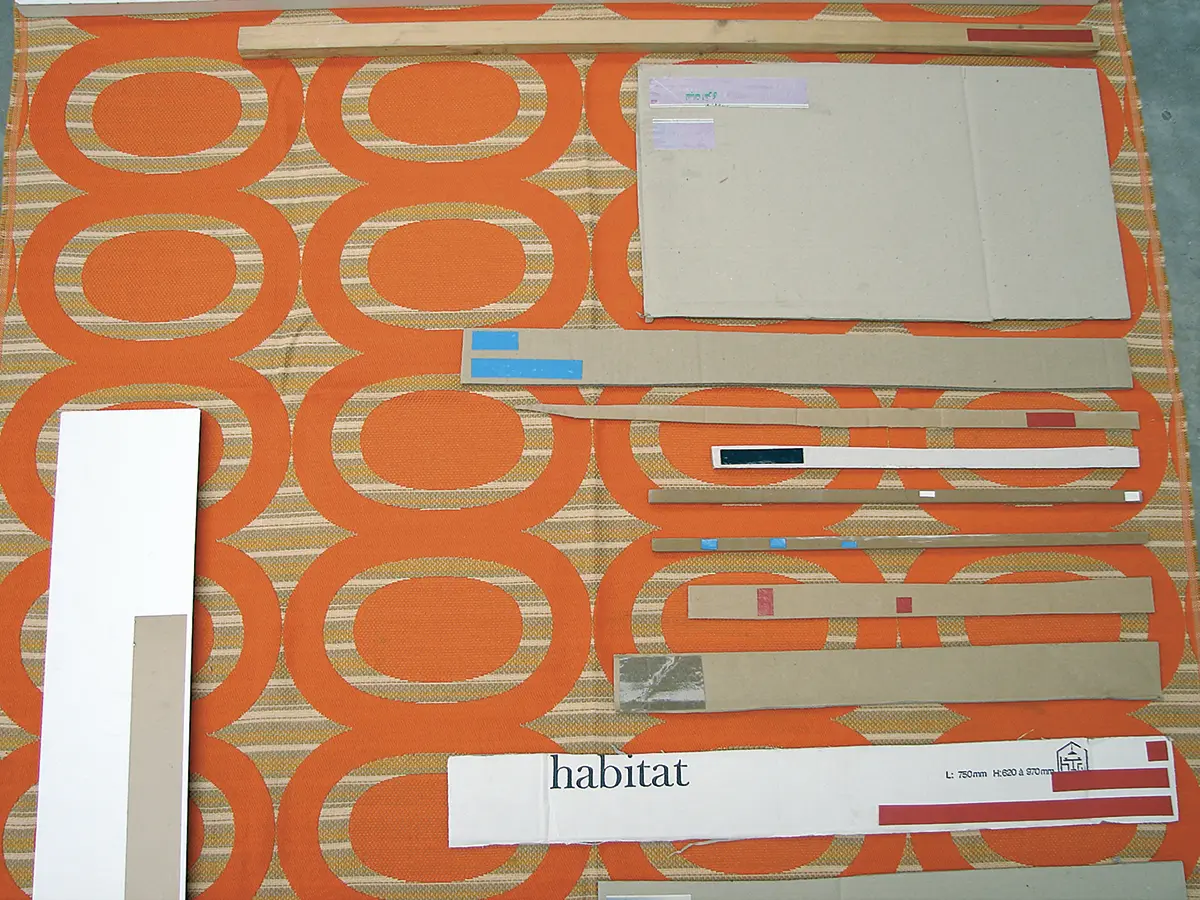
The main gallery is almost entirely taken over by more than eighty photographs by Peter Fischli and David Weiss, most of them from the early- and mid-1980s series Equilibre. Images of household items are piled up like a postmodern still life, represented with a classical intent in which light and shadow, the contrast between straight and curved lines, symmetry and the interplay of planes and spaces are constant, rendering eighty percent of one’s experience of the work a monotonous, tedious affair. These mostly black-and-white photographs, and the handful that are in color, bring to mind Giorgio Morandi’s paintings and the esprit nouveau of the twentieth century’s first post-war period. The flow is interrupted by another sculpture from Fischer, Addict (2006), in which two old tables are piled with a chair, confirming that classicism is in vogue among the postmoderns. The other piece is a very modest sample of Thomas Hirschhorn’s enormous 1990s installations, deploying the artist’s characteristic recycled materials on the gallery floor. Materials discarded by urban culture, fragments of detritus arranged seemingly at random and strewn about the exhibition space, comprise the core of this work by Hirschhorn, one of the most significant artists to appear in the last two decades.
The most striking works in the show are Rondinone’s installations: in the work In the Sweet Years Remaining (1998), a wall made of wooden planks holds dozens of black-and-white photographs of a snow-covered forest. In some of the photographs, one is able to see the slow steps of a woman who stops, observes, stands firmly in the snowy landscape, and wanders around the trees. Behind the wooden wall, multicolor lights shine on the landscape while sounds of human exhalations and sighs come from the speakers. In front of this installation, two adjacent walls are covered with a China-ink forest on white stucco. It is once again the representation of a secluded forest, and it belongs to Where Do We Go From Here? (1996). The patterns are interrupted by a door leading into a tunnel, similarly built-in wood and lit by neon, which in turn takes the viewer to a gallery where giant videos of four clowns lying down are projected on walls. Rondinone has already presented fiberglass sculptures of these grotesquely dressed and accessorized figures, but now they are personified by actors who do not “act” for the audience but pose and move in an almost imperceptible fashion for almost forty minutes. If the sculptures impress viewers for their inappropriate presence inside a museum, the images presented here provoke an unexpected feeling between fear and embarrassment for the laughter to which it is subjected.
In conclusion, the value of the individual works is inherent to each, without the need to frame them within a dictatorial, theoretical postulate. The curator’s text signals his intention, but it should not emerge as the only reading. The issue of nomadism among artists has been part of art-theory discussions since the 1970s, and national borders have been blurred and erased through the entire history of humankind—with greater emphasis after World War II, during the neo-liberal economic boom of the 1980s, and even today when geographic maps shift on a daily basis and reveal once again a new world divided into political units imposed by subjective power discourses.
LUZ SEPÚLVEDA