
Little “lead soldiers” with no helmet or
uniform, rather, children bearing arms: precise instructions to build a
potentially deadly weapon with “really cool” pieces of wood; images of
tombstones with irregular and clumsy scripts on them; cutting weapons and
firearms, their use justified with misspelled written words; diplomas
validating someone’s competence in employing violence to counter street
violence; these are the pieces that are part of Wilger Sotelo’s first solo
exhibit at the Casas Reigner Gallery titled Amenaza y Resistencia, Residentes
Comuna 5, Cartagena de Indias (Threat and Resistance, Commune 5 Residents,
Cartagena de Indias).
Regarding his thematic, Wilger Sotelo explains: “The interest in investigating urban violence derives from a particular way of seeing, feeling, walking, and perceiving two types of cities: One, a city exposed every day to hunger, to being born, and grow up in a violent and marginal environment”. Wilger Sotelo, until recently a student at the Fine Arts School of Cartagena, has been creating works dealing with the life conditions of young people living in the marginal part of Cartagena, which co-exists with the “historic” section of this city, a beautiful and well-known tourist destination that rejects any criminal act. Colorful facades and cobblestone public squares filled with cafés are in strong contrast with the gray and an opaque marginal city that is the “other Cartagena”, which according to Sotelo is “filled with unsafe streets, terrifying passages, hidden and desolate places that transform us into sorrowful victims of the city”.
This exhibit reminds me of the famous phrase by Paul Klee, cited by Herbert Read, in which he affirms that it is not the intention of art to reflect the visible, but rather to make things “visible”. This affirmation – so helpful in understanding modern painting – remains very current. Contemporary artists have devoted themselves to pointing out things concerning the world with the purpose of shedding light on the circumstances and events surrounding us. The artists of today show us the world and Wilger Sotelo is no exception. The works contained in this exhibit underscore, through a strategy of replications, the conditions, and the imagined conditions of young people from this sorrowful metropolis. Here, the threat is ever-present, and fear leads to violent actions, violence becomes threats and an endless cycle comes into being, in which the word “resistance” appears to draw the line: to end violence, fear, and threats, it is necessary to resist.
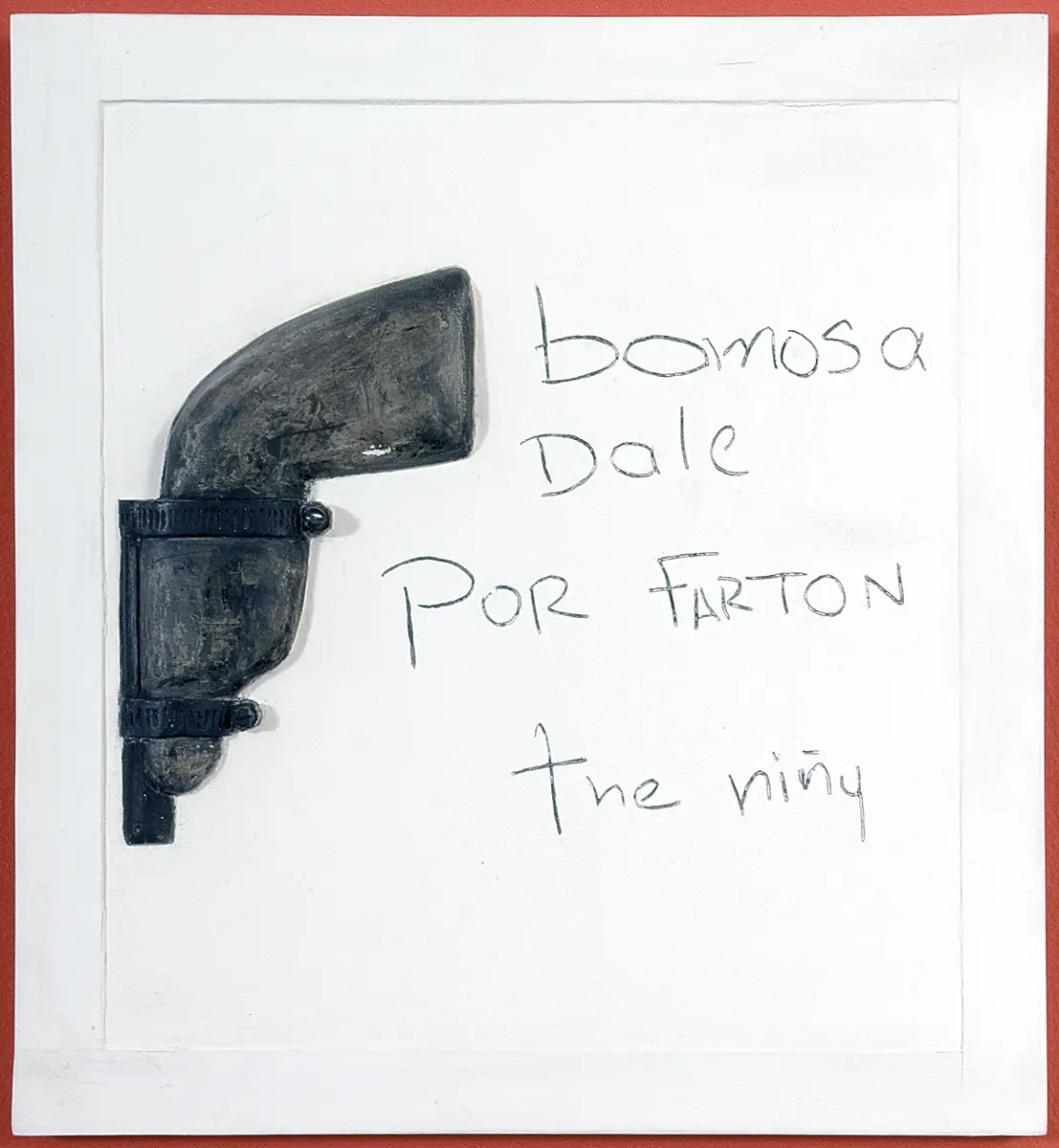
One of the characteristics of Sotelo’s work has been the utilization of verbal recourse. The artist frequently presents words and terms that are utilized only in this marginal environment. One example is the work he performed with Rafael Ortiz at the Cart(ajena) event, where the two transformed city walls into a dictionary that explained the meaning of terms used by these inhabitants from the “other Cartagena”. The works in this exhibit preserve the artist’s particular form of writing – his calligraphy and orthography. One example of this is found in Los Vivos del Oyala (The Living of Oyala), a series of printed photographs on metal that show images of tombstones at which some youngsters who at one time were the vivos (the living, or vivos can also mean the smart ones in Spanish) of that marginal neighborhood of Olaya, today lie in peace”: “The Yonky”; “The Cacho”; “The Chawa, 1980–1998”; “El Machete, 1981–2001”. The writing is also present in a series of reliefs, plaster surfaces with the imprints of the real weapons out in the streets. Next to these, we find phrases such a “Solo pa los calsetos y faltones El propio Mailonllasion”, written with clumsy calligraphy designed to be precise, although its written words point to the possible victims. To make this language visible, to bring it right before our eyes, allows us to observe another side of a world with which we are only acquainted through the mass media, which convey a point of view closer to the Cartagena of the tourists, always feeling threatened by urban violence. Preserving every feature of this marginal language places us in closer proximity in a more human and direct way to this world in which violence is a way of life, a world in which threat is persistent, where idioms mix, and where death arrives soon. The calligraphy sends us back to primitive writing that preserves something from our early writings. Most importantly, it illustrates a lack of education and alienation, as well as the presence of poverty that lives alongside violence.
The little lead soldiers are not accompanied by words. Its title takes us back to that old, sad children's story of Hans Christian Andersen. Sotelo’s soldiers do not wear red uniforms, and their posture does not convey the rigidity of military parades. There is no dancer making them die of love. Despite having on their faces and bodies the porcelain finishes representing sweet shepherd children, innocent children, these are miniatures of children who point to their “cool guns”, violent youngsters who resist with their ingenious and craftily created guns. In summary, these children represent a menace and in time will become “the Living of Olaya” – the “Smart” ones of Olaya.
MARTA RODRÍGUEZ