
With a recent solo exhibit titled Hides, Antuán explored two meanings of that word (taking refuge or the skins
of animals) and created an insightful metaphor of the fragile state of our
environment and the hypocrisy and drama dominating our contemporary societies.
The artist did this through large two- and three-dimensional works that were
characteristic of an important part of his oeuvre.
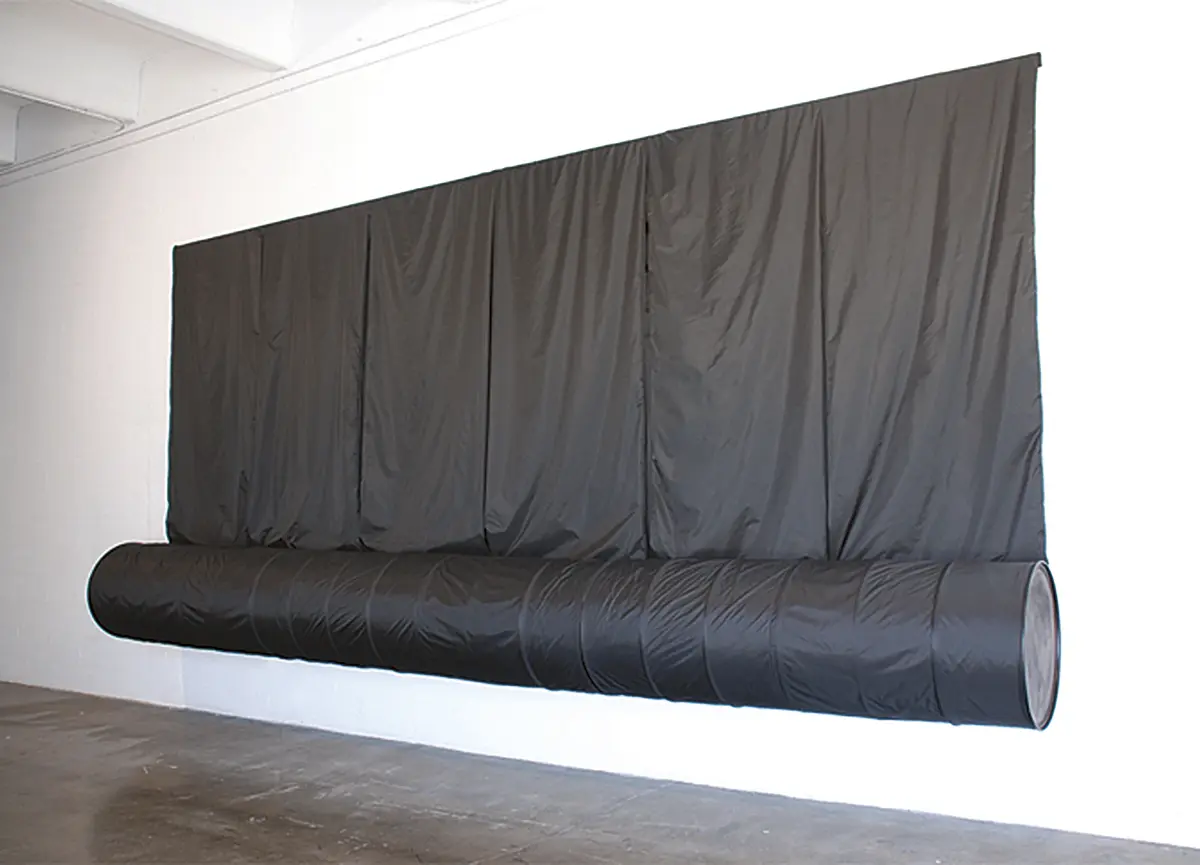
As one entered the gallery, the first piece was La Negra. It consisted of an enormous, black parachute-silk panel, similar to a theatre curtain, which contained six barrels that suggested oil pipes. More than a reflection, it appeared to be a prophecy, for oil prices skyrocketed during the run of the exhibit to more than one hundred dollars per barrel. This is a global crisis with no end in sight as long as world leaders do not pursue serious and sustainable energy alternatives and continue to ignore the murky dealings that ensure the dominance of black gold.
The Cast and Cast Away biographical diptych analyzed the sociopolitical and religious norms that have molded humans throughout history. What monstrosity was expected to emerge from these molds? Each society possesses its own answers, according to its teaching system, its religious beliefs, and the commercial and political demands dominating its mass media. Looking at this work, the viewer interpreted the presence/absence of the being that left a void between the clay and a broken cast standing in front of a blue background.
Bare Sky played on the homophones “bare” and “bear” with the capricious image of a cloud shaped like the head of a bear, which the artist reproduced with twenty-four stainless-steel rings that are usually used to connect industrial pipes. This monumental installation referred to multiple scientific reports that some characterize as alarmist, warning us of the impending disaster to besiege humankind because industrial development is set to collide with nature. There are myths in many cultures in which animals are usually messengers, guardians, advisers, or servants. In this image, the cloud-bear evoked the animist and magical vision of the earth embraced by the North-American aboriginal people: “Everything the Power of the Universe does, it does it in the shape of a circle. The sky is circular, and I have heard that the earth is circular and the stars are also circular.”
The work titled Makaira represented a marlin wrapped in a weave of blue spandex. It was a metaphor for the silent catastrophe inflicted on the sea by the indiscriminate fishing of species on the verge of extinction, the pollution of the oceans, and the cruelty of sport fishing. A similar denunciation was highlighted in Traffic: twelve elephant tusks fashioned from resin emerged from twelve large pockets of Prussian-blue cashmere. These were exhibited along with vain trophies that First World hunters often hang near their fireplaces, after having left groups of animals dispersed and spilled blood on the lands of the Third World. In Red Traffic, Antuán insinuated the shapes of human bodies enveloped under a bundle of elasticized red cloth as the viewer imagined what was hidden; in this instance, humans and not animals fell victim to the organ traffickers. This piece perfectly complemented another work titled Universal Healthcare. Here, the artist resorted to the rawness of the real object by showing six crutches resting in pockets made of green hospital fabric. This work was a bitter social commentary on the failure of the most powerful government in the world to guarantee a healthcare system for all of its citizens.
Another piece, titled Ironclad, provided an ironic reflection on the occasionally arbitrary character of the symbols of power. With a panel of fifteen guayaberas (embroidered mens’ shirts worn outside the pants in hot weather) covered with an iron patina, the artist illustrated the transformation of an article of traditional peasant clothing into an impenetrable wall or a symbol of social status in another context. Finally, the sculptural installation Update proposed an obscure religious and quasi-environmental metaphor. It presented a patinated bronze cross supporting a balloon, which inserted its arms/hoses in a gesture to save the cross. Similarly, Atuán’s video art piece Peran Tanatos was a reflection on the human destiny that depicted a young, nude couple kissing passionately inside a sarcophagus, an image that beautifully merged the great archetypes of love and death, Eros and Thanatos.
This exhibit reaffirmed Antuán as one of a select group of contemporary Latin-American artists whose work is motivated by the most relevant social themes in our times. Once again, he confirmed the description of him as a culinary artist who serves up consciousness.
RAFAEL LÓPEZ-RAMOS