
Three things stand out immediately in El Gran Mambo, Carlos Luna’s
well-articulated exhibition at the Katzen Arts Center of the American
University Museum. The first one is related to its axiological signification in
the field of today’s aesthetics, taking into account that we are in the
presence of pictorial content that can work as the counterpart to
pre-determined expectations within the framework of postmodernist painting.
Such fatalistic assertions with respect to the longevity of two-dimensional art
comes from a Hegelian pessimism in relation to the validity of “purist”
expressions of art, which has been counterbalanced throughout the last two
centuries by those practitioners who have filtered them into and fusing them
with the latest trends. These seventeen paintings by Luna agglutinate in
particular dedication to those who with the advance of postmodernism questioned
the continuity of brushes and palettes, giving blind credence to technology and
to the preeminence of the concept. Deploying these paintings strategically,
curator Cynthia McMullin not only proclaims long life for pictorial genetics,
but also rebels against the mole-like condition that a certain sector of
theorists seek to impose on painters.
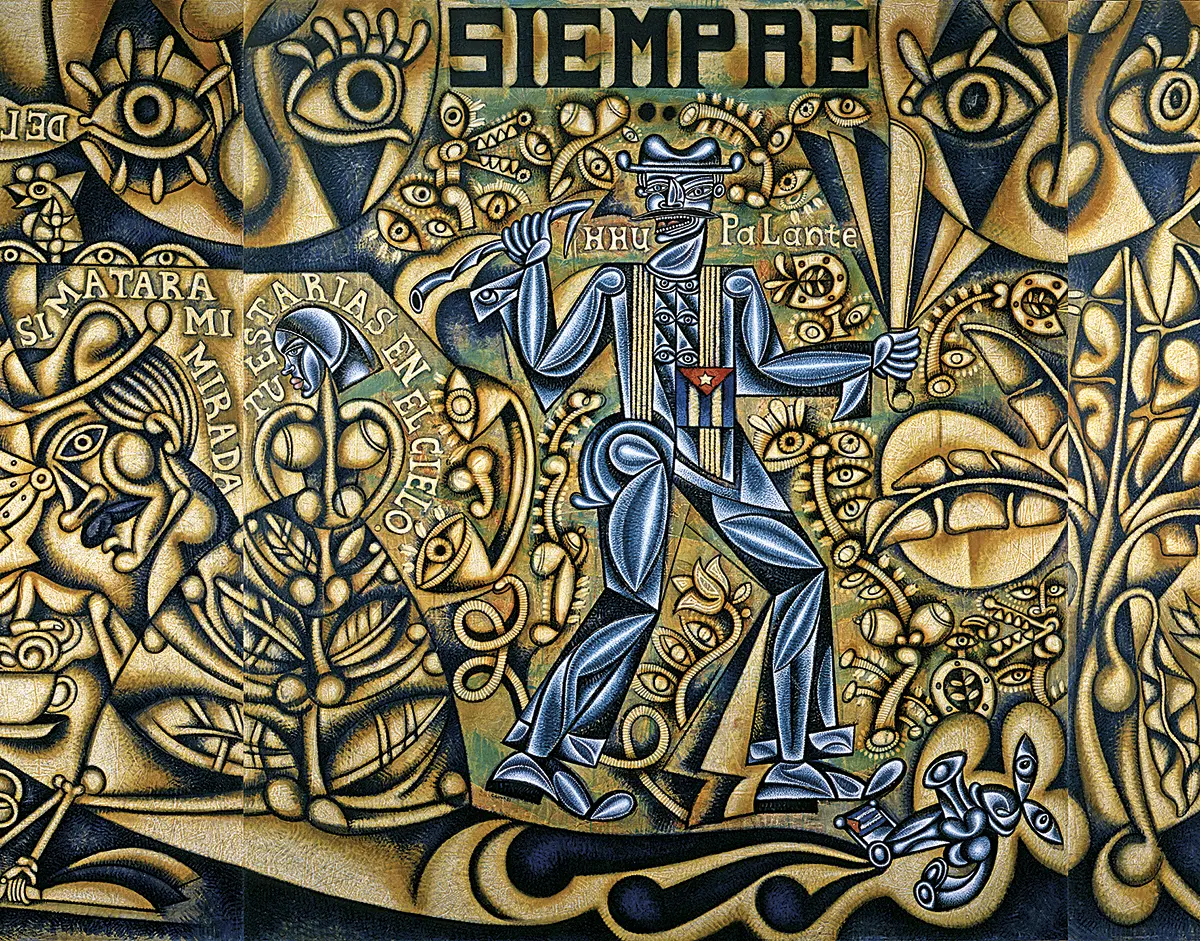
Another significant aspect of the show is the curatorship. McMullin stakes advantage of a spatial structure surrounded by white walls that advance in a spiral, propitiating the possibility that the exhibition script, besides its pulchritude would cede protagonist space to the warm effectism of Luna’s chromatic exuberances. One is overtaken by the astute conspiracy of architectural relentlessness and museographic intention, and then just as suddenly one is ambushed by the curator’s intention. This we felt as we walked through the grid of examples such as Árbol Grande (2001), El Rapto de la Catalina (2001), War- Hero (2003), Café Caliente Juliana (2004), or Tercer Mundo (2005), to arrive at the monumentality of El Gran Mambo (2006), a pathway where he subjugated the persistence forcefulness of Latin American imagination’s inherent iconography. As if Luna’s paintings were raising objections to Baudrillard’s well-known uncertainties about the supposed precariousness of the genre in the face of so much sophistication in recent art. There is no simulation nor disillusionment in these paintings, nor do we notice any cardboard-like of some kind of ancestral classicism. These works radiate energy and innovation and after the maneuver of a solid and efficacious academy it is able to shape and direct, without intellectual prejudices, motivations that relate to the popular.
In this way, Cynthia McMullin edged the sharp debate with a well put together argument. The curator assumed the project, originally designed for the Museum of Latin American Art (MOOLA) in California, as part of a platform of study that encompasses artists of Hispanic origin whose creativity is expressed through traditional methods and who manifests the vibrant influx of the autochthonous. The work of this Miami-based Cuban painter was a compact example of such synergy. The later itinerary or El Gran Mambo to the Washington side of the Katzen was planned back then; the Katzen’s institutional solicitude to also exhibit Luna evinces an interest similar to McMullin’s criteria.
Having set that, the culminating quality of this exhibition resides in the medullar force of the painter’s production. The sequence that comprises more than five years of work, including works that emerged from Luna’s hybrid experimentation during his Mexican sojourn, bear witness to a well-rounded practice, which has gained a niche of its own among the younger generations in the continent’s art scene.
Luna’s crop of works directs a well-trained gaze towards signs of a chaste kind of painting, one that is filled with semiotic provisions, painstakingness, a and sensorial weight, and that emerges from the very personal playful repertoire with which Luna stocks the vernacular events, anthropological commentaries, culturalist reminiscences, sarcasm, and neo-pop and kitsch evocations that coalesce in a novel way in a rustically refined narrative. This compound, of fresh formal singularity, is what has captured so quickly the interest of academics and critics in North America.
I must point out that if there is one work that epitomizes the spirit of the exhibition is the one from which it takes its name, El Gran Mambo, a colossal painting on a vast canvas surface comprises six aesthetically autonomous sections that, on coming together in a splendid mural assemblage reveal a rather complete condensation of Luna’s discursive code. This large “discharge” —as the artist defines it— is a kind of representative catharsis that, besides being the compendium of a vital journey contains aspects of a chronicle of the contextual background of its origin. A critic of the stature of Enrique García Gutiérrez has already called it anthological because it belongs to that kind of synoptic work of art that augurs presence and permanence in a museum. A possibility that can already be made extensive, in my opinion, to the rest of Luna’s workshop.
JESÚS ROSADO