
In his second one-person exhibition in New
York, Diango Hernández suggests that modernism, technology, and liberal
democracy have failed to liberate us. But the works on view nonetheless convey
a refusal to completely discard the utopian conviction that we can transform
our lives by reshaping our environment. In this group of recent installations
and drawings by Hernández, the viewer encounters modernist forms, remnants of
old communications technology, and images from John F. Kennedy’s assassination.
Throughout the show, elegance and purity of form are undercut with anxiety.
The knowledge that Hernández is Cuban-born and came of age during the late 1980s, when the fall of the Soviet Union caused a severe economic crisis in Cuba, encourages some general conclusions about the political meanings of his works. Hernández addresses Cuba’s relationship with the United States, imperialism, and propaganda, and it is clear that he is speaking from the point of view of an immigrant whose life has been profoundly affected by these political conflicts. The largest installation in the show, My Symmetry consists of a louvered wall that divides the long main gallery. On one side of the louvers is printed the phrase “patria o muerte,” while the other side is inscribed with the words “in god we trust”—the slogans of Cuban (and Latin American) revolution and U.S. liberal democracy and capitalism, respectively. Handprints soil some of the louvers, as indexes of human presence, of those who are forced to negotiate these conflicting political positions as part of their daily lives.
The second installation, waves inside my room, consists of a smaller gallery with a dropped ceiling of perforated hardboard. The ceiling is lit from above so that dramatic shadows fill the room, and the innards of an old-model radio sit on a white pedestal in the center of the space. Upon closer inspection, the perforated ceiling proves to be the scavenged backs of old radios, and this, combined with the title, leads one to think about how the United States since the Cuban Revolution has used the radio as a key mode of propaganda in Cuba (and in Latin America, generally). The title, waves inside my room, further suggests the image of a young Hernández listening to a radio stream from Miami in his room in Sancti Spiritus, Cuba.
In both of these installations, Hernández creates atmospheres of noir intrigue that suggest more ambiguous meanings. Dramatically lit from one side, the louvered wall that divides the main gallery throws strong shadows onto one half of the room, evoking a dramatic tropical interior. One thinks of Hollywood sets, scenes of CIA interrogations, and other fictional scenes of Cuba as it exists in the U.S. imagination. Less specific in its evocations, the perforated ceiling of the second installation is lit so that distorted geometric shadows stretch across the walls and floor. The buzzing hum of the broken radio that sits on the pedestal fills the room, creating a mood of foreboding and anticipation.
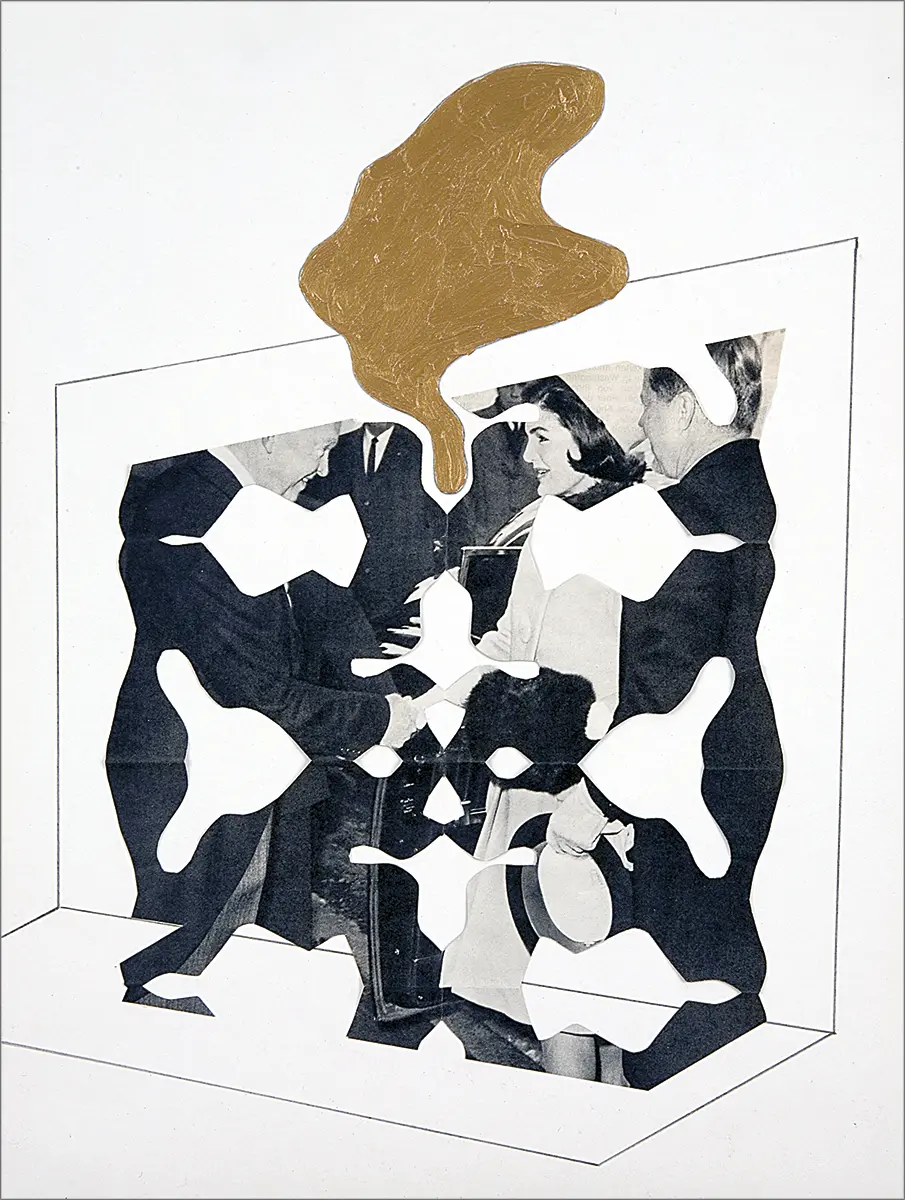
The louvered wall and the geometry of the ceiling tiles also evoke a kind of vernacular or improvised modernism. These associations are reinforced by the series of drawings that are hung along one wall of the main gallery, directly opposite the louvered wall. In these drawings, Hernández has combined abstract forms with collaged photographs of scenes surrounding President John F. Kennedy’s assassination. The drawings feature round, punctured forms that recall the watered-down constructivism popular for public sculpture in Europe and the United States during the 1960s. What is jarring about these wonderful drawings, though, is that Hernández constructed these abstract forms by cutting and pasting photographs depicting the events before and after Kennedy’s death. In a drawing titled Pure History, one can see Jackie in her pillbox hat shaking the hand of the Texas governor among the curves of what looks like a design for a perforated screen. In another, Hernández has cut an Arp-like shape from a photograph of Kennedy’s casket under the U.S. Capitol’s rotunda. In all of these drawings, the modernist forms function as either sculpture or architecture—sitting on top of pedestals or situated in relation to walls and floors.
What is so promising about this show is how Hernández has directed his political concerns toward questions of form. How visual forms are used on behalf of ideology is a difficult problem to examine, and Hernández begins to address it here. The work he has shown in biennials over the last several years has been more straightforward in its political references, but with this show, we see a subtle and more ambiguous aspect of Hernández’s political engagement. This is an interesting development in his work and reaffirms the visionary potential of the utopian projects that he participated in as a member of the collective Gabinete Ordo Amoris during the mid-1990s.
HARPER MONTGOMERY