
Under Agnaldo Faria’s general curatorship,
Dudi Maia Rosa (São Paulo, Brazil, 1946) exhibited a vast, singular solo show titled Eu Sou Outro (I Is Another) at the Tomie Ohkaje Institute, located in
the heart of the Pinheiros neighborhood. The exhibit lasted from February 29 to
April 13, 2008, and was installed in two large exhibition rooms at this art
center.
For more than two years, Dudi Maia Rosa worked arduously to put this important exhibition together, wearing Arthur Rimbaud’s artistic and existential emblem Car je Suis un Autre… (I Is Another…)” that revolutionized and shook up the practices, principles, and beliefs of that very notion of identity and subjectivity to which it refers. Originally written to his loyal friend, Paul Demeny, when Rimbaud was just 16 years old, it belongs to one of his most substantial texts entitled Letter of the Seer.
When Rimbaud outlined this marvelous syntagm, he opened up a passionate path unknown to art and particularly to poetry. With it, he also put into practice an axiom that surrealists, led by André Breton would take it to its ultimate conclusion: change a life. To achieve the level of a seer, Rimbaud would say, the initiated must experience an alchemy and metamorphosis to such a degree that the disorder and perplexity of all the senses are attained.
“I Is another” is one of the most influential and powerful phrases for the psychoanalysis and anthropology of this hypermodernity through which we are so carelessly passing. Let us be clear: this is not a bad translation of “I Is another”, but rather it is that the “I” who I am no more any longer belongs to me and acts according to its own free will.
With this example that was never again repeated, Rimbaud transformed the interaction between life and literature, life and life, life, and art, into something that was never before seen before the artist’s appearance.
It is not about work as it pertains to life, but about the unfailingly condemning script and the fate that permanently ties together both concepts.
In the renunciation of the identity he secured as a writer, of his principle of individuation, in other words, of his raison d’être, Rimbaud radically transformed himself into another. Even the photographs taken of him in Abyssinia are of “another” person. Rimbaud desired to be and succeeded in being “someone else”.
A visible seer, Dudi Maia Rosa took the introspective path of providing a subjectivity brimming over with the otherness proposed by Rimbaud. This involved presenting herself as the “other” within the context of an expansive 40-year artistic trajectory of creating an intense and robust production. It is pertinent applying to her work as an artist, art theorist The statement by Horace, Ut picture poiesis, is pertinent for application to Dudi Maia Rosa’s work as an artist, as an art theorist. To this, the writer of these lines would add Ut picture Kynesis, given these complexities, saturations, lexical predilections, expansive ways of knowing, of transmutating in different attires, as this artist has done with the operatic ensemble he exposed at the Tomie Ohtake Institute.
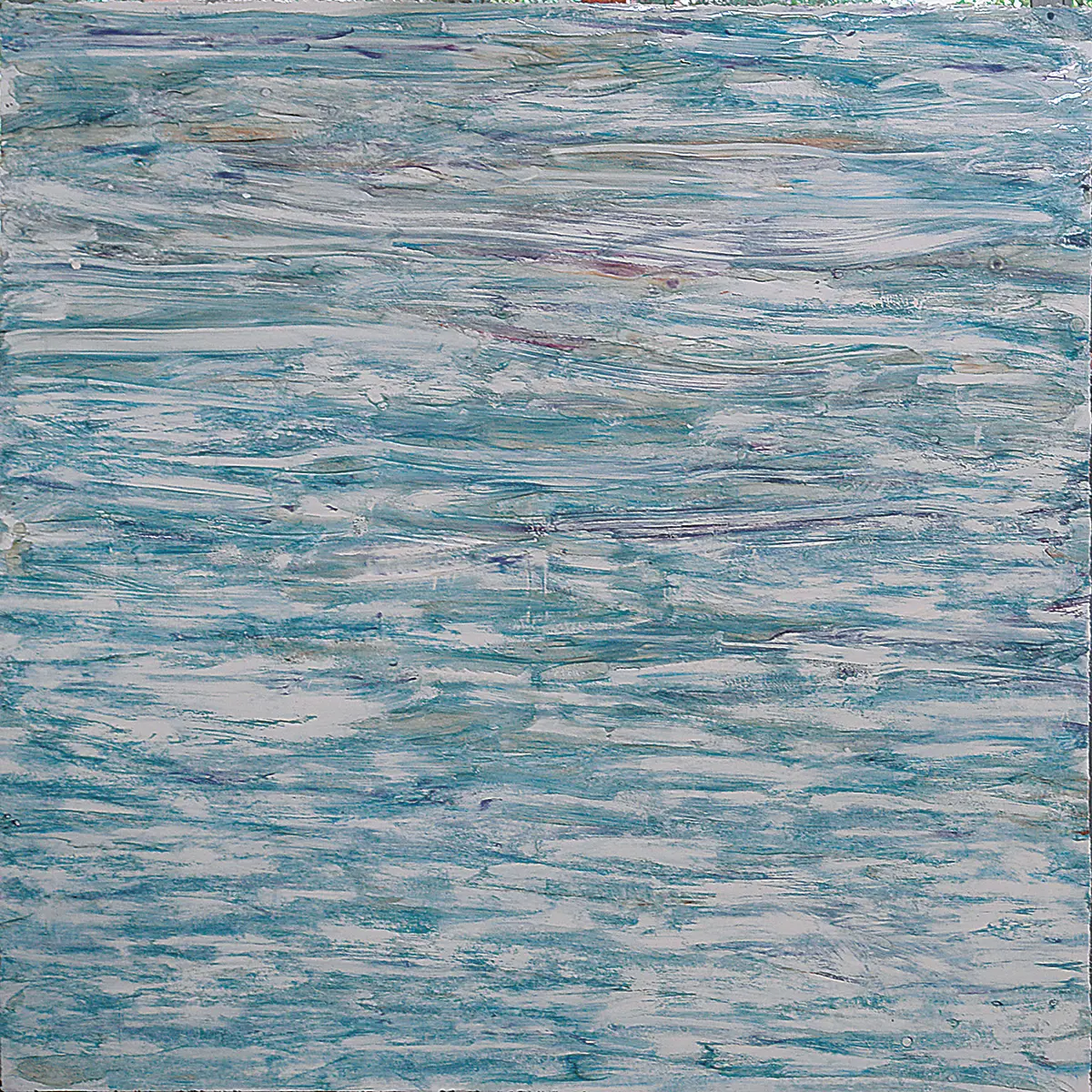
Two well-differentiated corpus can be identified when visiting the Eu Sou um Outro: The first segment, an opus composed of works of a more muted nature, is created with opaque and somber finishes, counterpointing textures, and differences in color. The second group of pieces showcases a profound preoccupation and constant experimentation with transparency, luminosity, and luster. In both segments, the artist points to the diversity and non-conclusive character of the works. To him, no work is ever finished. It is essential to bear in mind such an aesthetic and theoretical proposal, in view of the fact that it is already a cliché to assume that the artistic process contains characteristics of direct communicability and spontaneity. Such naïveté is responsible solely for identifying art in the work. Nevertheless, it is essential to understand, as Eu Sou um Outro corroborates, that today more than at any previous time, contemporary art casts a shadow behind itself, a sort of less luminous silhouette, onto which art refracts and becomes unsettlingly enigmatic as it retracts when attempting to possess it.
Maia Rosa has been creating pieces that are no longer supported by the classic canvas’ frame; his artist’s book Maia Rosa o as Mortes da Pintura (Metalivros, São Paulo, 2005) illustrated this departure from that format. He now uses glass resin blocks and has worked with pigmented polyester resin, in wh8ich we can observe the construction of his very own analog material, signaling his move away from the typical frame and into the pictorial object that is generally 8–10 centimeters thick. When referring to his work, we can now speak of tri-dimensionality, a quality reflecting one among many of the “resurrections”, Maia Rosa contributes to heterodox or “post-metaphysical” painting, as it is known. In his recent works, the majority of which are present in this exhibition, measure approximately 200 by 200 by 8 centimeters in thickness.
Car je suis un autre: It is clarifying to return to these words by Rimbaud after thoroughly visiting the two large exhibition rooms housing Maia Rosa’s works at the Tomie Ohtake Institute. What has become clearer and more violent is the light casting his artistic bearing, the more its essence is hidden and protected as a shadow cone accessible to everyone agreeing to become the “other”, the “other” that is not a mere projection or extension of “we” but conversely, is pure singularity and irreducible otherness that cannot be repeated.
CLAUDIA LAUDANNO