
It has been more than 30 years since the last individual show by Francisco Salazar in Venezuela. His work was widely known between the 1950s and 70s, the heyday of geometric abstraction in the country. Once resettled in Paris, in 1967, Salazar continued to show his work in galleries and museums in different countries such as Argentina, Colombia, Spain, Brazil, as well as France and Venezuela, among others. It is thus highly significant for an anthology show of works by the artist to be presented as part of a celebration of his 50 years of artistic career and 70 years of life. The place: a beautiful museum, an example of 1950s architectural modernism in Venezuela, located in a Plains region in the western part of the country, the state of Portuguesa. It is important to note this fact: this anthology show was conceived in a regional museum and it will travel from there to Caracas, to be shown at Sala Mendoza. Things generally occur in the opposite direction, with the capital generating the resources for exhibitions in the interior of the country. This effort is the work of the Museum’s director, Alí Cordero Casal, who formed the curatorial team alongside Bélgica Rodríguez and Perán Erminy. The result was a gathering of 31 works, most of them unknown to the Venezuelan public. The exhibition was complemented with a selection of notebooks, important documents of the artist’s research process.
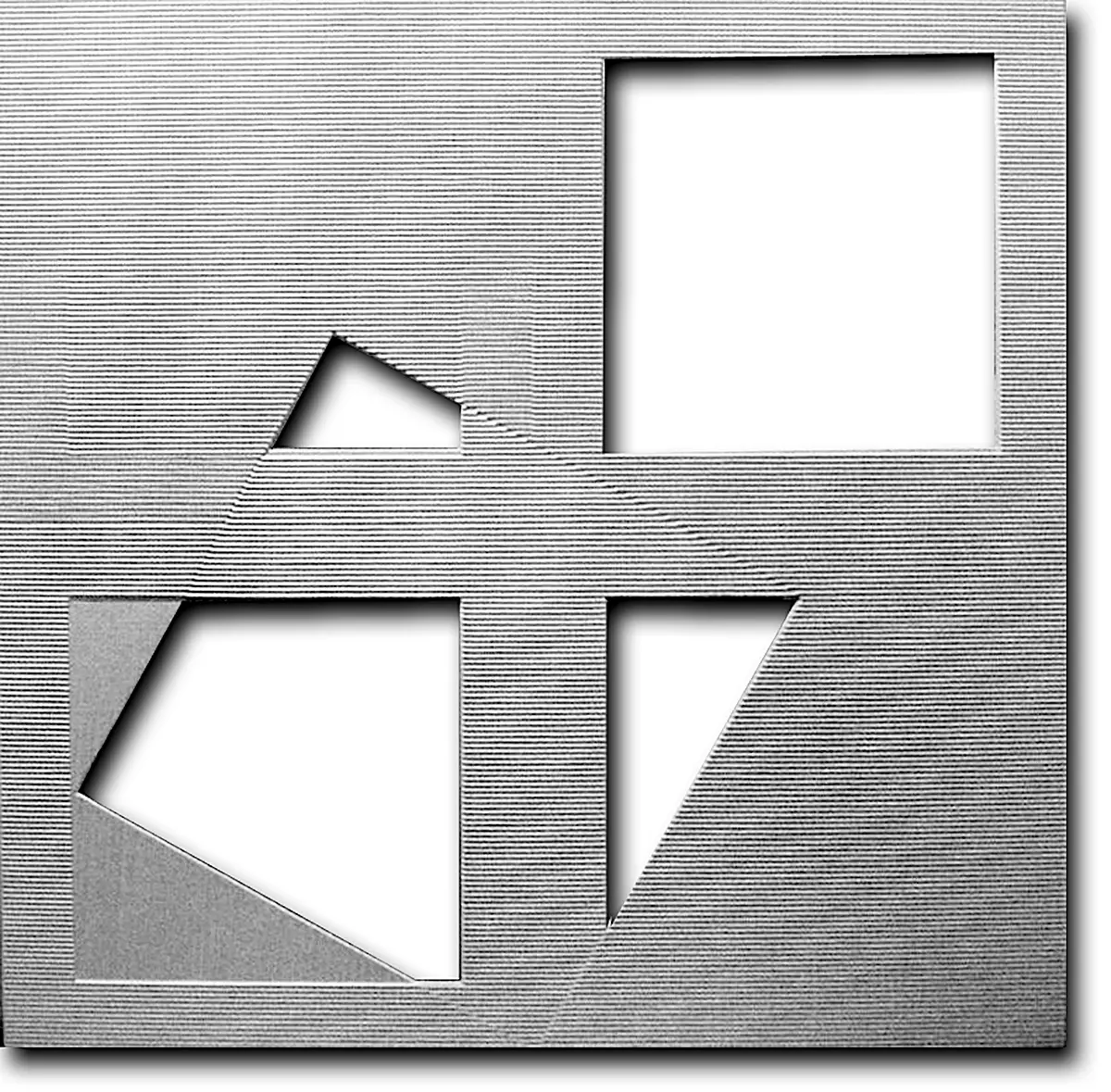
The show’s title alludes to two specific aspects of Salazar’s work: light and space. The former implies the latter. Let’s look at the process: after a brief informalist period, Salazar started to explore, in the early 1960s, optical phenomena, in works with a constructive and geometric character. By then, kinetic art was on the rise in Venezuela and Europe, and, while the exploration of movement as an optical effect in a work of art was a common concern to many artists at the time, Salazar approached it from a very personal point of view: the point of view of light. Light acts on his work in two ways: through the use of pure white as support and “argument” of the work, and through the consequences of natural light —or the artificial kind, in the exhibition space— as it acts on the pictorial surface. These two ways are in turn mutually implied: white light in relief —thanks to the use of corrugated cardboard, finely intervened— generates through light different readings and aesthetic appreciations. In turn, a change in the direction of the light source changes our view of the work, creating new compositions. Salazar’s work is, in that sense, multi-sensorial, becoming “dynamic” by means of light fluctuations, generating interesting and shifting patterns of lights and shadows, which also change as the viewer moves. The use of relief, on its part, produces a tactile quality, which we appreciate without needing to touch the work.
These light-related (and, in consequence, kinetic) qualities of the work acquire a more transcendent dimension when they involve space, breaking the support’s traditional format. As Bélgica Rodríguez notes, this is the result of “a long investigation on the behavior of filled-in space in relation to empty space.” The rupturing of the format has important implications: an extension of the work beyond its support is produced. This extension happens in the empty squares proper, but also in the environment in which the work manifests itself or is revealed. The subtle interplay of lights and shadows acquires a different value when it is extended beyond the pictorial plane and involves space in its entirety. It intervenes in the atmosphere around it. Thus the imperative need to mount each one of these works away from the wall: the shadows generate another work, or an extension of the original one, on the wall. Because of this sensorial multiplicity, Perán Erminy points out that no analytical model is fully pertinent to Salazar’s work, and that the best way to appreciate it is Zen meditation. It certainly is an art to be contemplated, in the deepest sense of the term, not any kind of contemplation but that which allows recognition of our existence in a wider dimension. This is possible thanks to the aesthetic experience provoked by works of art that appeal to maximum purity and, in a way, to silence: white.
Francisco Salazar was born in 1937 in Quiriquire, state of Monagas. He studied at the Cristóbal Rojas Visual Arts School and has as his teacher’s artists of the stature of Alejandro Otero, Ramón Vázquez Brito, Mateo Manaure and Carlos González Bogen. He had several individual shows and exhibited his work in the country’s most important halls, until his move, in 1967, to France, where he currently lives.
SUSANA BENKO