
In the history of Mexican cinema, one
figure stands out, without whom it would be impossible to understand this
country’s cinematic tradition: Gabriel Figueroa (1907–1997). An essential
reference for many directors, Figueroa has increasingly become an icon of world
cinematography. His body of work comprises artistic works beyond celluloid; his
transcendence circumvents the seventh art to ensconce itself beyond
cinematography. Was Figueroa an artist who lent his oblique perspective to
public life and set in place a succession of necessary guidelines in the
history of Mexico? Figueroa’s work spanned his lifetime, and his life was a
work of art; it was above all else a part of the history of a country torn
apart, and a reliable and loyal record of the players and landscapes that
inhabited hundreds of locations day after day, inside and outside of his movie
sets.
From February until May, the Fine Arts Palace Museum in Mexico City presented the exhibit Gabriel Figueroa, Cinematographer. Throughout an uplifting survey supported by pertinent and purposeful wall text, the exhibit recounted video screenings, editing fragments, fixed images, pictorial works, poster testimonials, and documents on the artist from Mexican and international museums. There were not only memorable scenes photographed by Figueroa (the scenes with María Felix were highlights in the very long list) but also screenings of fragments of several of his films (especially those in which his distinguished visual vigor was well utilized by Sergei Eisenstein and Luis Buñuel), and even photographs of Figueroa while he worked on his sets, many of these captured by the well-known photographers Héctor García and Rodrigo Moya. Deserving of special mention is the late U.S. filmmaker John Huston, who wrote to Figueroa, “Come spend some days with us in Puerto Vallarta.”
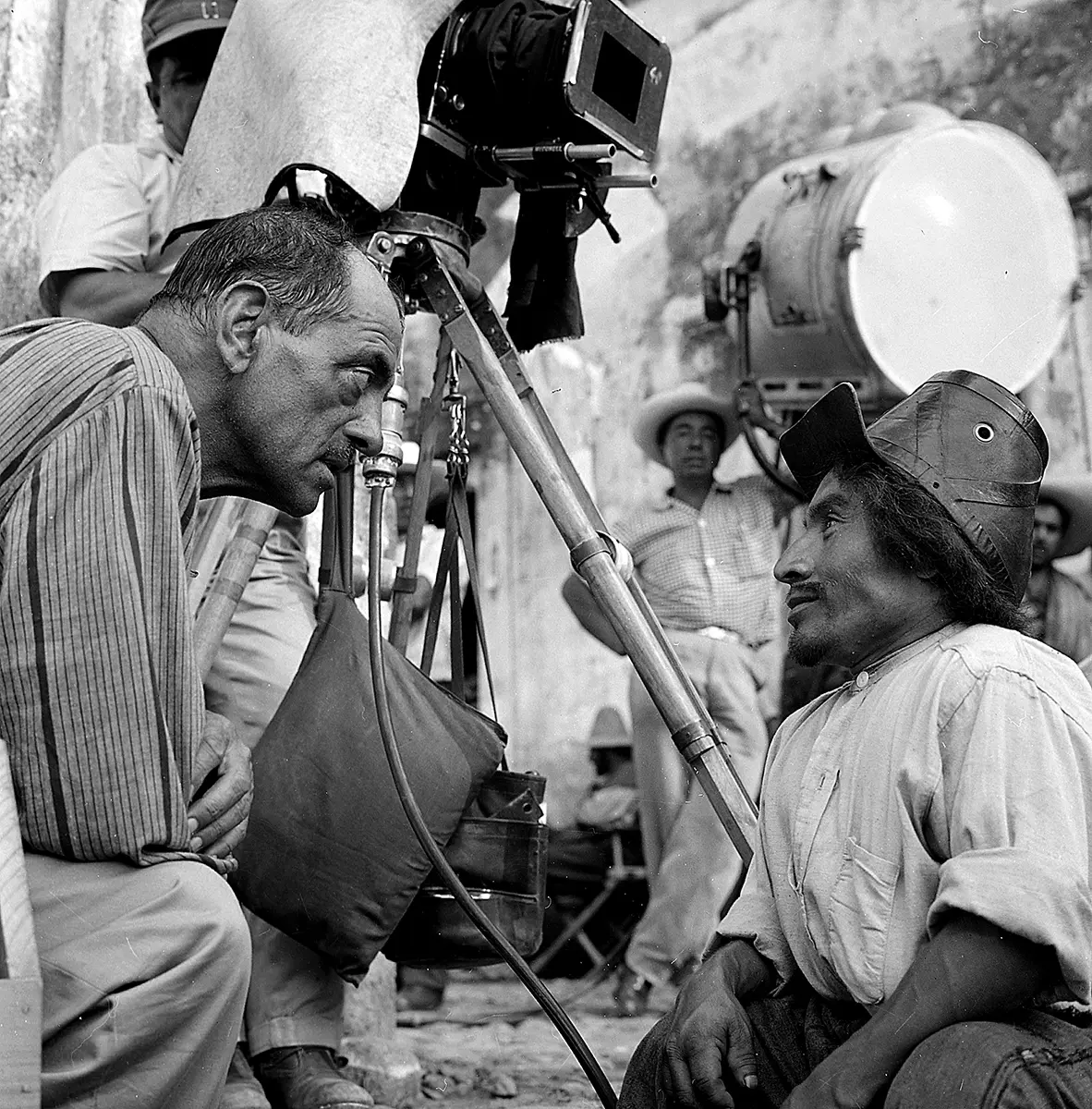
This retrospective collection of nearly 300 pieces derived from many multicolored origins and thirty digital screen projections occupied the museum’s eight galleries. The show was organized around several themes that through coincidence or conversation merged Figueroa’s iconography. One could find the cinematographer’s work on the city (Metrópolis), his collaborations with Emilio “El Indio” Fernández (El Indio), his erotic work (Amor, Amor, Amor), his gloomy and random environments (Noche), the movies he crafted with Luis Buñuel (Buñuel), or his participation in television projects (Pantalla Chica [Small Screen]). After two years of preparation for this exhibit, Alfonso Morales spoke of its urgency: “It reaffirms the importance the cinema has had in confirming the Mexican identity of the twentieth century. It also reminds us that an industry as relevant as that of the cinema must not be lost and become solely be a part of our golden years; it is necessary to have a powerful and independent national film industry that is not subordinated to external models and that is capable of building its own images.”
Independently of the curator’s recommendations, the examples of Figueroa’s work—and his persona as an intrinsic component of the creative model that appeared in several of the exhibit’s vignettes—recreated a personal aesthetic that narrated the history of Mexican cinema; but above all, it was assumed to be part of an independent representation, putting aside any pernicious nationalism. Therefore, Figueroa’s photographic work was universal, and its visual proposal was not exclusively stamped with a Mexican seal. True, it was Mexican to a great and obvious extent, but it also was imbued with an invisible third eye that moves the sensitivity of all human beings.
It is symptomatic that, in the last part of the exhibit titled Pléyade (Pleiad), there appeared still and moving images of three film adaptations of literary works. These are The Fugitive (John Ford, 1947), based on The Power and the Glory by Graham Green; The Night of the Iguana (John Huston, 1964), an adaptation of Tennessee Williams’s work, and Under the Volcano (John Huston, 1983), inspired by the Malcolm Lowry novel. These were universal works: they were shot in Mexico and photographed by a universal artist. The last picture in the exhibit (by an anonymous photographer, silver on gelatin, 1.5 x 1 meter) depicted the final scene in Under the Volcano. In this, Figueroa registered the death of Consul Geoffrey Firmin at the hand of El Farolito regulars. Viewed immediately after this picture was the letter by John Huston. In it, the director noted that the film was on the verge of becoming a masterpiece thanks to the knowledgeable, agile, and decisive eye of Figueroa. Under the Volcano was Figueroa’s final film, and the moving eye, REM with eyes wide open, ceased to turn.
CARLOS ANTONIO DE LA SIERRA