
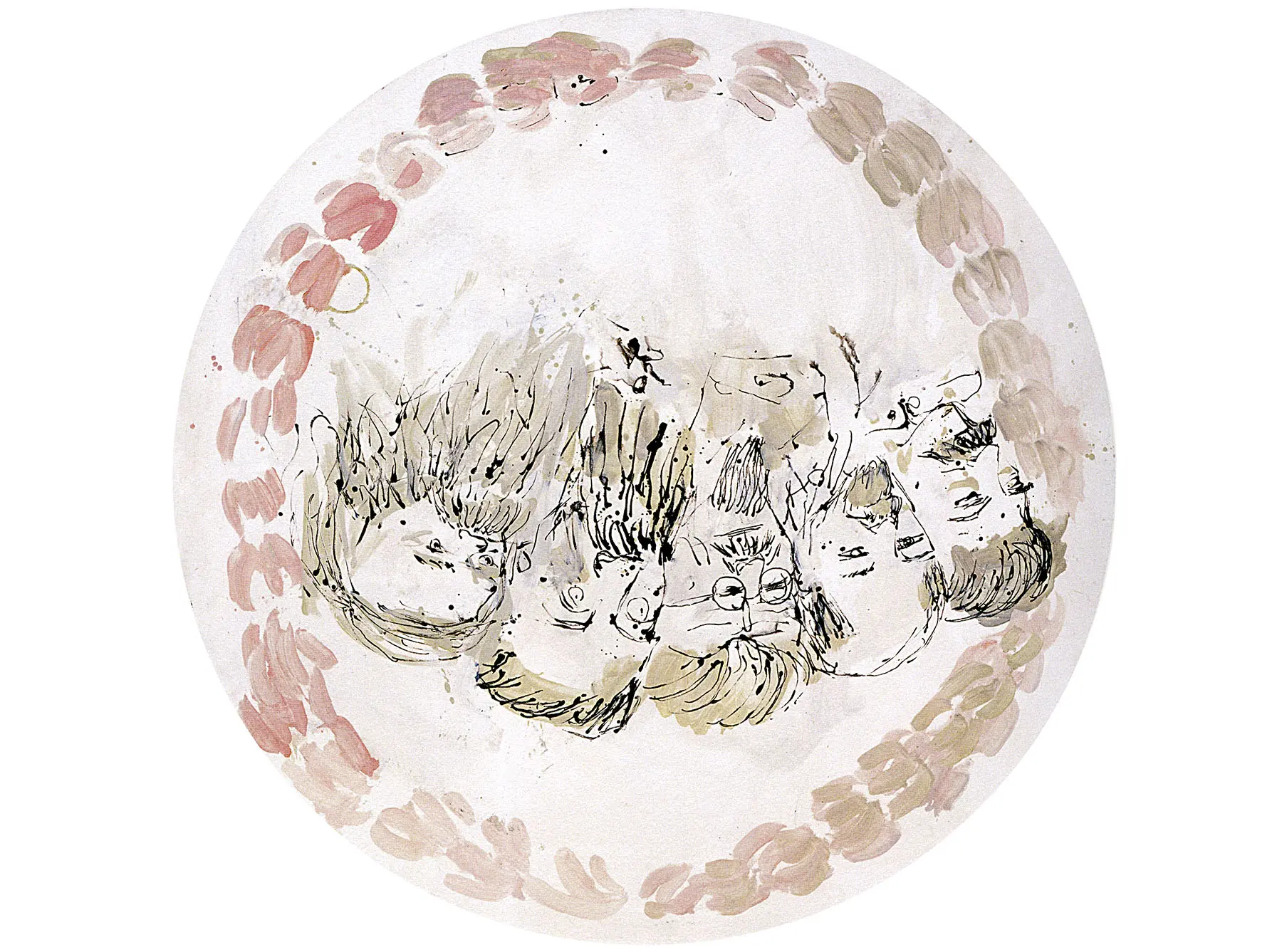
The Deichtorhallen in Hamburg recently exhibited
Baselitz’s Russian Paintings, a
series created between 1998 and 2002. Russian Paintings does not accurately
translate the original title, Russenbilder,
“images of Russian people.” Baselitz, who grew up and was educated in the
German Democratic Republic (GDR), or East Germany, used this series to settle
some accounts.
I should forewarn that I am not a Baselitz fan, that I considered the exhibit irregular at best, and that it would not merit much discussion had it featured a less fashionable artist. The sixty large pieces made a good exhibition in terms of design, but that speaks more to the credit of the wonderful space and the paintings’ arrangement than to the work itself. Regardless, the show raised issues worth discussing: the use of art as a tool for personal therapy; the definition of Baselitz not as an artist but as a painter; and the possibilities of art as a vehicle for national identity.
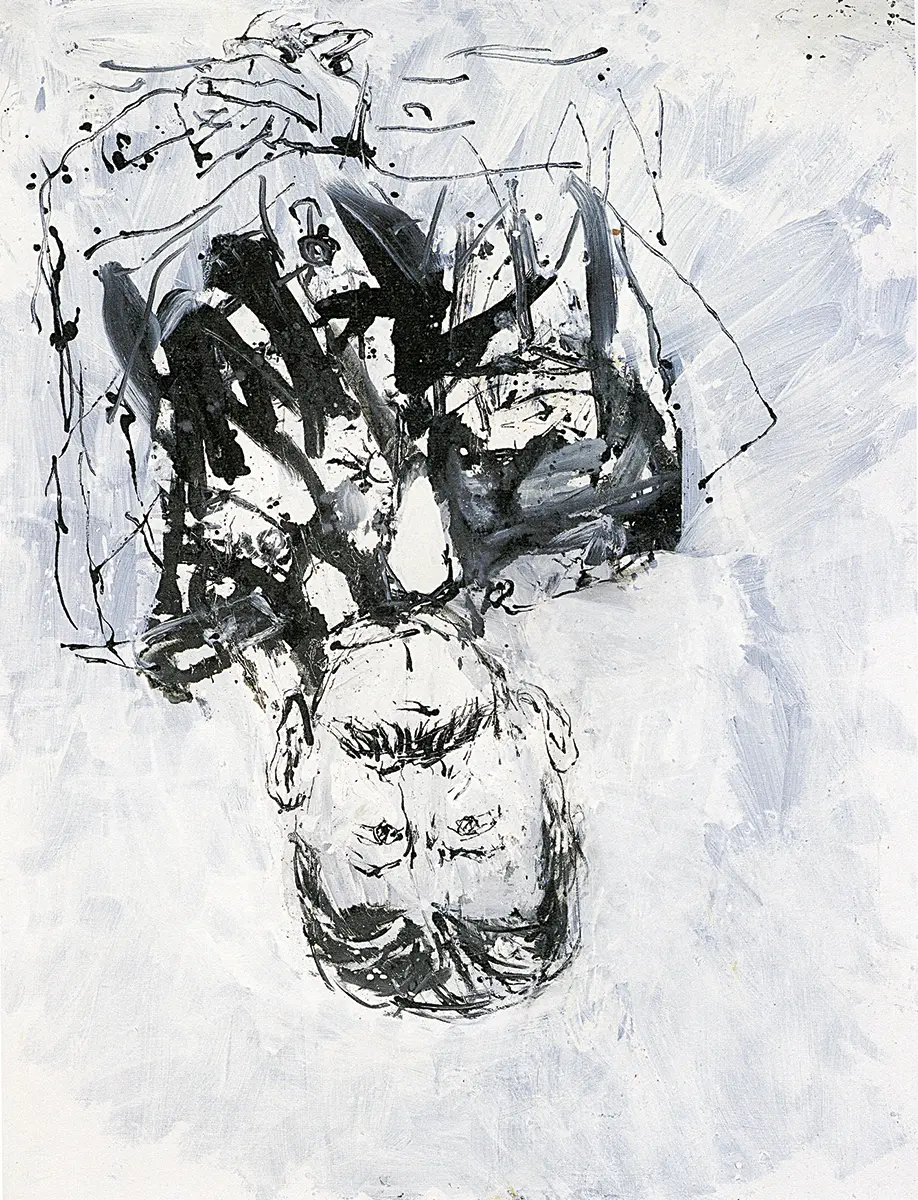
Baselitz is one of the Neo-Expressionist artists are seen as an enfant terrible. Over the years, his paintings depicted taboos ranging from masturbation and excrement to allusions to Hitler; during the early sixties, some were considered sufficiently offensive to be removed from his exhibitions. And this censorship did not occur in Stalinist East Germany, but in the open-minded West, where Baselitz had settled in 1958. Baselitz considered the trend toward abstraction in Western Germany bland and tried to challenge it with content and “crude” painting. Probably unknowingly, he embraced Latin American neo-figurative devices that were already well in place. His process, highly dependent on the work of Edvard Munch and the German Expressionists of the early twentieth century culminated in his “upside-down” paintings, which have been his trademark since 1969. Baselitz is therefore considered the angry painter who deconstructs what viewers tend to expect from the craft. He speaks of his continual search for “disharmony,” and painting upside down is a way of creating a critical distance from what he is doing.1
Yet, overtime, this device hardly can be called disharmonious. Instead, the viewer associates it with the artist and accepts it as the opposite, as a form of harmony that allows abstraction and content to coexist peacefully. The effects of aggression and catching the viewer off-guard are dulled or canceled; what remains are Baselitz’s decent skills as a painter. His brushstrokes can be rich and powerful and his colors can lead the eye over large surfaces.
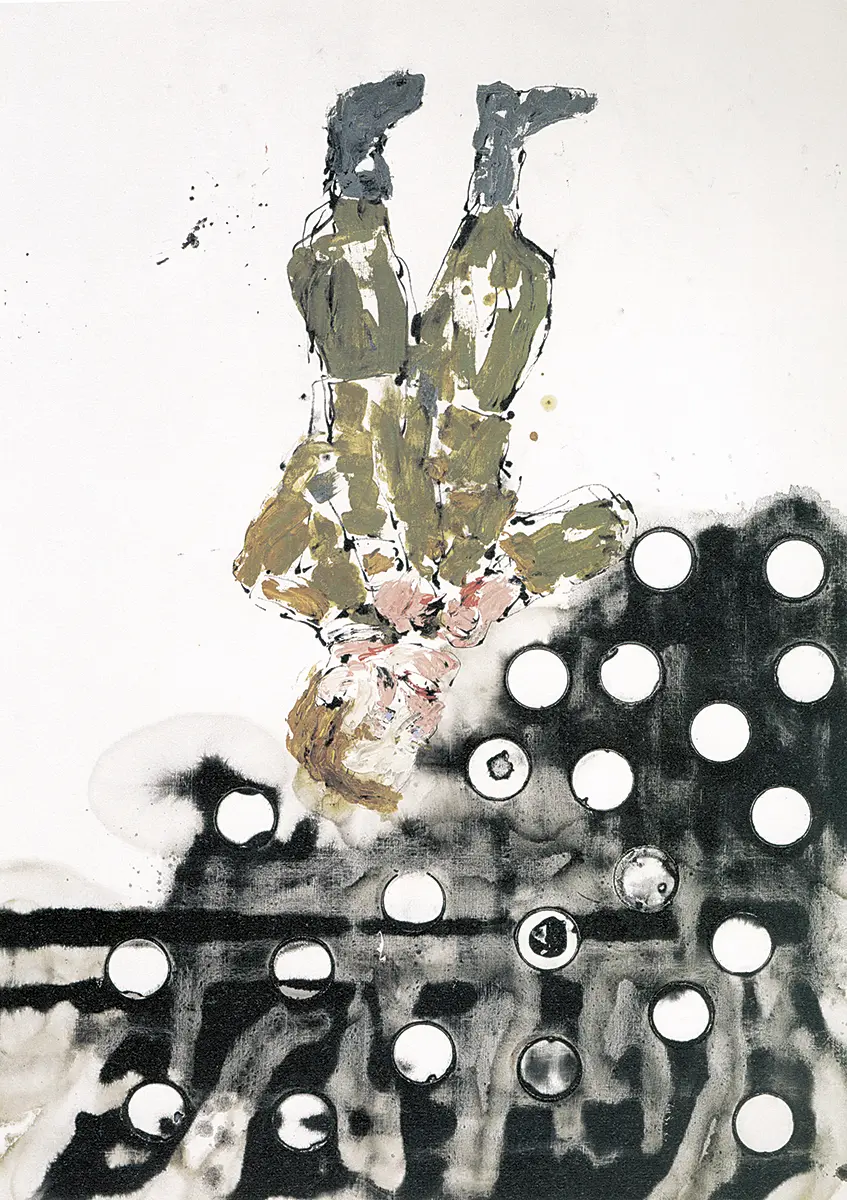
In this exhibition, that richness was mostly absent, supplanted by a watercolor-like quality occasionally punctuated with isolated and heavy strokes of paint. The orientations of the figures varied and were sometimes set at forty-five- and ninety-degree angles. Aggression, if one could call it that, was introduced by arbitrary formal elements like white circles, appearing singly or in patterns, which disturbed the content but ultimately created pleasant surfaces. The weakest pieces featured an unchallenging, stereotypical, and simplistic way of drawing that reduced any possible impact. These works were more illustrative and resembled clumsy interpretations of Ben Shan's illustrations more than reflections of either anger or analysis. Images of Stalin were acknowledged as based on some sympathetic drawings Picasso had made in 1953, but they seemed to be employed only to ensure recognition.
Baselitz grew up in highly regimented social and artistic environments. In his life, Soviet imagery provided the icons. Art encompassed the Soviet defeat of the Nazis, Soviet heroes and accomplishments, and Soviet Socialist Realism. In 1957, Baselitz applied to the Art Academy of Dresden and was rejected. It is safe to assume that he presented a non-rebellious portfolio that roughly fit academic expectations. Subsequently, he went to a school in East Berlin where he was expelled after one term because of his “socio-political immaturity.” He continued to study in West Berlin, and once the Wall was erected, he remained in the West. In 1961, he changed his original name, Hans-Georg Kern, to Georg Baselitz. Together with A.R. Penck, Sigmar Polke, Gerhard Richter, and others, he was considered an escapee by the GDR. In 1977, Baselitz had withdrawn from Documenta VI (along with Gerhard Richter) in protest against the inclusion of GDR artists. On the occasion of a 1979 exhibit of the work of two East German luminaries (Willie Sitte and Wolfgang Mattheuer) at the Neue Gallerie in Aachen and sponsored by the collector Peter Ludwig, both Penck’s and Baselitz’s works were temporarily removed under pressure from the GDR.2 In 1992, a couple of years after the unification of West and East Germany, the two art academies of Berlin were fused into one institution. Baselitz, who was teaching in the Western part, resigned in protest.
In light of this history, it is not surprising that Baselitz feels resentment and vents it in his paintings. The question is how helpful this is for his work. Art has an unavoidable therapeutic component and all artists take nourishment from their biography. But how much of that biography is of interest to the public? The great challenge when one faces one’s life and uses it to generate work is to transcend those events in order to make them relevant and useful for the viewer. Otherwise, the work remains on the level of a monologue, barely listened to by the one who utters it and only useful for releasing steam.
Paradoxically, the Russian Paintings are tamer and possibly more cerebral than other works by Baselitz. It is interesting that the essayists in the catalog don’t reach a consensus. Lóránd Hegyi writes that in the Russian Paintings there is also “the problematic of self-recognition by the painter, of submerging in himself, to question within the depth of personal, mental and cultural origin.” He adds: “The Russian Paintings surprise us with their direct, personally addressing, subversive, simultaneously melancholic and interrogative painterly agility.”3 Robert Fleck, Director of the Deichtorhallen and the curator of the exhibition at that location, states that Baselitz produces a new type of historical painting: taking actual paintings of the Soviet era with their standard historical references and reworking them to incorporate a personal perspective, so that the result is a body of work about identity. According to Fleck, this elucidation leads to new painterly freedom and resonance, “where the nearness of the content to late-nineteenth- and early-twentieth-century Russian literature gives the title of the series, The Russian Paintings, the character of homage.” 4
There is no reason that two different readings of Baselitz’s work cannot be applied to the same work. Fleck’s interpretation suggests the possibility of transcendence beyond therapy. In certain ways, however, the paintings seem conflicted and unresolved. One reason maybe the fact that Baselitz self-identifies as a painter and not as an artist. He is quoted as saying: “A painter is a painter. I only see paintings... I have to paint paintings. I have to be alive.”5 The works that seem more successful are precisely those that show some planning and go beyond mere painting, those that possess an intentional ambiguity.
Baselitz seems to need to establish some distance between the subject and himself to produce his work well. The departure from gravity is one technique for this process, although it is gimmicky in repetition. The use of a chainsaw for his sculptures (which were much more powerful than the paintings exhibited in this show) is another. Yet Baselitz’s general attachment to craft, his trust that the medium will solve all of his problems, seems to be a trap from which he is unable to escape. When in the 1960s Marshall McLuhan proclaimed, “The medium is the message,” we all applauded the great insight embedded in the catchy phrase. Looking back, however, the statement seems more like a glorification of artisanship. At the time, it helped us to understand the broader implications of how things are done but, in hindsight, it crowned the old tradition that is imprisoning Baselitz instead of opening new pathways. Upon seeing his exhibitions, one can say that Baselitz is no Velázquez.
If disharmony is a meaningful goal, “just painting” is not the best way to achieve it. By pursuing it the way he does, Baselitz is following a tradition of angry-and-cursed painters that was extinguished with the death of Francis Bacon. Lucian Freud, much closer to being a Velázquez than Baselitz, employs painting without giving the feeling of being limited by it and vents his anger while remaining a master of it. The same can be said about De Kooning’s work (which is admired by Baselitz). Both artists accept that there is no disharmony, only new harmonies, and thus neither Freud nor De Kooning has room for gimmicks.
Fleck’s comment about the reinterpretation of historical paintings as paintings of identity is intriguing. Fleck also tries to extricate Baselitz from the German Expressionist tradition and connect him with Abstract Expressionism. According to him, this stresses the predominance of space over deformation; with it, Baselitz’s work is somewhat de-romanticized. 6
In 1953, when Baselitz was fifteen years old, an exhibition of Soviet Socialist Realist art circulated in the GDR. In the introduction to the exhibition’s catalog, Otto Grotewohl, then the Prime Minister, wrote: “[The show] raises as much the question of the unity of subject matter and content of ideas as it offers the design of progressive content and moving contemporary themes, informs both creative and appropriate to our times. It contributes the recognition of a solution fitting for our own national art.”7 The statement was an endorsement of Soviet Socialist Realism as the aesthetic to follow in the German Democratic Republic. It is not clear, nor does it matter, whether Baselitz saw the exhibition or if he read the catalog. What is relevant to understanding his work is that this was the artistic atmosphere in which he was educated and which determined his rebellion and the direction of his development as an artist.
It is interesting to note that Grotewohl’s statement doesn’t sound so bad if one takes it on its face, without knowing that it refers to Socialist Realism and that what it embraces is an imported ready-made aesthetic. This is exactly what all empires do to art production in their colonies, and it continues today in the push for a global market aesthetic.
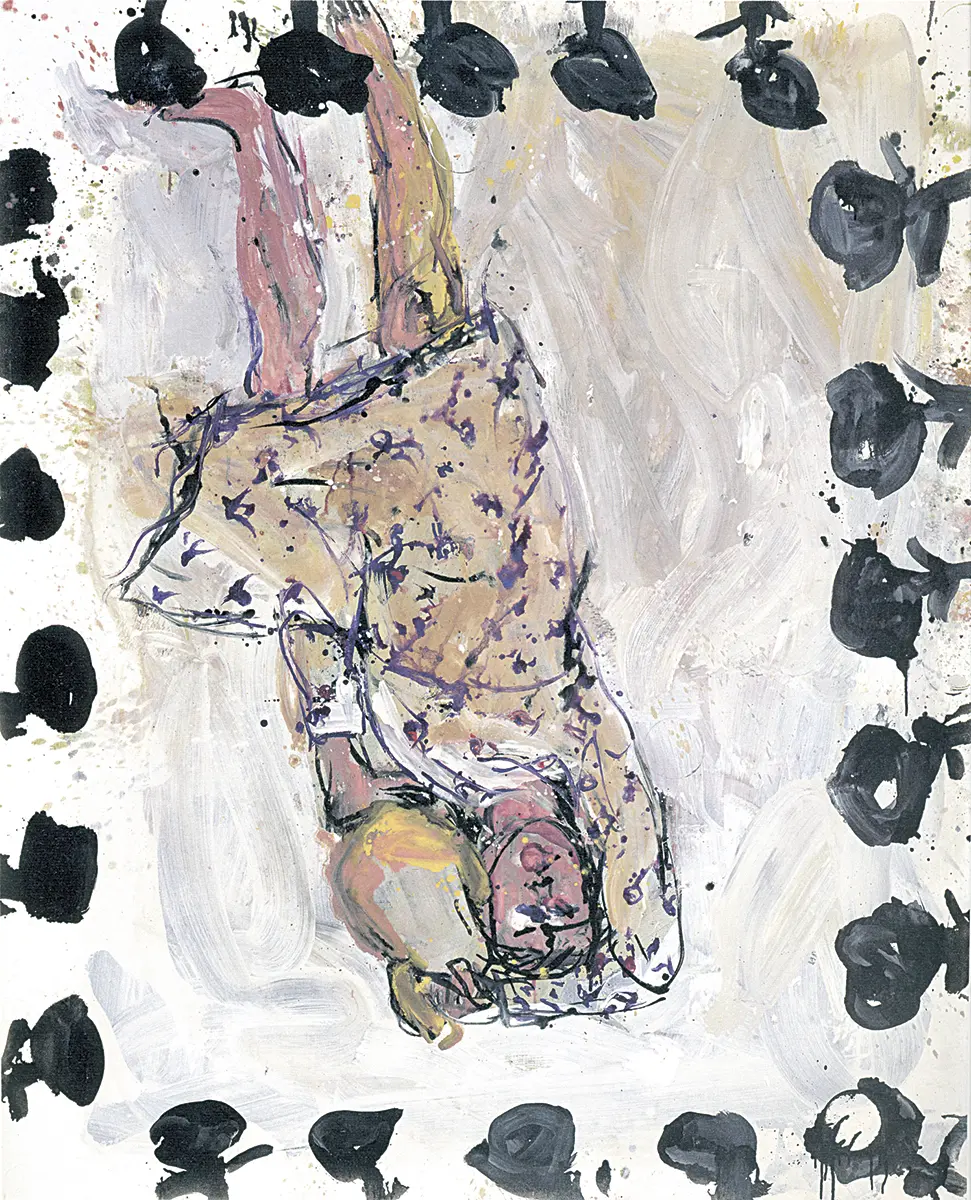
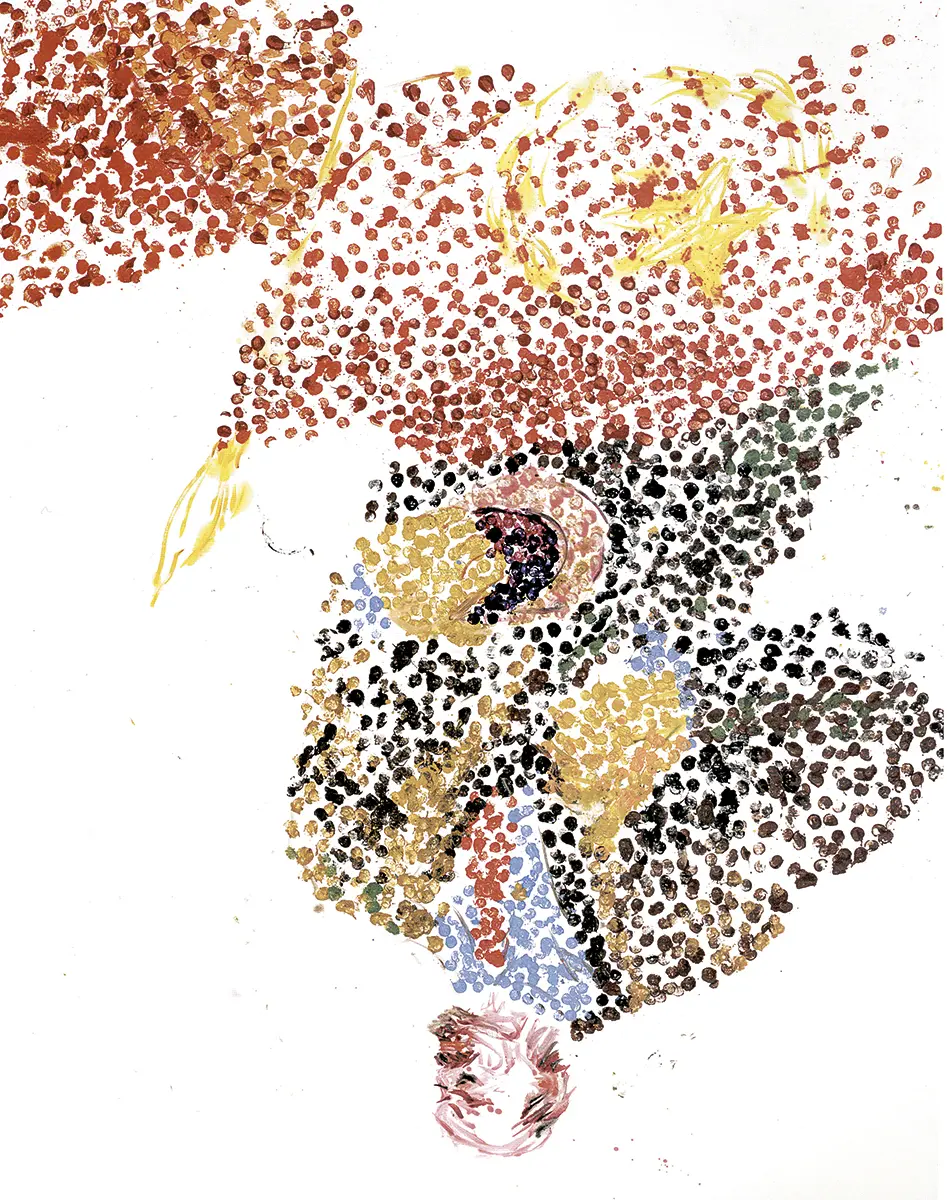
In his Russian series, Baselitz certainly distanced himself from Soviet aesthetics, not just by using his own style but also by exploring a weirdly pointillist effect. The pointillist pieces were unexpected and disconcerting, and, as a consequence, more interesting than the others in this exhibition. At first glance, they seemed clumsy and easy, but after a while, they grew on the viewer. Pointillism here fulfilled the same function in his work as the painting of images upside down (a device he also adhered to in these works). This approach helps Baselitz to create distance between himself and the subject matter and, in theory, allows him to focus on pure painting. However, although they had clues to historical referents (Lenin can be seen, for example), these particular works appeared to be more concerned with killing the narrative of the originals than with an in-depth exploration of the act of painting. They could be seen as post-conceptualist works and, as such, as examples of risk-taking in the trajectory of his oeuvre.
On the other hand, Baselitz, even if not intentionally, seems to endorse Grotewohl’s interest in national art. His references are to a local aesthetic, to Grünewald’s darkness and Cranach’s rejection of physical beauty rather than to Botticelli’s idealization of the human body.8 In the Venice Biennial of 1980, Baselitz’s sculpture of a figure raising an arm in a Nazi salute stirred controversy. It was not helpful to the work that it was shown in the same pavilion as the Wagnerian works of Anselm Kiefer. At the time, it seemed as though Germany was breaking away from globalist aesthetics and going it alone.9 This heretical defiance, along with the ambiguity of the symbols, ensured a scandal since these referents of German national history were supposed to have been deleted after the end of the Second World War.
That storm passed, proving only that, ultimately, national identity in art is not something that can be programmed. That goal failed both in Nazi Germany and in the Soviet Union. It failed, also, when Grotewohl tried to import aesthetic solutions, and it failed at the German Pavilion in Venice (assuming the curators had that intention, which isn’t entirely clear). The works of Kiefer and Baselitz were not examples of German national art but were merely autobiographical footnotes to history. They were part of a national identity insofar as autobiography always falls within a broader cultural history.
Baselitz (with some of his colleagues) was instrumental in not accepting hegemonic aesthetics as the only viable form of art. He added to his personal experience a cocktail of painting devices taken from a German tradition stretching from Mathias Grünewald to Max Liebermann, Edvard Munch, Ernst Ludwig Kirchner, and Emil Nolde. With this combination, he created a distinctive platform separate from and in contrast to the aesthetic concerns informing the rest of Western art production. Baselitz grew up within a Nazi family, was educated under a Stalinist regime, was exiled from one half of Germany, and migrated to the other. It isn’t yet clear if Baselitz’s struggle to come to terms with the questions raised by these anguished experiences has resulted in a honing of the German aesthetic tradition. In the meantime, one is left with the feeling that the Russian Paintings show the limitations of autobiography as a vehicle for rewriting a history that is much larger than the artist.
NOTES
1. His paintings supposedly are not turned around after they are done but painted in an upside-down position.
2. www.kunstverein-muenchen.de
3. Italics in the original. Lóránd Hegyi, “Baselitz: Russenbilder, Von alten Bildgeschichten zu neuen Bildidentitäten” in Georg Baselitz Russenbilder (2007), p. 6. Published on the occasion of the exhibition at Musée d’art de Saint Etienne Métropole, 2/9/07–4/22/07; National Museum of Contemporary Art, Seoul, Korea, 5/11/07–7/15/07; and Deichtorhallen Hamburg, 11/16/07–2/3/08.
4. Robert Fleck, “George Baselitz’s Russenbilder,” in Georg Baselitz Russenbilder, p. 127.
5. Hegyi, p. 8.
6. Fleck, p. 127.
7. Fleck, p. 122.
8. Interviews with Uta Baier, Die Welt, 03/01/05, and with Mathias Schatz, Bloomberg.net, 09/24/07.
9. Luis Camnitzer, “Bienal de Venecia 1980,” Arte en Colombia, nº 14 (March 1981).
LUIS CAMNITZER
Uruguayan artist. Emeritus professor at SUNY College, Old Westbury.