
If Capitalism has achieved one thing, it is
the dissolution not only of the relevance of materials but of a symbolic order
that gave objects a definite identification. At the same speed at which the
media is capable of transforming yesterday’s event in history, the boundless
production of capitalist excess is able to create an absolute dynamic of
obsolescence. Mounds of refuse, piles of detritus, junkyards, old computers,
became the residue of the consumerist landscape in a continuous process. Just
like the impulse of necessity and innovation seems to be recreated every
second, the leveling out of this inert epic will require slow
millennium-long processes.
In its inanimate appearance, waste has become what Slavoj Zizek calls “Capitalism’s impulse at rest”; instead of becoming a prompt to reflection, it fades from our thoughts instantly, by switching the object for the desired substitute. If for Baudelaire —who demanded the advent of poetry for modern life— the mythical landscape for this poetry was by force the city, the great Nineteenth Century urban center with its anonymous masses, alleyways, and penury, for today’s citizen the romantic line of the urban horizon is a chain of garbage that hides and rises inside and outside of the city itself.
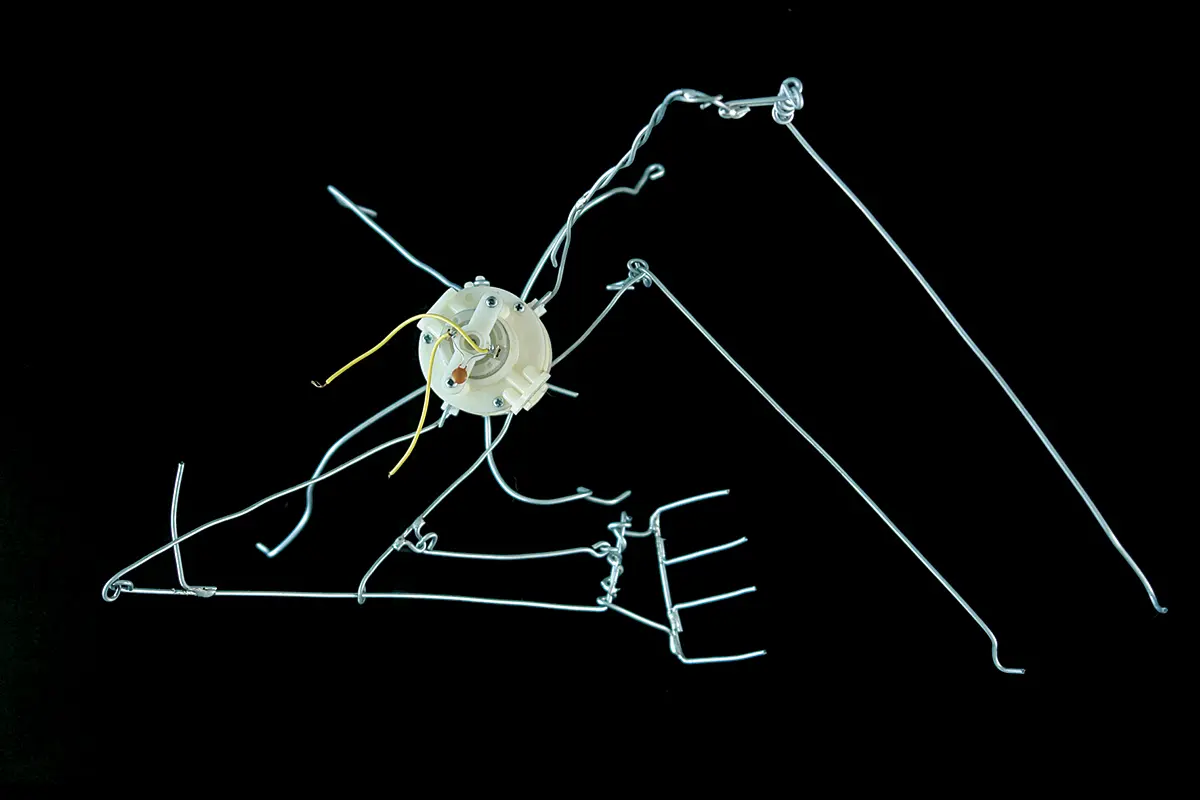
But new forms of life can also emerge from this lifeless environment; the ppndr-s are an example of that. Cybernetic animals that invaded Garash Gallery in Mexico City for several weeks, on the occasion of a show by Gilberto Esparza Aguascalientes (Mexico, 1975,) these technological organisms are a new fauna introduced into the urban context, born from the city’s own waste. The offspring of garbage, these “electrical wiropods” remove and disperse dirt like an endemic virus. In the exhibition space we saw these creatures in action, while at the same time a video was shown of the futuristic insects installing themselves in the city, under the gaze of astonished passers-by.
Those who know Mexico City will have no problem recognizing those piles of garbage that rise after sundown in the streets of the city’s historic center, accumulated by hundreds of street sweepers. On a second pass, a squadron of human recyclers (“pepenadores”) separate it in search of salvageable materials.
Esparza’s ppndr-s, however, have as their mission to continue with the chaos of waste, feeding on our consumerist impulses. They become organic beings that herald the power of nature over industrial civilization. But this cloned nature has very little to do with the harmonious notion of the lost paradise but corresponds to nature in a state of decomposition.
Gilberto Esparza received the Vida 9. Incentive Award for New Productions from the Telefónica Foundation in support of bestiary project, a careful encyclopedia of incredible beings of which the ppndr-s exhibited at Garash are only one part; as in many of his works that use technology to create different artificial lifeforms, Esparza makes his characters part of a real story in order to integrate them into the city’s imagination, as if they were part of an evolutionary process in the era of mass waste.
In his website, www.parasitosurbanos.org, the artist lists and classifies an entire series of electronic parasites: the mrñ belongs to the helmintos family, their bodies formed by cables and fragments of acrylic. It lives near sources of light in order to feed on electricity. The mosca is a kind of elipter that also feeds on power terminals. Each mosca has a small motor and a helix, taken from cell phones. The dbld (small devil) is an ecatropod that lives in the city’s electrical grid and feeds on the energy that flows through the cables. Individuals from this species hoard sound from their environment and reproduce them according to their mood. The clgd is the missing link in the chain of poleapod helmintos. Its body is formed by a number of articulated, discarded PVC tubes, which animate this shapeless parasite.
The ppndr-s or any of Esparza’s “creatures” could be the protagonist of a postapocalyptic film. As in Tarkovsky’s Stalker or Luc Besson’s debut film The Final Battle, the world has been overtaken by wild beings, who is none other than the remainders of a destroyed human civilization. The landscapes are those of giant deserts, or flooded rivers covering the ruins of a civilization exhausted by its own surplus. But Gilberto Esparza’s ppndr-s are not part of a natural world that simply takes over the space of garbage and covers it with its omnipotent mantle. It is an entire new fauna that emerges, precisely, from that waste, transforming its obsolescence in activity, removing and dispersing it in a future wasteland.
RUTH ESTÉVEZ