
The Argentine photographer Graciela Sacco
is known for her innovative way of combining technology and photography, and
especially for her experiments with affixing images on unusual surfaces. Her
most recent exhibition, Historias del m2: espacio mínimo vital was
at Diana Lowenstein Fine Arts, and, living up to expectations, she once more
offered a different perspective on the use of photography. The show had eleven
works, including a video installation and two videos.
To produce these images, Sacco placed a camera under a translucent staircase in an area of heavy traffic and recorded thousands of people walking on it. This project was monitored from a remote station, from where the artist would control the editing. Her voyeurism from a distance was consistent with current techniques of observation: an anonymous spectator whose mission was to record the passage of people on their daily march. They became a number, just an abstract mass to give the idea of the individual versus the group—how the first is embodied by the second and disappears in that context. Sacco compared the social space versus the individual space: where it begins and where it ends, when one is in individual space, and when one has crossed it to become part of a moving mass. The relativity of individuality is constantly challenged by society.
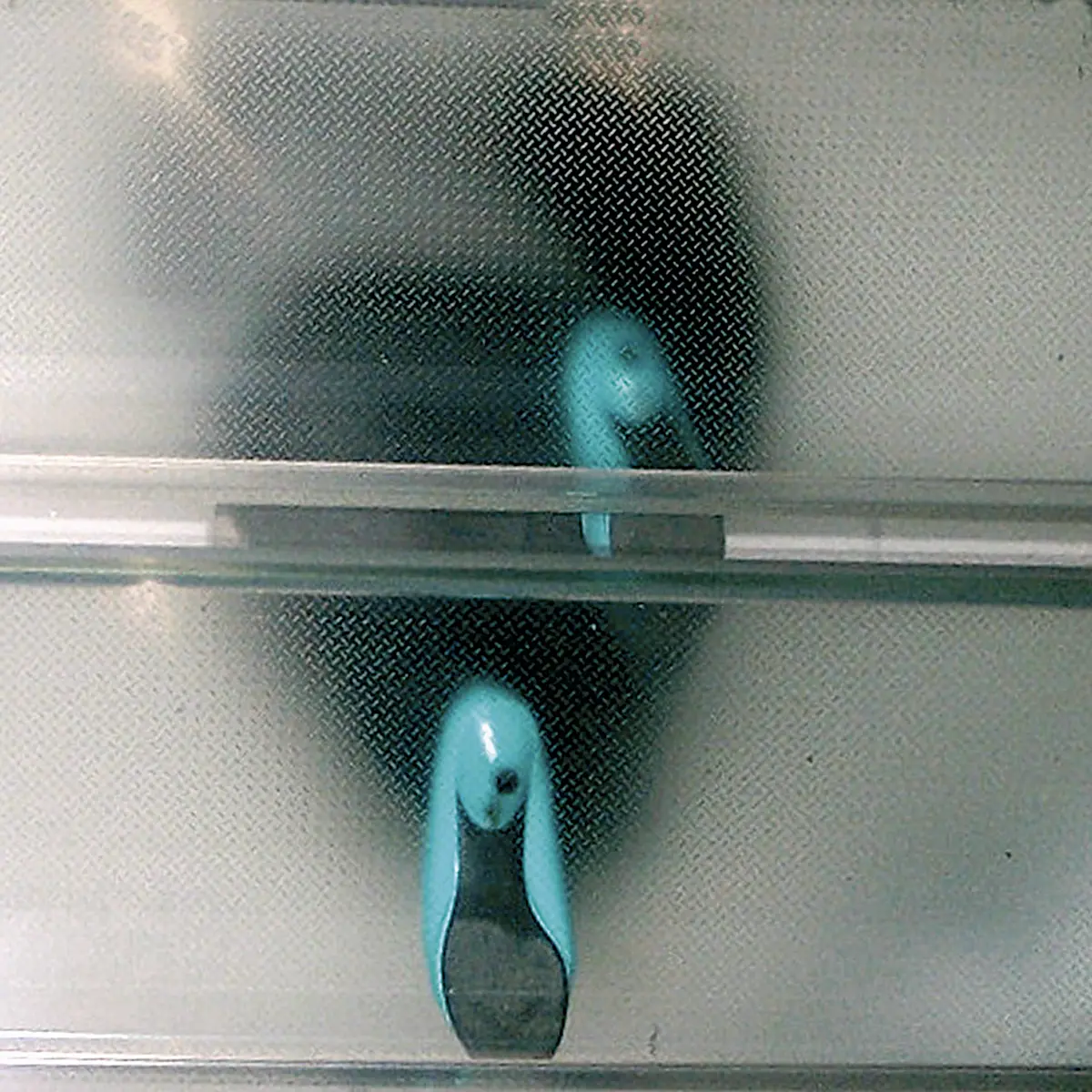
The resulting images, especially the videos, created the effect of people walking over the viewer. The physical act of crossing from one point to another was extended to the connection between different persons. Deliberately not showing any other part of the bodies, Sacco used the images of the “walking shoes” to imply movement in a general sense. Her idea was to address the sense of nomadic life that has permeated contemporary society, in which increasing numbers of the population do not live in the places where they were born. The metaphor of the man in transit was extended from the physical action of movement to the philosophical act of living, of literally passing through the earth.
Most of the images were sepia-colored, creating an atmosphere of uniformity, a certain intimacy, and distance at the same time. Only two works used color: Zapatos Turquesa, a photograph on aluminum, and Pies en colores, on Plexiglas. In both, Sacco manipulated and applied color only to the shoes, accentuating their perception as the symbols of movement par excellence. This was not the first time the artist used the shoe element in her work. Previously, in her series Sombras del Sur y Norte, she used shoes as the surface on which the photos were printed with the heliography technique. Here, she portrayed the shoes in a different way, via images of the people using them, walking in the city, and making them living entities. The shadows suggested the idea of the subject but just a hint, a profile, enough to leave the images open to imagination: one could construct or think about the stories of these people from a safe distance. This is what Sacco accomplished by recording these images from her anonymous position.
The technical requirements of Sacco’s work are often challenging for the gallery display and for the collector. Nevertheless, it is this same quality that makes it unique. Sacco is always experimenting, pushing to the limit, and finding something new. This is an important part of the process in her work, which ultimately defines the end result. Here, she played with the transparency of the Plexiglas surface of several of the images in the exhibition, which mimicked the clear staircases under which she filmed the videos. Even from the photographs, one still had the impression of being under the staircase, looking up as people walked over one’s head.
By projecting images of shoes moving in both directions, Sacco alluded to the forceful movements that plague contemporary life. People move from one city to another, from one continent to a different one. Language is no longer a barrier and globalization has become a reality not only in economic terms but in the social arena as well.
IRINA LEYVA