
On a recent Saturday afternoon, hordes of
people lined up at the Philadelphia Museum of Art to see the Frida Kahlo (1907–1954)
retrospective commemorating the centennial of her birth. Eager to see the works
by this celebrated Mexican cult figure, the crowds missed a small jewel-like
exhibition, just a few galleries away, of work by Juan Soriano (1920–2006),
Kahlo’s friend and contemporary. Fragile Demon: Juan Soriano in Mexico,
1935–1950 at the Philadelphia Museum of Art was
guest-curated by Edward J. Sullivan, a dean of the humanities and professor of
fine arts at New York University. The exhibition focused on the fifteen-year
period that Soriano spent in Mexico City and featured only sixteen works by the
artist. Four of them belong to the Philadelphia Museum of Art collection, the
only U.S. museum housing a substantial number of his works.
Although Soriano is recognized in Mexico as one of its best modernist artists, his art is almost unknown outside of his native country. His works—portraits of friends and family, images of children, still lifes, and landscapes—offer a distinctive variation on the themes and artistic styles of his contemporaries. Soriano knew he was going to be a painter when he was eight years old. Encouraged by one of his four sisters, he enrolled in art classes and participated in his first show at age fourteen. He became a very important figure in the 1930s and 1940s in Mexico City.
When Soriano moved to Mexico City from his native Guadalajara in 1935, he befriended Diego Rivera, Frida Kahlo, José Clemente Orozco, and David Alfaro Siqueiros, among others. However, he rejected the social agenda of the Mexican Muralists. Soriano described Muralism as dogmatic. He did form a lasting relationship with the writer and future Nobel prizewinner Octavio Paz, who wrote in 1941 an essay on Soriano describing him “as a boy dressed like a man,” emphasizing Soriano’s fragile persona.
Like Frida Kahlo, he rejected the label of Surrealist. Kahlo based her work on the harsh reality of her life (the bus accident that led her to undergo thirty-five surgeries and several miscarriages; her frequently unhappy marriage to Diego Rivera), and therefore it was not the dream-oriented exploration prescribed by the Surrealist leader Andre Breton. For Soriano, Surrealism was an international enterprise, and he did not want to be confined to its tenets. Like Kahlo, Soriano drew upon his deep interest in colonial, popular, and indigenous arts, as well as nineteenth-century still lifes and portraits.
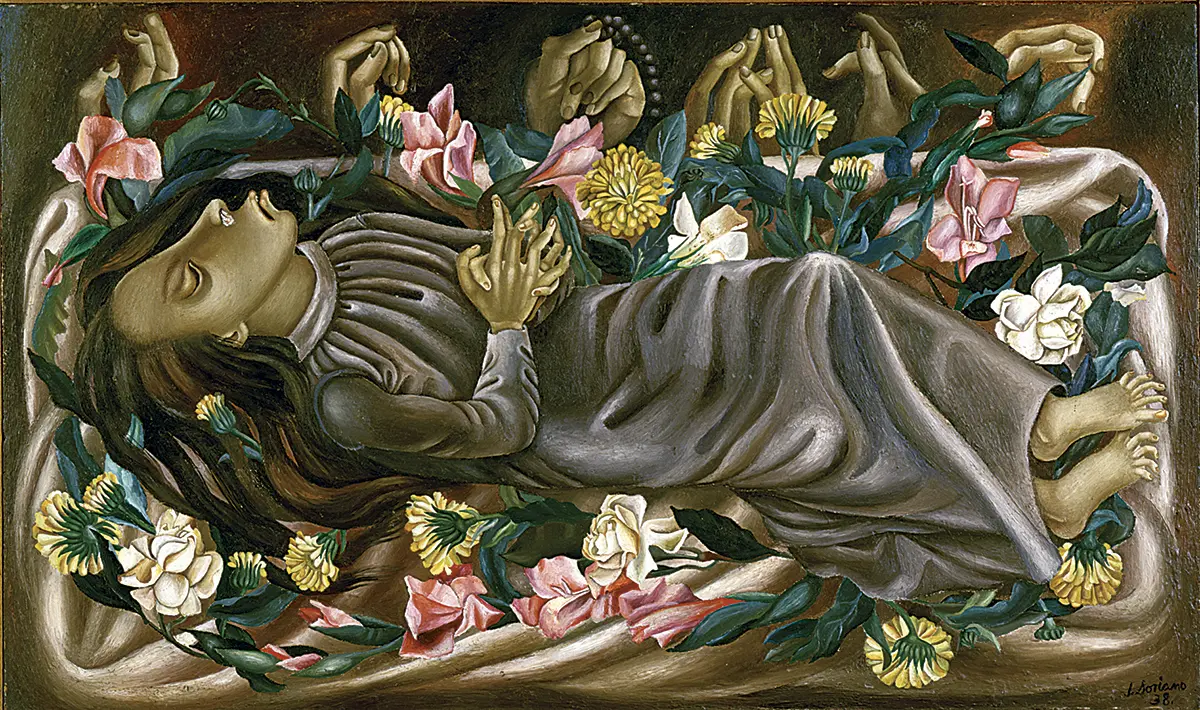
Soriano’s most famous work, Dead Girl (1938) from the collection of the Philadelphia Art Museum, shows the artist’s poetic and enigmatic style. The young girl lies on a bed covered with a simple white cloth. The brown dress on her dead body is far removed from the white gown in which deceased children are usually depicted. She is surrounded by flowers, and her body appears elongated and distorted. Disembodied hands appear at the upper register of the picture, suggesting mourners’ hands praying for the dead girl’s soul. It looks like a Surrealist vision of the dead child, and it maintains a sense of the unreal, like many of Soriano’s works.
The most striking painting in the exhibition was Saint Jerome (1942), from the Fundación Juan Soriano y Marek Keller, in Mexico City. Here, Saint Jerome, the translator of the Latin bible, is seen as a young, naked, and handsome male—the object of homoerotic desire—instead of his usual depiction as a hermit saint meditating in a cave near a lion. The model for this painting was Soriano’s lover at the time, the Spanish émigré author and socialite Diego de Mesa.
Child with Bird (1941), a gouache from the collection of the Museum of Modern Art, New York, was another disconcerting yet welcome surprise in the exhibition. It perversely shows a semi-naked young boy, wearing only a red conical hood and a sleeveless jacket while standing in front of a white sheet. The boy displays a naughty smile and holds a bird in front of his penis.
The Soriano exhibition was placed next to the Philadelphia Museum’s permanent galleries dedicated to Marcel Duchamp and Constantin Brancusi. It was also close to the new temporary installation by the Mexican contemporary artist Carlos Amorales (born in 1970). Amorales’s installation displayed a range of different mediums such as drawing, animation, and performance. As in Soriano’s paintings and drawings, Amorales’s work is inhabited by shadows of humans, birds, animals, and insects, presenting a personal view of the world in which familiar images and objects invoke anxiety and fear. In a way, although separated by fifty years, both Mexican artists dealt with their own surreal vision, creating a rewarding experience for the visitor who saw their works displayed side by side.
CLAUDIA CALIRMAN