
The exhibition of Kcho’s works at
Marlborough was a comprehensive survey of his artistic output: Paintings,
drawings and sculpture were competing for attention, throughout Marlborough’s
expansive Chelsea space.
The exhibition also included installations, which integrated the architecture of the gallery space. Círculo vicioso (Vicious Cycle) for example, consists of a series of toy boats forming a circle on the floor where they are placed, and this is how they are portrayed in the catalog, but at the exhibit, the pieces were set around a huge white column, which stressed the smallness of the vessels in comparison to their great height. It also emphasized the displacement and sense of individual isolation when confronting a seamlessly endless element like the water of the ocean. The sense of possible and complete loss that fragile, small boats must always confront at sea, which is one of the strongest emotions evoked by Kcho’s art in this particular exhibition.
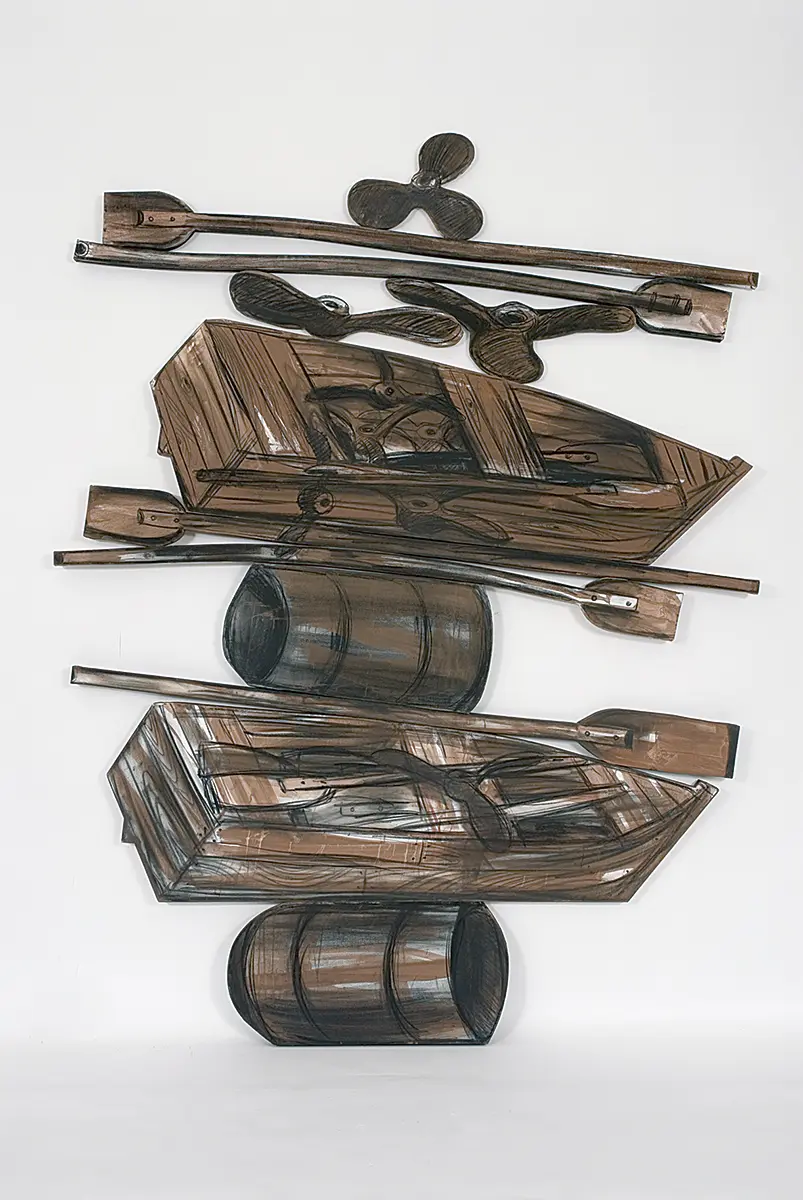
There is one piece in particular which brings the point home as far as integrating the subject of fear into the object: A wooden rowing boat (R.E.C.) sinuously curved impresses upon the viewer the disquieting notion that the vessel itself is a shark, thus solidifying into the object of transport, the worst nightmare of the refugees that have manufactured these fragile bridges to a better life.
Kcho’s work manages to indirectly illustrate the obvious failure of the Cuban Revolution’s promise of a betterment of conditions for the downtrodden. All his pieces project a strong component of poverty and the makeshift re-cycling that is a permanent feature of the constructions of refugees of all ages. A great example of this feature is from the Cardinal Points series, On the Edge of the Abyss, an installation that consists of a truck tire, of the type that always appears to be present when American coast guards find Cuban refugees arriving on Florida shores. On top of the tire, at each one of the cardinal points sits a small, derelict house, of the type that we have seen repeatedly in documentaries on Cuba, whether in urban or country environments, it is the wooden shanty which is as much of a permanent feature in the international architecture of poverty integrated in all metropolitan cities, and particularly in Latin America, is as ubiquitous a presence as the glass towers that house the luckier part of the population. Being born into one of those favela homes is the most direct way to secure a passport into the boats.
These constructions are also very similar to the architectural structures of Roberto Diago, a contemporary Cuban artist that is from the same generation as Kcho that was showing a selection of installation works at the Caribbean Contemporary Art exhibition at the Brooklyn Museum, which closed just a few days before the Kcho exhibition opened. Both visions are similar in their concern for the fragility of existence and the polemics of economic survival which are particularly poignant reminders of the evaporation of dreams of prosperity and illusions of social improvement that the politics of Revolution failed to deliver.
Artists like Kcho render poetic the materials as well as the portrayal of poverty, much in the same way that in Post War Italy Arte Povera artists struggled to depict the disillusion with the Italian economic miracle of the immediate post-war years, as it collapsed into a chaos of economic and political instability. The Arte Povera movement introduced everyday materials to artistic creations to throw the door of opportunity open to anyone that wanted to produce art meaningful to the times, but would not want to be encased by the customary luxurious materials associated with traditional art production.
Kcho’s production of fragile wooden boats incorporate the elements of an aesthetic in direct opposition to the materialism that he perceives is overwhelmingly present in the first world economies that the refugees in the boats are hoping to reach. It also provides the viewer with pointed reminders to the illusionism and disappointment that is an integral part of the migratory experience of refugees whether economic or political, in our time.
ALBERTO BARRAL