
Today, art invades all spaces. This freedom
makes possible an osmosis in which meaning can sometimes gain in intensity. The
Argentine artist Marcela Gómez (born 1963, Rosario), who has been based in
France since 1980, chose an exceptional site to present a series of works under
the title of Vanity… in reference to the biblical passage of Ecclesiastes 1:2
that reads: “Vanity of vanities, all is vanity and chasing the wind.” The soul
of the exhibition space, a Dominican monastery next to a church, undoubtedly
influenced the artist, because the seven works on exhibit were far from
appearing anachronistic or anecdotal. On the contrary, in their sobriety and
pertinence they suggested not only a visual but also a spatial dialogue with
the site—a small white room and a long white hallway opening to the
garden—without jettisoning the demands of a language whose materialization is
entirely contemporary.
The relationship of the Dominican friars with art harks back to a tradition of accompanying contemporaneous art in which we find, in the twentieth century, Georges Rouault (with his Christs), Fernand Léger (the Sacre-Cœur church in Audincourt), Le Corbusier (the La Tourette convent), Alfred Manessier, and Yves Klein. Created twenty years ago by the Dominican priests inside their own monastery, the cultural center organizes conferences and exhibitions by young artists. Its goal is to create a dialogue that brings the issue of faith to the fore of contemporary debate, engaging contemporary philosophy as well as theology, poetry, and literature on topics as varied as our relationship to our bodies, disarmament, sustainable development, pleasure, and the Internet.
It was, then, an open place without intellectual or visual preconceptions that Marcela Gómez seemed to have enjoyed adapting and adding sensibility and meaning. Only on rare occasions are we able to see the work of this artist whose aesthetic discourse seems to follow, in various ways, a logic that is directly connected both with life and with a deep reflection that interrogates its imperative fleetingness. After previous works that questioned space by means of tense geometric lines and that established a relationship with nature by focusing on roots and branches, Gómez dealt here with an essential existential issue—the inexorable passage of time. This idea has always lurked in her work’s relationship with the real, and she translated an inner necessity that has never been separate from a concomitant concern with form.
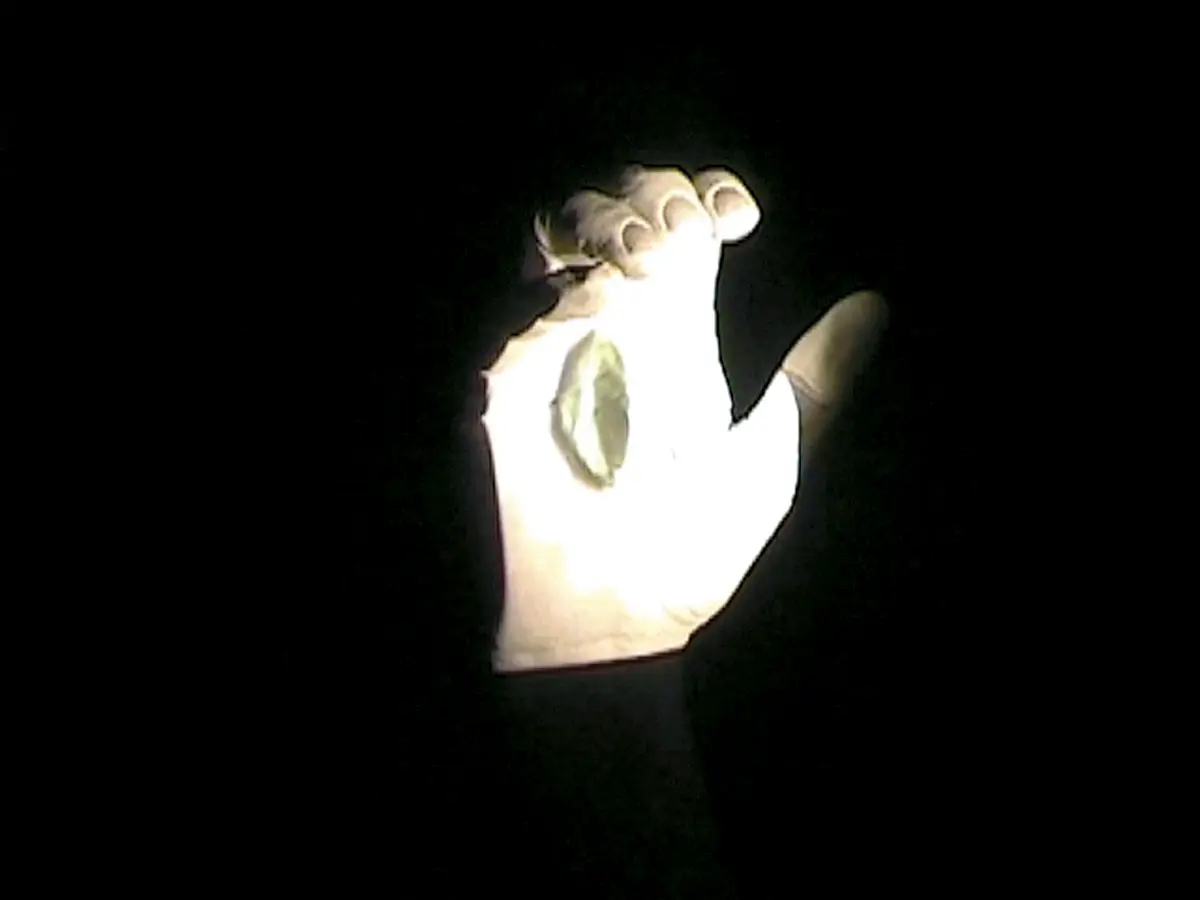
For the seven works presented, Gómez became more minimalist in her work, preferring a black/white duality that dominated almost the whole exhibition. At the entrance, on an electronic poster, the biblical text on vanity scrolled. An illuminated open hand was seen alone in the dark (in a fifty-second video loop, Sin título); a small plant leaf was seen in the hand that opened, closed, and disappeared. It was a metaphor of appearance and disappearance, showing that nothing lasts, that all is an illusion, a fleeting instant, that all is ephemeral. The sensible geometry that characterizes Gómez’s approach reappeared in a series of small black thread constructions suspended against a white background, which represented simple forms that connect us with nature (Sin título; 20 x 20 cm.; rubber, wood, points, paint). The shadow that supported each structure changed under the effects of light and added a delicate touch to this concept of the uncertain and the unstable.
Entering the hallway, the viewer was dazzled by the whiteness of the walls and the dome under the light coming from the patio, where one found the show’s four installations. In spectacular, ostentatious works by other contemporary artists (such as Damien Hirst or Jan Fabre), the theme of vanity, which combines the fleetingness of time with the presence of death, has been questioned. This turns the discourse about vanity into a paradox because the theme is highlighted to excess in order to better critique it and thus be nullified.
On the contrary, Gómez reduced her visual vocabulary to the minimum and chose simple forms, proposing a turn toward the evanescent and the essence of things, combining the opposition between emptiness and fullness. In her work, there were no skeletons, there was no jewel-encased skull, there was no hourglass or deathly representation, and there was no color. The relativity of time was conveyed by silence, sobriety, and neutrality. The intense light that almost burned the butterflies suspended by nearly invisible threads (Sin título; rechargeable flashlight, butterflies; 250 x 150 cm; 2007) turned this installation into a metaphor for the dazzling seduction that sometimes threatens and traps the fragility of the living. There was no chance here but rather a destiny that another, equally symbolic installation confirmed: heaviness against lightness, curve against the straight line, round against planar. Four “pearls” or “droplets” of white plaster (Sin título; plaster, pulley, steel cable; 250 x 40 cm) were suspended from a cable that ran on a pulley and evoked a contained or stopped time that resists human decision. This work conveyed an inherently human dialectic, and the central tension made equilibrium possible. Another installation (Sin título; plaster; variable dimensions) echoed the previous one: many white plaster “pearls” or “droplets” seemed unstably placed on the surface of the wall for their shape and weight and invoked Gómez’s beloved principle of weightlessness. In these maximal works traversed by contrary forces, weightlessness became the essential springboard, the master key of the artist’s inner-directed, aesthetic discourse. But while Gómez left behind all that was superfluous, her work was not austere.
Protected by the calm and quiet of the place, visitors fell into contemplation as if sharing with the artist an experience that was at once intimate and universal. These works did not speak, they murmured. They didn’t laugh but smiled. They paid no mind to the noises of the world and invited one to be, for a while, secluded. For Marcela Gómez, the demand of the essential translated into soft metaphors, into poetic and sensitive minimalism. This is an uncommon experience in our times, when so many works of art are noisy, even annoyingly so. A prejudice for provocation invites the viewer to transgression and subversion, unlike Gómez’s proposition, which is based on active meditation.
CHRISTINE FRÈROT