
The work of Mónica Girón (born 1959,
Bariloche) brings forth a theme that is latent in the Argentine imagination:
the formation of the individual and collective self. Based on a vocabulary that
stands out for its disengagement from the commonplace, Girón gives form to
persistent questions about the foundations and the transformation of beings and
the interweaving of the self into its formative context.
Several factors motivated Girón to transfer her own existential restructuring into creative activities and to pay special attention to the art process: a knowledge of the finite certainties derived from a family history marked by immigration; the tension between the prevailing tendency to emphasize a European background and a contradictory history of domination; her understanding of herself as Patagonian and her sensitivity toward that fascinating geography; and an encounter with Europe and her later life in Buenos Aires.
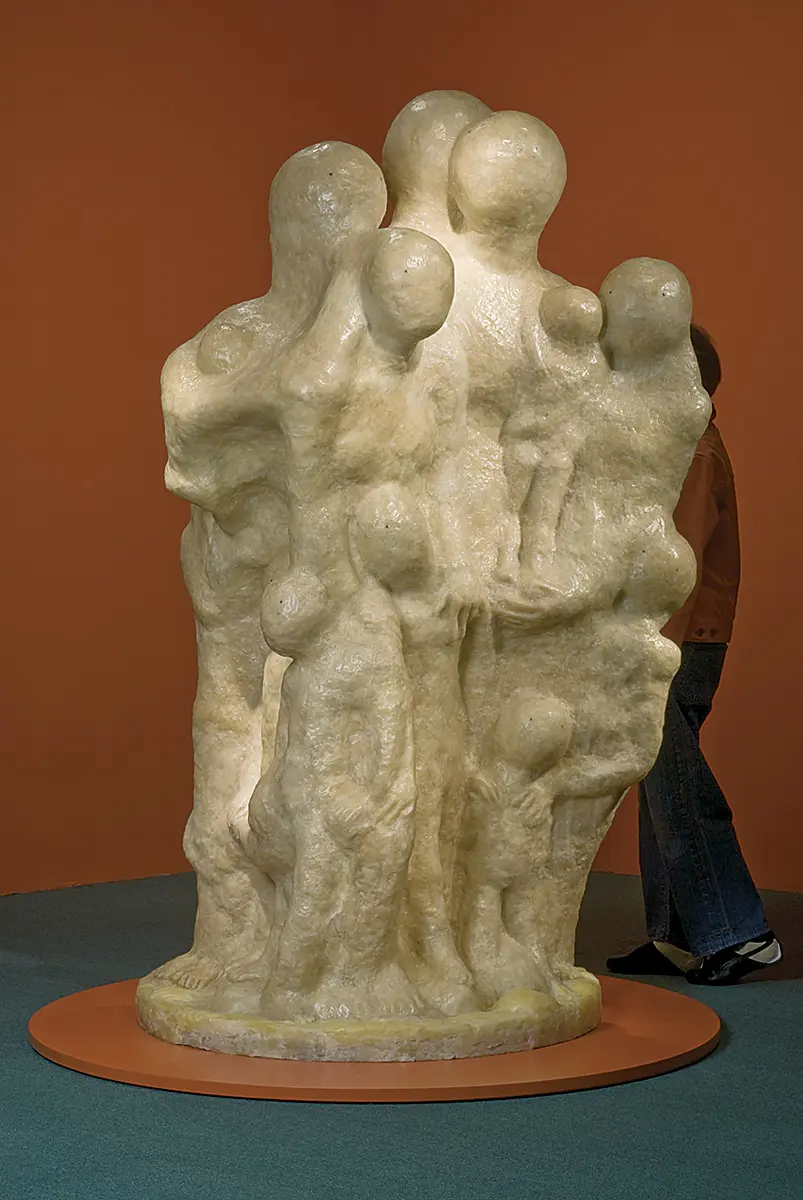
Neocriollo, Girón’s most recent exhibition presented from October to November 2007 at MALBA, marked a new period in her investigation. Curated by Gustavo Buntinx, who displayed great erudition in his entertaining text for the catalog, the show was evidence of Girón’s incursion in two fields: literature and psychoanalysis.
The exploration of psychoanalysis is not a new chapter in Girón’s work; in fact, her oeuvre is traversed by a continued interrogation of human behavior. The recent show included a series of works that allegorized the processes of formation and reconfiguration not only of a personality but also of a mentality.
Presiding over the show was a huemul, a life-size reproduction of a small Patagonian deer in resin and paraffin wax. Girón combined ideas of birth, death, and passages with the posthumous consumption of the deer’s hide as a sleeping bag. She also equated the huemul’s skin with a caterpillar that becomes a butterfly; based on this “wrapper,” she called one’s attention to the mutability of being, to the constitutive phenomenon. The work also recreated and reasserted the imprinting of a given context on the self.
The adjoining space was devoted to the exploration of the psyche but, as with the huemul, the approach lent itself to a symbiosis of collective history and psychoanalytical introspection. Groups of disembodied doll-heads in several displays alluded to beheadings and genocides throughout history. Ósmosis, a group of heads with smaller ones attached to them, posited a reading of the mental deformities caused by domination and dependence. The “shrunken heads” of another display formed an allegory of more frequent perturbations and quests for balance: hysteria, masochism, self-pity, and compensatory behaviors.
While Girón developed these works with doll-heads, she also began the apotheosis of this creative cycle, Neocriollo. Inspired by Leopoldo Marechal’s novel of the same title, Neocriollo constitutes a metaphor for the shaping of Argentina’s national identity. The scale of Girón’s formless sculptural group, from which the supposed sires and offspring of a common center—the soil of the fatherland—stand at different heights, corresponds to the vast scope of its allegory. Once again, wax, paraffin, and resin come together with a pointed lack of definition in the features to ratify the formative and unfinished character of the foundational symbol embodied by the shapeless human mass. Marechal’s book is filled with these figures of transmutations, of that which used to be one thing turned into something else, or which, due to life’s circumstances, subverts a portion of its identity. These are Frankenstein monsters of old times and new, characters with diverse origins transformed after their exodus to the southern nation, the mythos of the wandering character, Adam born in Buenos Aires, a Babel-like tree trunk in Latin American lands.
Minuscule pupils flicker in the vague faces of Neocriollo, revealing a seed of life and perhaps the emergence of consciousness. They also appear in Laguna, which, unlike the Neocriollo, is not anchored on land. Suspended from the ceiling to indicate the absence of gravity around its meteor-like body, Laguna parodies the origin of our planet.
It was Buntinx’s idea to group these pieces. Beyond the excellent exhibition design, dominated by the purple hues that amplified the presence of the works, the curator’s selection had the singularity of imitating the narrative structure of Marechal’s stories of heroic paths. Paths of initiation, learning and understanding, and constructing and reconstructing individualities were established in Laguna (a genesis prior to human existence), moved to the deer’s body (a context made homologous to the formative self), through the doll-heads (the study of one’s own self), and to the collective emotional body, Neocriollo.
The return to the ancestral, to the reckoning of experience and history, and to one’s innermost spaces to explain the present self is a topic that will never lose its relevance.
MARGARITA SÁNCHEZ PRIETO