
The Biaggi Faure Gallery recently presented Jardín de Enigmas, an exhibition of works by Néstor Millán. The show
comprised fifteen works that dazzled the viewer with the pervasiveness of gold
and excess, the main subject of Millán’s art. Sculptural ornamentation from the
Medieval, Mannerist, and Neoclassical eras and inspired by motifs from
classical antiquity—vegetal trunks, garlands, basilisks, lions, medallions,
shells, and modillions—were an integral part of these trompe l’oeil works that
also depicted the quasi-technological visual elements of contemporary culture.
In these works, the collection of fantastic elements was inspired by
architectural reproductions abandoned in the gardens of old seigneurial homes
or sold in gardening supply stores.
Millán’s work fuses an apparent celebration of the legacy of late Mannerism and of Neoclassicism with a discourse about the residual, superficial, and empty meaning of appropriation and historicism in current artistic practices. His proposal is connected to the taste of local consumers for reproductions and objects based on motifs and figures taken from Mannerist, Neoclassical, and Victorian culture, which have become emblems of Puerto Rican culture. A notable instance is Frederick Leighton’s Flaming June, a late-nineteenth-century British painting in the collection of the Museo de Arte de Ponce, an exemplar of nineteenth-century historicism. Leighton’s painting objectifies for the local public a nostalgic, beautiful, and exotic sense of the past. Millán, like other contemporary artists attentive to tradition, borrows from it not to provoke feelings of nostalgia but to show the way that it is transformed by consumer and media culture.
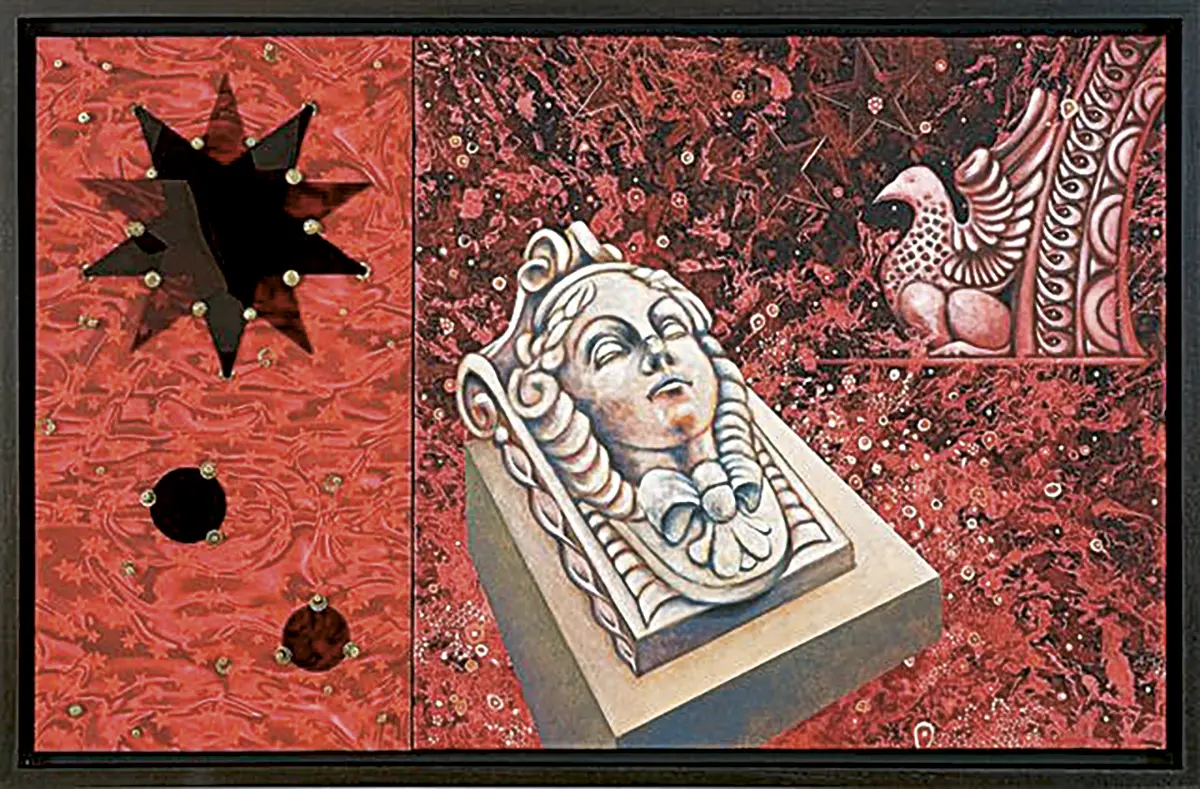
The garden of enigmas of the show’s title appeared in some of the works as a modern-day hortus conclusus where stipites jut from the green foliage; among other things, it is a galaxy of hyper-excess and hyper-color, in which float broken medallions and modillions with enigmatic blank-eyed figures. The emblematic elements of Mannerist and Neoclassical culture, reduced to marmoreal ornamentation, are subjected to the chromaticism of neon lights or of glossy magazines. The artist argues that the orange-colored stipites and the rose-tinted modillions attract a public that is accustomed to interiors decorated with those hues. The sculptural is subordinated to the pictorial while reasserting its stone-like aspect.
In Astrarium, a modillion with a female head seems to float in an astral space suggested by Abstract Expressionist drips. The background, like that in De lo fugaz a lo infinito, displays great technical virtuosity that competes with the plastic surface of Mylar, which suggests an optical movement of colors. The manufactured and cut-out shapes (such as stars, circles, crosses, puzzle pieces, and small animals) are all made of Mylar.
Millán reiterates the decorative and superficial meaning of not only the Mannerist and Neoclassical traditions but also those derived from Abstract Expressionism: drips and loses brushstrokes. These are not an expression of his interest in the purity of the medium; rather, they mutate into ornamentation. Millán assumes as mannered not only the decorative repertoire but also abstract art, which has achieved great commercial success in the local market. On the one hand, the Puerto Rican public associates abstraction with high art, with museum and gallery art, and, on the other, it identifies Medieval, Mannerist, and Neoclassical elements with a powerfully evocative art of feeling. This last element, in conjunction with the hyper-chromaticism and the hyper-manufacture that characterizes Millán’s paintings, is in perfect synch with a culture of consumption that accentuates the rhetorical, the skin-deep, and the banal.
In late-modern or hyper-modern culture, under a general impulse toward the privileging of the past, classical antiquity and the classical avant-garde are of interest to museums. Nevertheless, tradition or the past of art, in memory and in artistic appropriation, lacks meaning. It would seem that, in order to have value, the past must shed a heavy load. Art becomes light and meanings are forgotten. Motifs were taken from tradition, devoid of religious, historic, or social meaning in current times—times that are incompatible with history—provoke an interest that is essentially visual.
In Millán’s painting, classical ornaments freely interpreted are not relics but hyper-ornaments. However, through the blunt triviality of the image, the works suggest a meditation on the nullity, the vastness, and complexity of art and of a culture that wishes to disengage from anything but purely visual enjoyment.
The work of Néstor Millán generates a debate about superficiality and depth as cultural values. According to Vicente Verdú: “This argument corresponds to the evil of appearances and the good of essences.”1 Millán’s garden, even as it appears dazzling and represents the colors of the media images that are its referents, seems to have been created to remind us of an idea found in Francesco Colonna’s 1546 The Dream of Poliphilus, that the garden once had the function of liberating the soul and revealing hidden truths. Néstor Millán unfolds images that exist between the banal and the deciphering of an enigma.
NOTE
1. Vicente Verdú, Yo y tú, objetos de lujo. El personismo: la primera revolución cultural del siglo XXI (Barcelona: Random House Mondadori, 2006).
INGRID M. JIMÉNEZ MARTÍNEZ