
For the past nine years, I have had the opportunity to visit and review on these pages a good number of international art fairs, mostly in Europe, where year after year I have followed the recent evolution of two fairs that are as different as they are paradigmatic: Art Basel and ARCO. Both have served as my referents when analyzing the movement of art in a market inscribed within a complex cultural and social context—and I have tried to consistently take this approach. In other words, art commerce cannot be understood outside of a society’s values and practices within a network in which the market is but one node.
Until a few years ago, the commercial aspect of art, its professionalization, was reserved to a reduced group of collectors who, with the mediation of the galleries, formed private collections that responded to personal interests and tastes and that in extraordinary cases transcended the private realm to become semi-public or public by means of donations to institutions. This formula never excluded patronage or sponsorship that, added to the domains of cultural promotion and diffusion, anchored and modeled relationships among artists, institutions, and collectors. Logically, these relationships have been more or less tense and have implied a constant negotiation of the intentions of the art object, of its symbolic value within a given culture, and its value as a commercial good in a capitalist, global market structure.
In this context, art fairs appeared as the dynamic agents of an art market that exists only because it does not sell “regular” objects governed by simple supply-and-demand laws. An object enters the art market because it possesses an added symbolic value, and it is on the basis of that value that its prize will be eventually justified. Supply and demand are of course factors in the art market, but the fluctuations of both are subject to the aura of art, to its cultural and social valuation. This generates a co-dependence between the fair as a specifically commercial event and the exhibitions, criticism, and institutions as the wider context in which artistic practice unfolds. The art system is the conjunction of all of these elements, and it would be difficult for one of them to exist without the others.
Even so, it seems evident that something has changed during the past few years. We have seen a constant and not very gradual proliferation of art fairs around the world. Eight or nine years ago, an art fair was rooted in the context from which it emerged—Chicago, Madrid, or Cologne—and it responded primarily to local collectors and economic systems and based its success or failure on them. Galleries participated in fairs outside their local context to expand their market and promote their artists in new regions. Recently, however, it has become difficult to pinpoint what is original in any given art fair. The expansion of communication technologies, which helps to move information faster and farther, has increased the visibility of a small group of artists, galleries, and mediators in the “international circuit,” while local actors who do not enter that circuit have an increasingly smaller presence, even in their home locations. Cheap airfares have assisted the process, promoting the mobility of those agents who thus multiply their presence into all corners of the world.
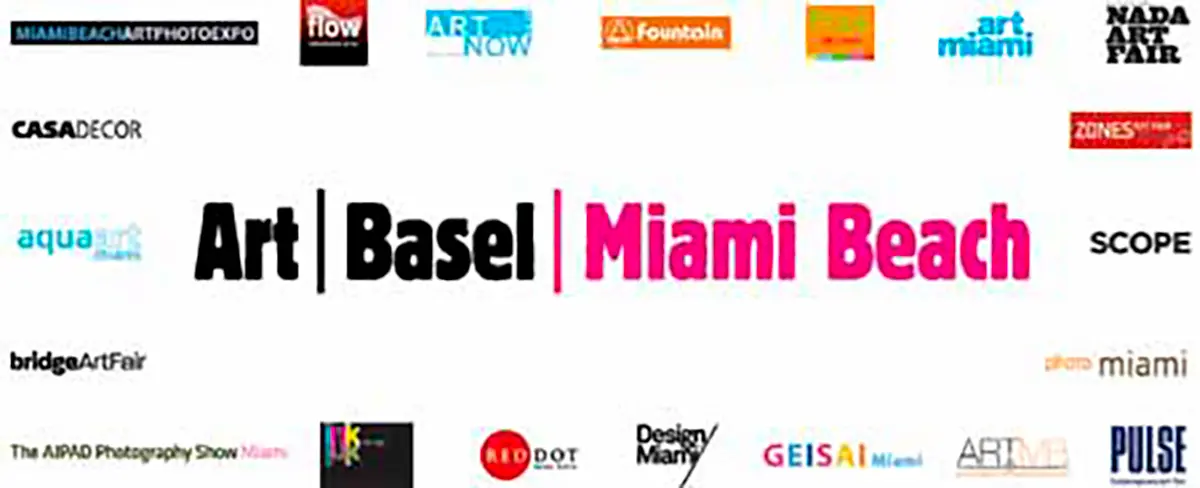
It is not an exaggeration to say that the model that takes this practice to its extreme and finally “liberates” galleries from localism is Art Basel Miami Beach (the geographical collapse in the name is a symptom). In a move of genius, Samuel Keller, the former director of Art Basel, transferred the brand to the East Coast of the U.S. The first attempt was in 2001; when the Twin Towers fell, the whole thing was postponed for a year. Under normal circumstances, this would have been a bad omen, but, in the sometimes-twisted world of art, it did nothing but increase expectations and suspense. Art Basel Miami Beach’s unprecedented success is also due to Keller’s vision, as he knew that the combination of a mild winter climate, American luxury and excess, and art would be explosive. Clearly, the art world’s most frivolous and spectacular face was unabashedly on display in Miami, surrounded by the best of contemporary art: an ideal pairing.
In this way, contemporary art became an overnight public sensation, of interest not only to insiders but also for the society pages, the business and finance world, and the tourism industry. Yet many of us believed that Art Basel Miami Beach would have dire consequences for other local fairs, for the uninvited galleries, and for the whole spectrum of the system that was excluded. Indeed, fairs like ARCO, which was the natural marketplace for Latin American collectors, was seriously hurt by the presence of Miami. However, another effect of Art Basel Miami was to transform contemporary art and everything that surrounds it into an object of desire, an exciting and glamorous world to which one could aspire if one belonged to a certain social class—or wanted to. Ever since the market for contemporary art has grown beyond all precedent. Somewhat surprisingly, the strategy devised by the outsiders was to situate their operations on the wake of the Big Fair and to generate parallel events designed for different, very specific publics. If in the early years there were two or three parallel fairs in Miami, last year there were more than twenty. Municipalities and cities realize that an art fair is a tourism event that they can have on the cheap (in fact, galleries pay to come) with the result that, as with the Guggenheim Bilbao phenomenon, today every location wants to have its own fair. Thus, all the keystone fairs—among them ARCO and Art Basel itself—have seen the blossoming of others around them; some fairs that were left for dead have reemerged, like Art Chicago; new art fair stars have been born (Frieze), and markets once thought unthinkable are now open, such as China. Everything seems to indicate that the contemporary art market is in peak form.
Contemporary art itself, however, is a different animal. Due to this proliferation of fairs and the disproportionate importance it gives to the art market, we are witnessing the paradoxical, gradual, and inexorable extinction of what was the fair’s raison d’etre: the art gallery. Today, a gallery’s success is directly proportional to the number and importance of international art fairs in which it participates. This forces the galleries to work no longer for the immediate, local market but to present an internationalist and almost virtual program that will win points with the selection committees of fairs. Artist represented by galleries that participate in many fairs are forced, in turn, to produce at the pace set by these events, and rarely do they find opportunities to show their work in contexts with less noise and more relaxed timeframes. The mediators—consultants, curators, official buyers, and advisors—make their selections from what the gallery offers, with all the limitations implied. Even collectors plan their yearly schedules around visits to art fairs, which increasingly leaves them with less time to visit their local galleries. This is what has happened, and it has happened very quickly, with the consequence that the entire system is increasingly more homogeneous.
As a coincidence or a sign, 2007 was the last year for Samuel Keller at the helm of Art Basel and Art Basel Miami Beach. After communicating his retreat to a more peaceful job at the Beyeler Foundation, the fairs’ organization announced that his position would be fulfilled by three people working in different areas: finance, artistic direction, and international expansion. Leading to further confusion, in the last few days one of them, Cay Sophie Rabinowitz in charge of artistic direction, also presented her resignation. With Keller’s departure, the project of a visionary is coming to an end. To a great extent, Keller modeled and defined the contemporary art market and, before being devoured by his own creation, made room for a multinational corporation that will be more efficient but also more impersonal.
During the last edition of ARCO, where ArtNexus initiated its presence in this kind of event, more than two decades ago, I learned that the magazine will no longer feature reviews of art fairs. This is good news because it is increasingly difficult to distinguish one fair from another, to find differences among them. Freshness has been inevitably lost, and it is time to return to spaces where art flows with less constraint and less urgency, which is without a doubt a great step forward.
ISSA MARIA BENÍTEZ DUEÑAS
Art historian specializing in contemporary art and the theory of art.