
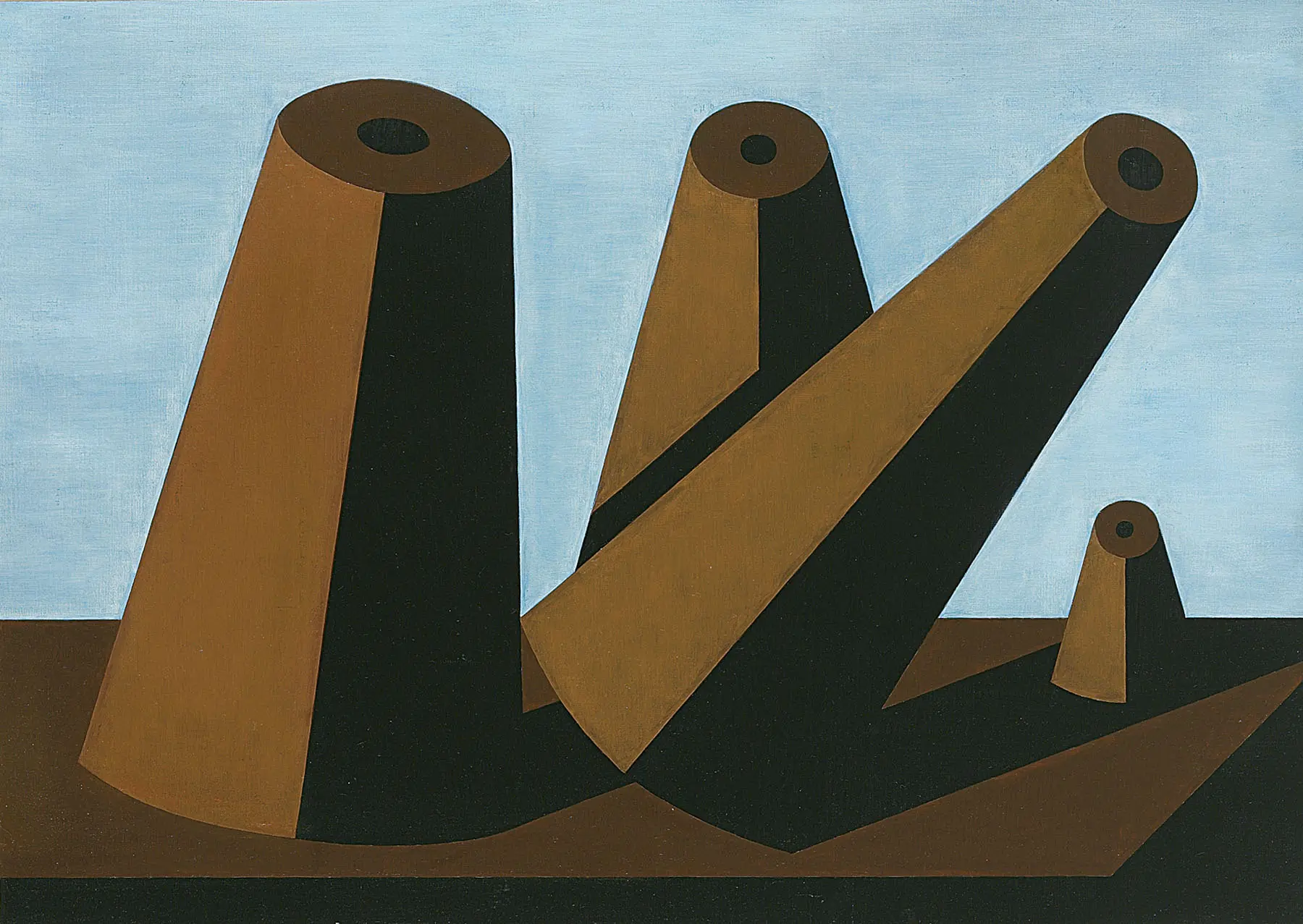
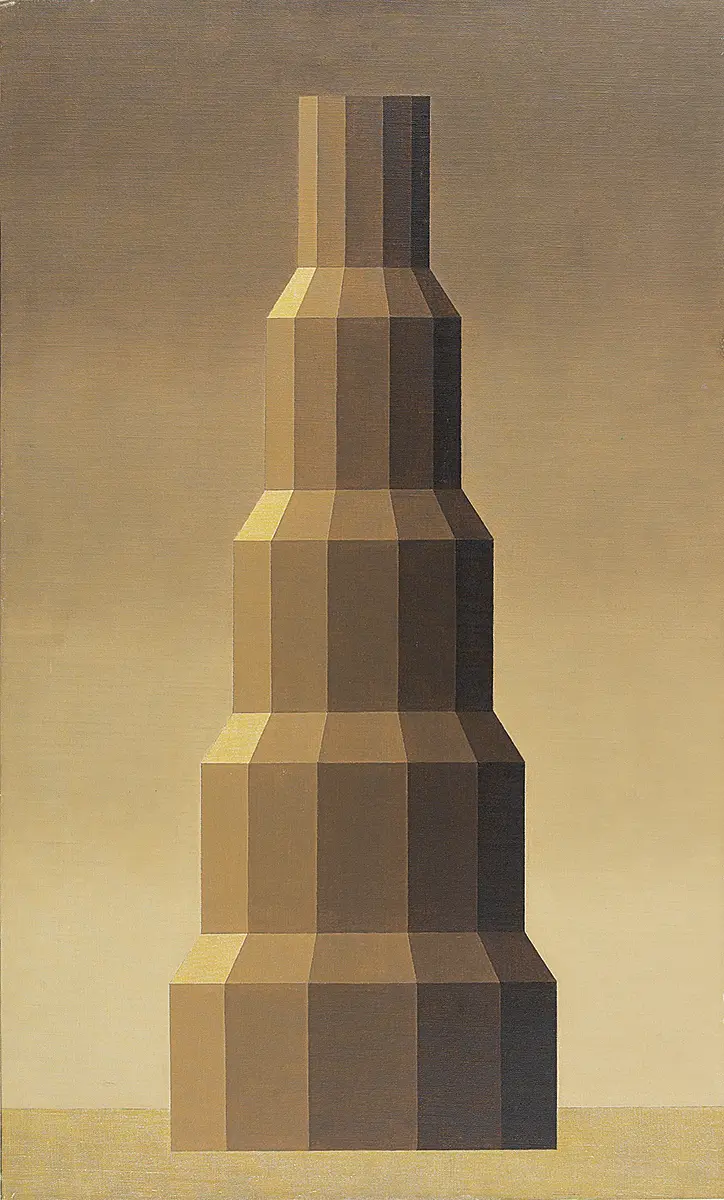
One of the Argentine artist Roberto Aizenberg’s well-known “towers” (Torre, 1981–82) monopolized the attention at the Christie’s auction last November in New York and was sold for $133,000, establishing a record for his work and more than doubling the value estimated by the auction house ($40,000–$60,000).
In the same room in 1986, with Aizenberg present, one of his paintings didn’t find a bidder. That same year, the artist met Dawn Ades, the British professor who runs the Centre for the Study of Surrealism and its Legacies, a joint venture of the University of Essex and the University of Manchester with the Tate Gallery. Ades tells the story of her encounter with Aizenberg in the prologue to a 2007 exhibition catalog: “On November 4, 1986, Roberto Aizenberg received me in the study of his Buenos Aires home. I had fallen in love with his towers and wanted to know more about his work. I thought it astounding that an artist of his vision and talent was practically unknown in England and in the rest of Europe. This first visit to Argentina in 1986 was part of the preparation of “Art In Latin America 1820–1980,” a large exhibition at the Hayward Gallery, which was finally presented in 1989.”1 Ades continues: “If I had today the opportunity to curate an exhibition that allowed it, I would dedicate it to Aizenberg . . . That exhibition, for which this volume offers an excellent model, would present the work of Roberto Aizenberg from a double perspective: first, it would establish the unique and entirely distinctive character of his paintings, along with his artistic growth and development; second, it would explore the different lines that connect his work with modern art in Argentina, Italian painting, Surrealism, and the European avant-garde.”
With his work reproduced on the cover of the general catalog of the Latin American Collection of the Blanton Museum in Austin, today Aizenberg is increasingly recognized abroad and undoubtedly admired in Argentina; many young artists (such as Max Gómez, Nicolás Guagnini, and Benito Laren) even cite him repeatedly in their own works. Aizenberg’s highly sought work will be on exhibit in mid-2008 at the Ruth Benzacar Gallery.
Who is Roberto Aizenberg?
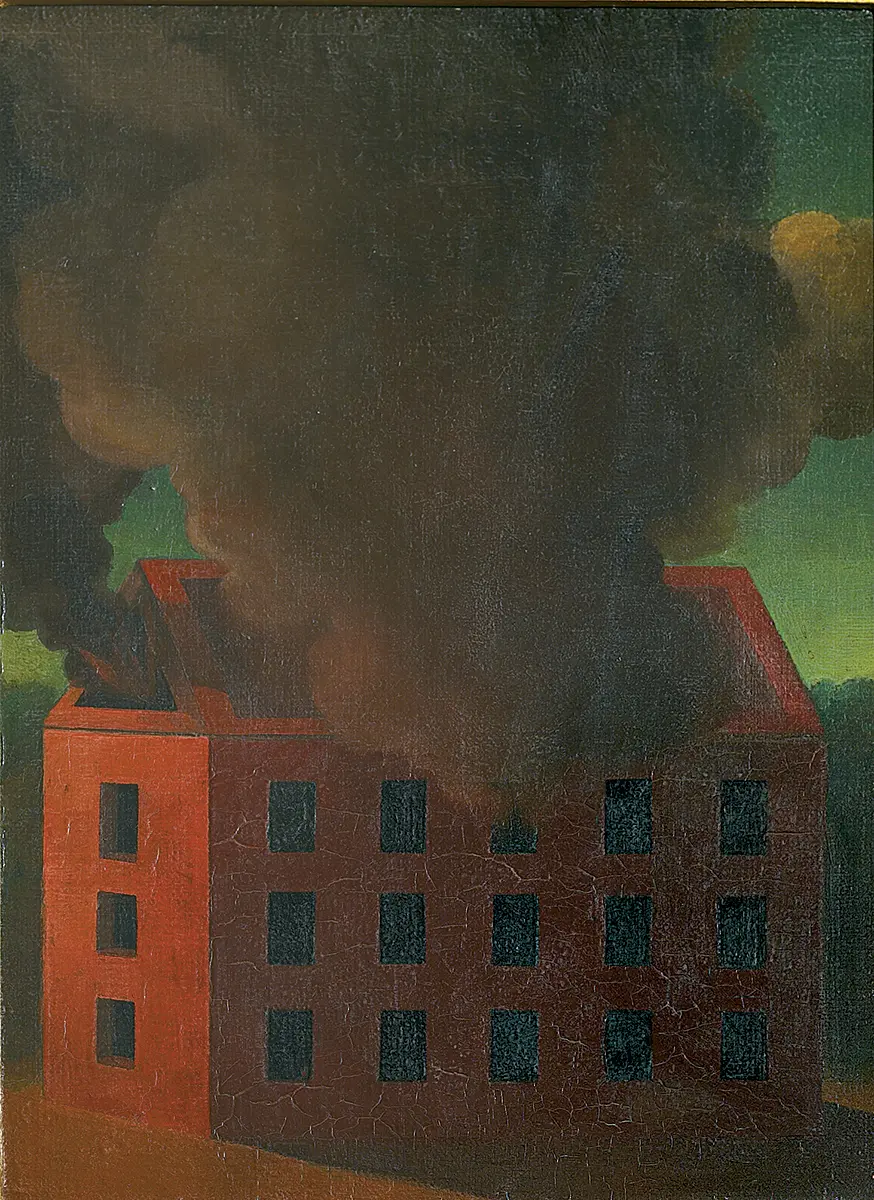
From the moment of his first emergence on the Argentine art scene, back in 1954, Aizenberg left an indelible mark, noted by critics who encourage and respect him. He painted silence marvelously, revealing the beauty of colors; he handled space, volume, and light like no other, capturing a different reality with shadows. The forty years after his emergence confirmed that the brilliance of his first show was founded on exceptional talent. The work Incendio en el Colegio Jasidista de Minsk in 1773 from 1954 soon became one of his most emblematic works. Rather than announcing purification or an unbridled sexual passion, the depicted flames described a tragedy in progress: were the teachers and students inside the building able to escape, or were they killed en masse?
Aizenberg worked each of his paintings to perfection; he didn’t stop working until they fascinated the viewer. The refined finish of his works, devoid of excess or stridence, was the product of a patient process of construction and distillation that quieted the unreason and the randomness that emerge from his automatic drawings.
The child of Jewish immigrants from czarist Russia, Aizenberg was born in 1928 in Entre Ríos, where, due to the humidity, greens are greener and dusk has pink, sienna, and golden colors. Even today, sunsets outside the small city present a unique hue. The transparency of the colors that Aizenberg captured in his paintings is unreal: perhaps it evokes the colors of his native land. In the southern region of the continent, the sky shines powerfully and spills whites and blues, ochres and golds, while the line of the horizon fades into the vastness of the territory populated by ghosts from other centuries and more recent unburied bodies. Caressed by a masterly light, the dazzling spaces, the simple forms, and the inscrutable characters that populate Aizenberg’s works insinuate climates filled with existential dilemmas that continue to surprise the viewer with irreducible openness.
Dubbed from an early time as “the Spinoza of Argentine painting” by the critic Bengt Oldenburg, presumably for a rejection of sectarianism and for rationalism rooted in Cartesian principles and fantastic Jewish legends, Aizenberg was compared by Marta Traba to Borges, because his work was “just as unexpected and exact” as the writers.
Aizenberg’s paintings are often dominated by timeless immobility that, depending on the eye of the beholder, reveals either a deep spirituality or overwhelming loneliness. His collages reflect an insatiable curiosity, while his drawings let us see something of his sharp sense of humor, which in private can become lethally ironic.
Unclassifiable and marked by metaphysics, surrealist developments, and lyrical geometries, the artist opened doors and constructed a timeless oeuvre that is also notable for its circularity. We can’t say that there are periods in Aizenberg’s expressions but rather a variety of syntheses and emphases that unveil and provoke a sensation of permanent, portentous wonderment.
Unencumbered with trends or with the exaltation and/or neurosis of national identity, Aizenberg chose to follow a secluded and audacious path of one. From the beginning of his career, he borrowed the method of automatism from Juan Batlle Planas and from the Surrealists, executed a poetic geometry, and produced expressions connected to an early-period Giorgio de Chirico. Aizenberg admired Piero Della Francesca’s treatment of light, as well as that of the Flemish masters, but he also looked toward Duchamp and Dada, Picasso and Cubism, and was dazzled by the mysterious Xul Solar.
Over time, in his quest for existential meaning, Aizenberg abandoned what seemed like an approach to the supernatural, in the belief that art and science are essentially the same as they coincide in the search for knowledge. But, contradicting the artist’s expressed opinions and intentions, his stealthy oeuvre appears situated in a magical rather than scientific aesthetic terrain and provokes in the viewer emotional and subjective rather than intellectual sensations.
Aizenberg died in Buenos Aires in 1996, at the age of 67, leaving behind an oeuvre that is as painstaking as it is enigmatic: oils, drawings, collages, sculptures, etchings, silkscreen prints, and monoprints, as well as notebooks, studies, and sketches. An extensive literature—his own texts, chronicles, criticism, and testimonies—enunciates and underscores his intellectual honesty.

Extraordinary Skies
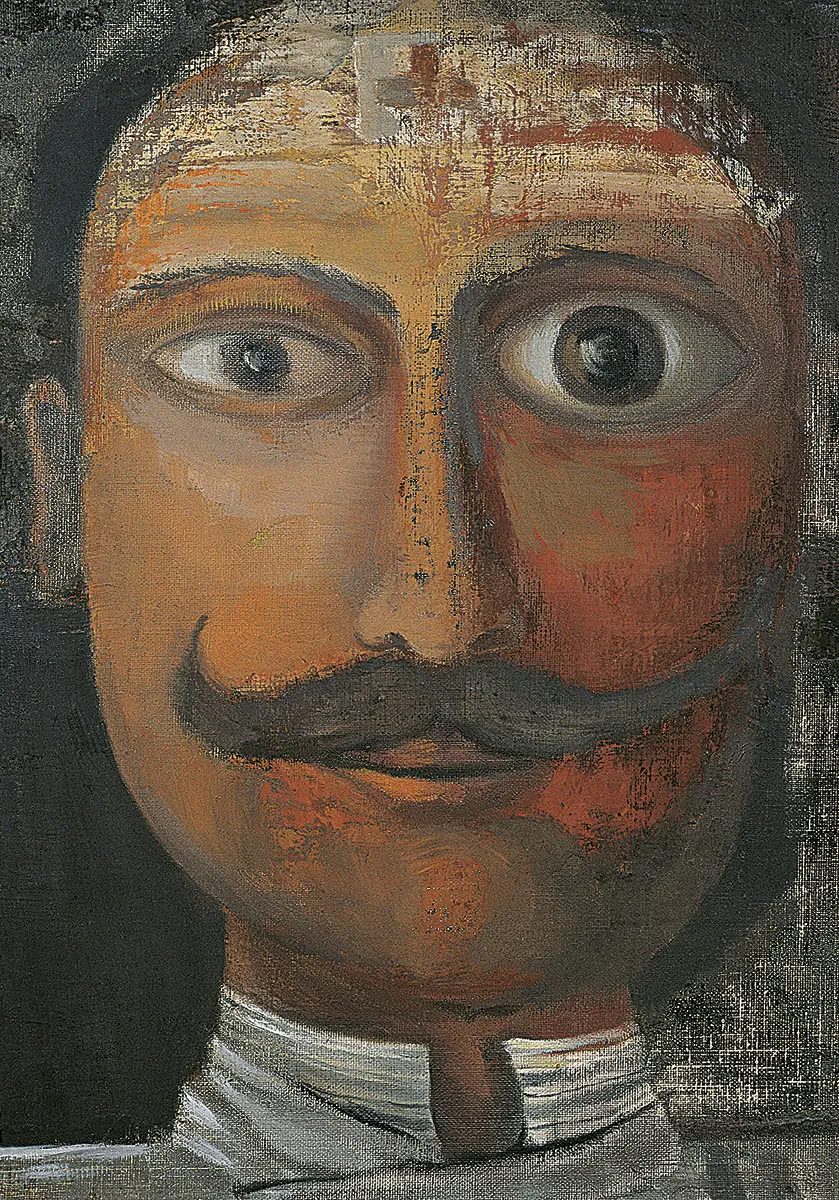
After encountering the work of the notable and multifaceted Antonio Berni, Aizenberg deepened his passion for constructions and cities while attending the School of Architecture for a year, a subject reflected masterfully in many of his later works. His earliest preserved works confirm that this was his earliest love (Portrait of Hieronimmus Bosch, 1951), while some of the faces of his ancestors probably served as models for his earliest, forceful oils (Portrait, 1952).
Then came the magical encounter with Surrealist Batlle Planas, the most important person, artistically speaking, in Aizenberg’s life. Aizenberg always said Batlle Planas was his “teacher in all aspects, both in terms of work dynamics and in the understanding, at first very difficult and then increasingly more lucid, of the work tool he taught us to use, automatism,” which Aizenberg never renounced. Although he never saw himself as a surrealist in the strictest sense, Aizenberg was invited to every Surrealist show organized in Argentina.
Like Max Ernst and Batlle Planas, Aizenberg created his earliest collages by integrating his own drawings and old illustrations from books—optical instruments, items from curiosity cabinets, images of organic substances—that reveal his nascent interest in science, as seen in The Nine Sparkling Rays of Protuberancies, according to the Observation held on August 18, 1868, at Wha-Tonne by M. G. Rayet (1963).
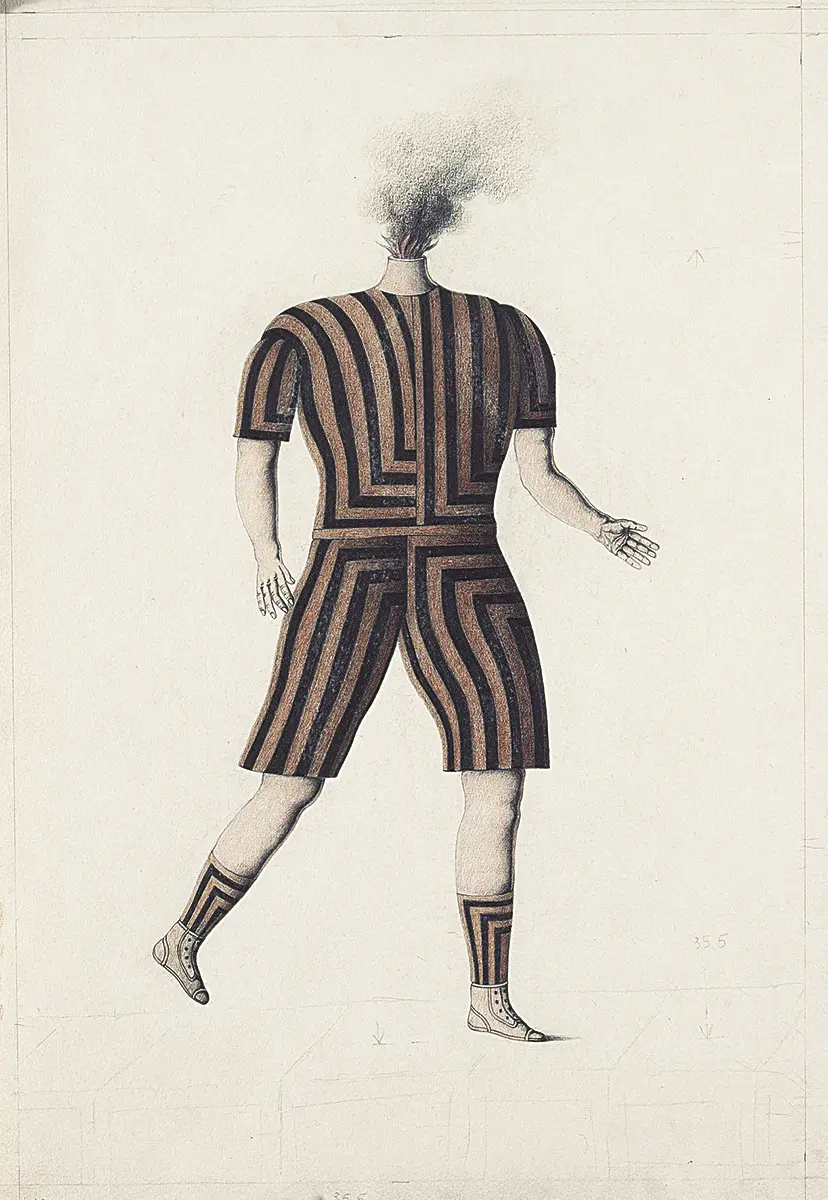
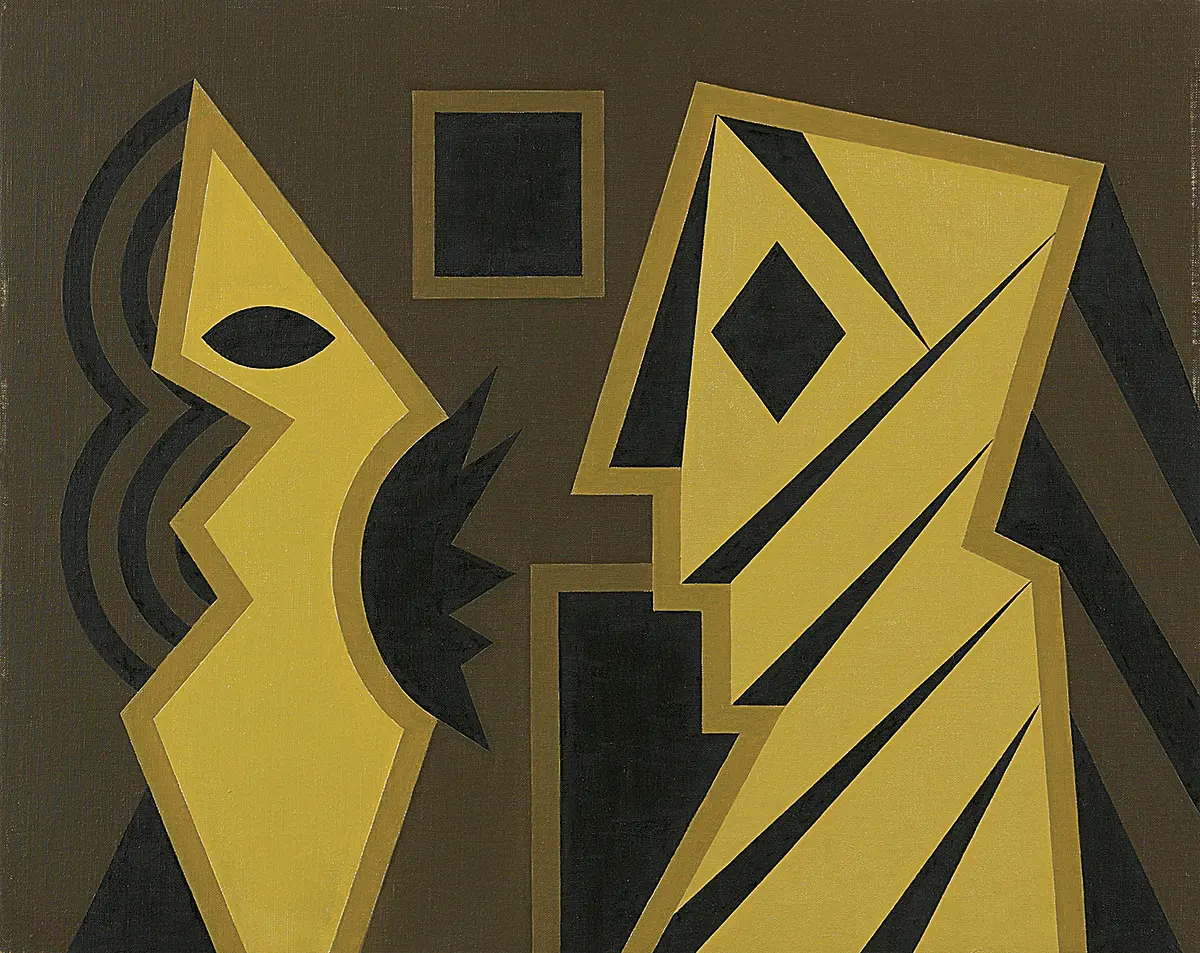
From the beginning, between the ages of twenty and twenty-six, Aizenberg produced a series of images that—drawn or painted, multiplied and reinterpreted, masked or evident—constitute a large part of the iconography he used throughout his life. Among the motifs and appearances he reinvented obsessively and lucidly, there are x-rays (the earliest one dated 1948, the last one dated 1995), towers (1950–1995), fans (1953–1979), headless or “smoking” figures (1953–1991), beachgoers (1954–1980), and harlequins (1954–1989). Later, he added anatomies (1956–1983) and floaters (1966–1995) to a repertoire that includes Central European faces, men and children, bicycle riders, elegant dames, circus people, birds, mannequins, phantasmagoric cities, empty constructions, monuments, windows, masks, plane and volumetric or faceted geometries (as seen in Untitled, c. 1995).
There is something almost religious in the emblematic towers and in the fans that appear in 1950 and 1953, respectively, like profane prayers. Both figures and their variants, located at the center of the composition and embraced by extraordinary skies, are connected to the fundamental topic of Aizenberg’s works: life and death. When he described the towers as representing “that Tower of Babel that is life itself,” he was not positing man’s arrogance or divine ire, as alluded to the Biblical story. Perhaps he used the analogy positively because the confusion of tongues and the dispersion of peoples were the origins of different kinds of knowledge. At any rate, the artist seemed to appeal to the vertical as an image of life. Rightfully, the allegorical tower (a symbol of guard and refuge, architecture and prayer, but also prison and alienation) from 1955–56 is the image used on Argentine postage stamps that pay tribute to the artist.
Through Gustav Meyrink’s book The Golem, Aizenberg found the image of a “headless ghost,” which became one of his preferred representations. For an intellectually alert artist in his mid-twenties, in the midst of discovering surrealism and filled with curiosity about supernatural phenomena, Meyrink’s was the perfect novel: it became a significant source of iconographic inspiration for Aizenberg, who adopted, recreated, and perfected the “smoking,” “headless” figure.
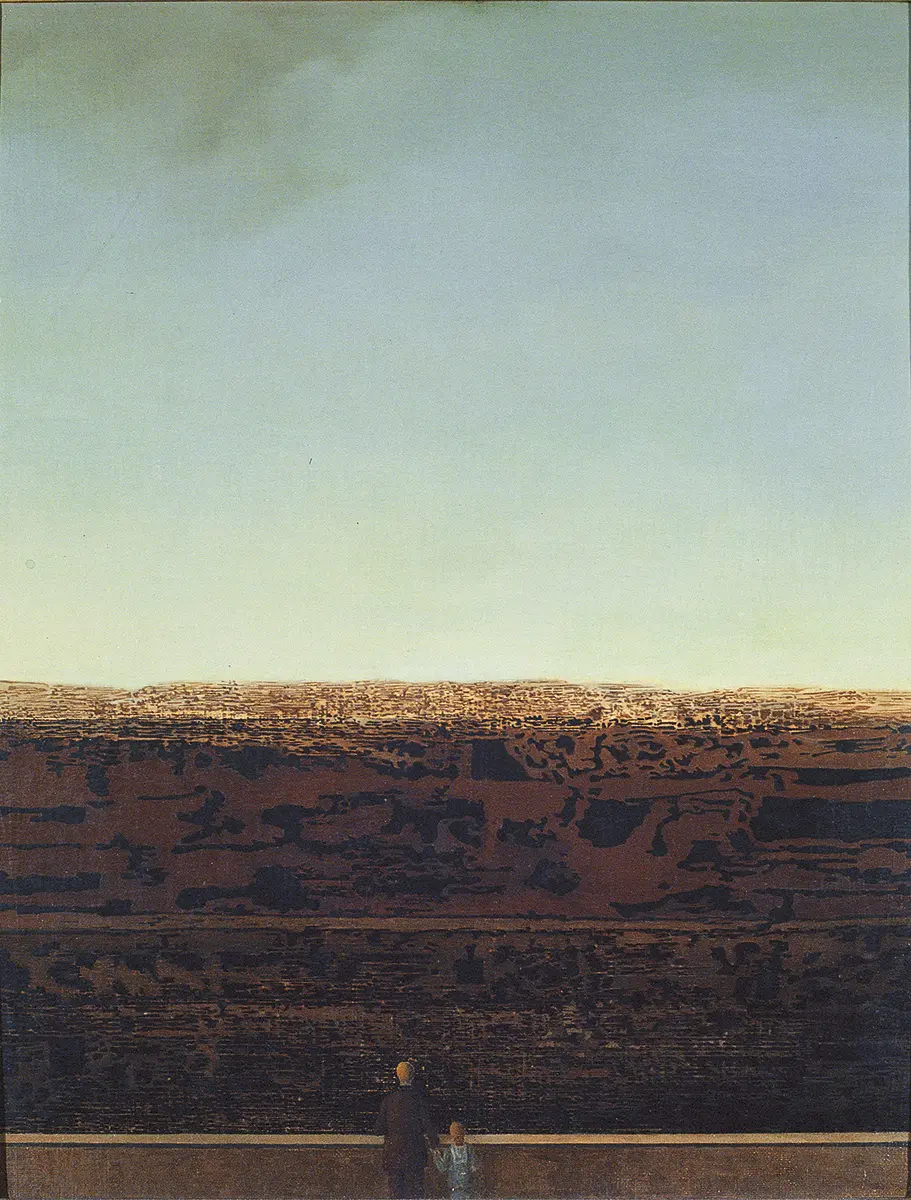
After his first individual show in 1958, Aizenberg created another memorable series, one that features a man and a child holding hands with their backs to the viewer, contemplating or imagining various unbelievable landscapes. Are they father and child, or teacher and pupil? Does the man represent Batlle as a father figure? These scenarios all seem to be true in these works, in which the small and very quiet figures are rendered even smaller by the dominant, translucent skies, which create atmospheres comparable to certain Romantic works. The father/teacher in these paintings appears as a benevolent figure, rather than a demanding, judgmental one; the father always holds the son’s hand, protecting him.
A Triumphant Retrospective
Besides being selected for the 1963 São Paulo Biennial and participating in the most important exhibitions and prizes, Aizenberg was given a triumphant retrospective at the Torcuato Di Tella Institute in 1969. Jorge Romero Brest, who curated the show along with Aldo Pellegrini, said that Aizenberg worked “as if completing the task of the enlightened.” Aizenberg’s dazzling compositions, in which the sublime and the sinister coexist with an unsettling precision and a mystical atmosphere, seem as if they have peeked into eternity with the force of those who aspire to it.
In terms of painting, Aizenberg’s production was slow, due to the thought process and technique used. He took pleasure in working with oils (mostly Dutch ones, which he diluted) and with marten-hair brushes; his materials had long drying times, but this was not the central point. The rhythm of the work was imposed by reflection. With Renaissance-like discipline, he often painted several canvases simultaneously. He thought and perfected, beginning one canvas and then another, taking on the third one, turning his back to the fourth. He destroyed one, erased another one, and went back to yet another. He rethought and painted. He painted in thin layers, with superimposed glazes, seeking transparency, seeking perfection.
Aizenberg’s works are in the collections of the Museo Nacional de Bellas Artes, the Museo de Arte Moderno de Buenos Aires, the Malba–Constantini Foundation, New York’s MoMA, and Austin’s Blanton Museum, among others. The winner of many prizes, Aizenberg exhibited extensively in Argentina and abroad throughout his life.
The artist had to leave Buenos Aires at the peak of his artistic powers, along with his wife Matilde Herrera, whose three children (Valeria, José, and Martín Beláustegui, all in their twenties) were kidnapped by the military and disappeared with their partners. This family tragedy forced Aizenberg to embark on a pilgrimage through European, for which he was unprepared since he was a highly recognized feature of the Buenos Aires cultural world, admired by critics and gallerists and well-loved by his peers. In 1982, during his forced exile in France and Italy, the artist presented the show “Dibujos de Roberto Aizenberg” in Milan, and Italo Calvino wrote a short story inspired by the drawings.
With the country’s return to democracy in 1984 and after seven years of exile and sacrifice, Aizenberg returned to Buenos Aires, where two of his grandchildren lived (two others remained disappeared). Heartbroken, Matilde saw her health decline, and she died in 1990. A saddened Aizenberg cloistered himself and painted the series Homenajes a Matilde, which, as Silvia Bloise (executor of Aizenberg’s artistic estate) says, are “a bitter hymn to life: to dreamed, unrealizable life. The characters scream from an experience of anguish and hurt; better yet, they describe figures that find themselves faced with the inevitable.”
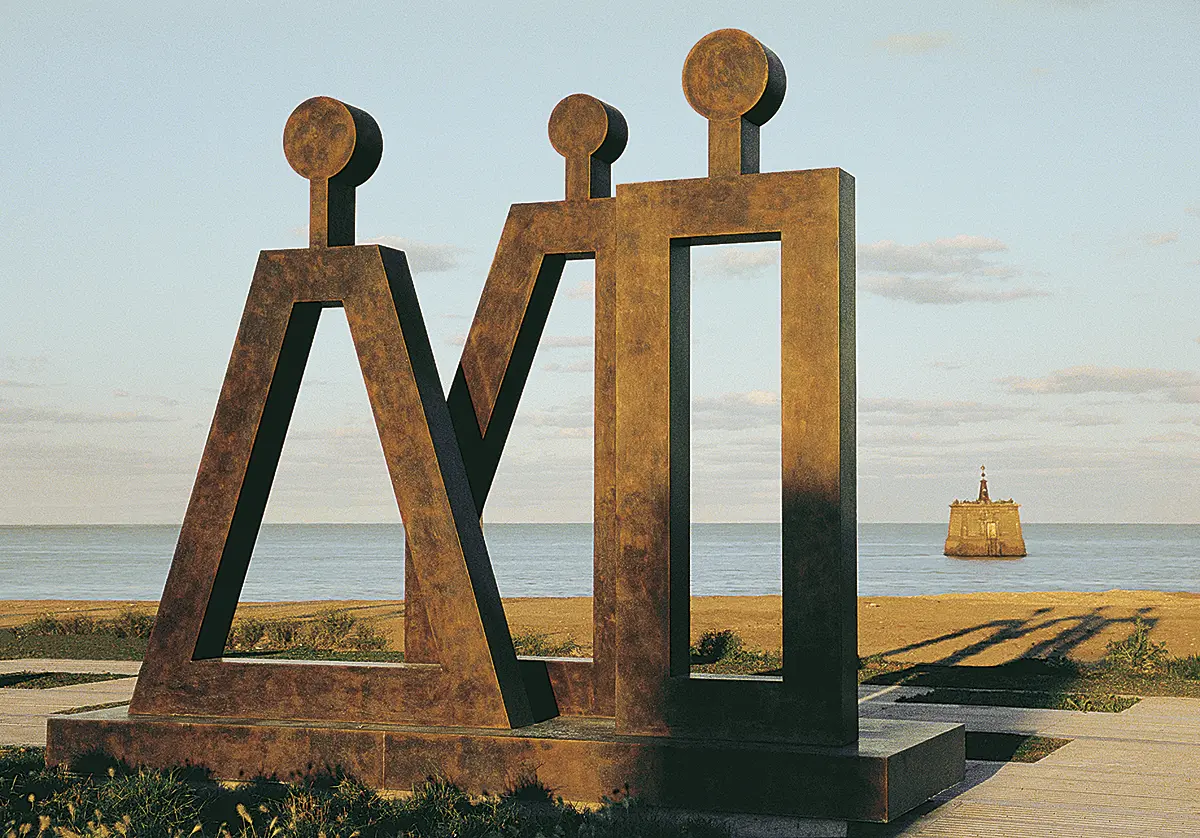
Even in the darkest hour, Aizenberg worked daily: painting, drawing, projecting, designing, modeling sculptures (in wax, cardboard, Styrofoam, and wood) that he longed to see executed at a monumental scale. One of them was erected in 2003. Six meters tall, Sin título was based on a reinterpretation of Aizenberg’s plans and placed in the Parque de la Memoria of the Autonomous City of Buenos Aires. The sculpture’s small spheres and strong lines depict three figures (one thinks of Valeria, José, and Martín) against the limitless sky, next to the wide and murky River Plate, that “sweet sea” where hundreds of Argentine citizens disappeared, the victims of state terror.
Asked in 1995 if he identified most with “surrealist, symbolist, or metaphysical panting,” Aizenberg was categorical in his rejection of all labels and described himself as a transducer, a device that converts information and distributes it. It is true that aesthetic labels are unimportant, because, as Dawn Ades concludes, “Roberto Aizenberg was one of Argentina’s great twentieth-century artists, and is a part of its history; but that shouldn’t be his sole recognition. His place is in the global history of art in the twentieth century.”
NOTE
1. Victoria Verlichak, Aizenberg, prologue by Dawn Ades, chronology and selection of works by Silvia Bloise (Buenos Aires: Centro de Estudios para Políticas Publicas (Aplicadas, 2007).
VICTORIA VERLICHAK
Critic, journalist, writer, and author of Aizenberg, Marta Traba: Una terquedad furibunda, and Martha Peluffo, among other books.