
The Bogotá artist Rosario López has been defining
her approach to the concept of sculpture since her presentation in the
exhibition Nuevos Nombres in 1996. The Bojotes
exhibited on that occasion reflected the artist’s interest in formless,
unstructured masses, “without boundaries of form or demarcated territories.”
López says, “It is manifested as an irregular mass that thins out, puffs up,
twists. It is matter in itself that penetrates space and manipulates it as an
uncontrolled goo.”1
This penetration of matter into space is one of the starting points for a reflection that gives special meaning to emptiness, inasmuch as it can become a space for movement. López explores important experiences that Latin American artists advanced throughout the twentieth century, deepening through her own work the way that contemporary sculpture redefines its relationship with concepts such as movement and emptiness.
Helio Oiticica’s invitation for the viewer to inhabit painting in his penetrables and the spatial action and the object/subject relationship provoked by his Parangolés are some of the references present in López’s works. Others are Lygia Clark’s proposition of the body as a problem to explore and Gego’s Drawings without paper.2 The contributions of Minimalism to space/form problem also influence López, such as the works of Robert Morris, Bruce Naumann, and Robert Smithson with his approaches to emptiness and anti-form.
López is interested in artists who have based their creative proposals on non-Western philosophies. In them, the concepts of emptiness and form are built within different parameters. While in the West the notion of emptiness often carries a negative connotation, in Eastern cultures this concept plays a decisive role in art, to the point that what is empty is more meaningful than what is filled. Movement takes place in free space: there resides the intangible, the possibility of perceiving life experiences. The founder of Taoist philosophy, Lao Tzu, said in one of his poems: “Doors and windows are carved in the walls of a house, and it is because of the empty spaces that we can use them.”3
This series of investigations of contemporary sculpture constitutes a frame of meaning with which to approach López’s work. In her career, she has consistently explored a redefinition of the traditional relationship among the sculptural object, the public, and the exhibition space that contains them.
An example of this line of research is the video projection Series of Resurrection, which López presented in 1998 upon her return from England. It showed the Plymouth lighthouse and the gallery were also filled with a number of wooden strips placed haphazardly in the exhibition space. The image of the lighthouse circulated around the gallery and produced a continuous movement, which invited the viewer to move throughout space.
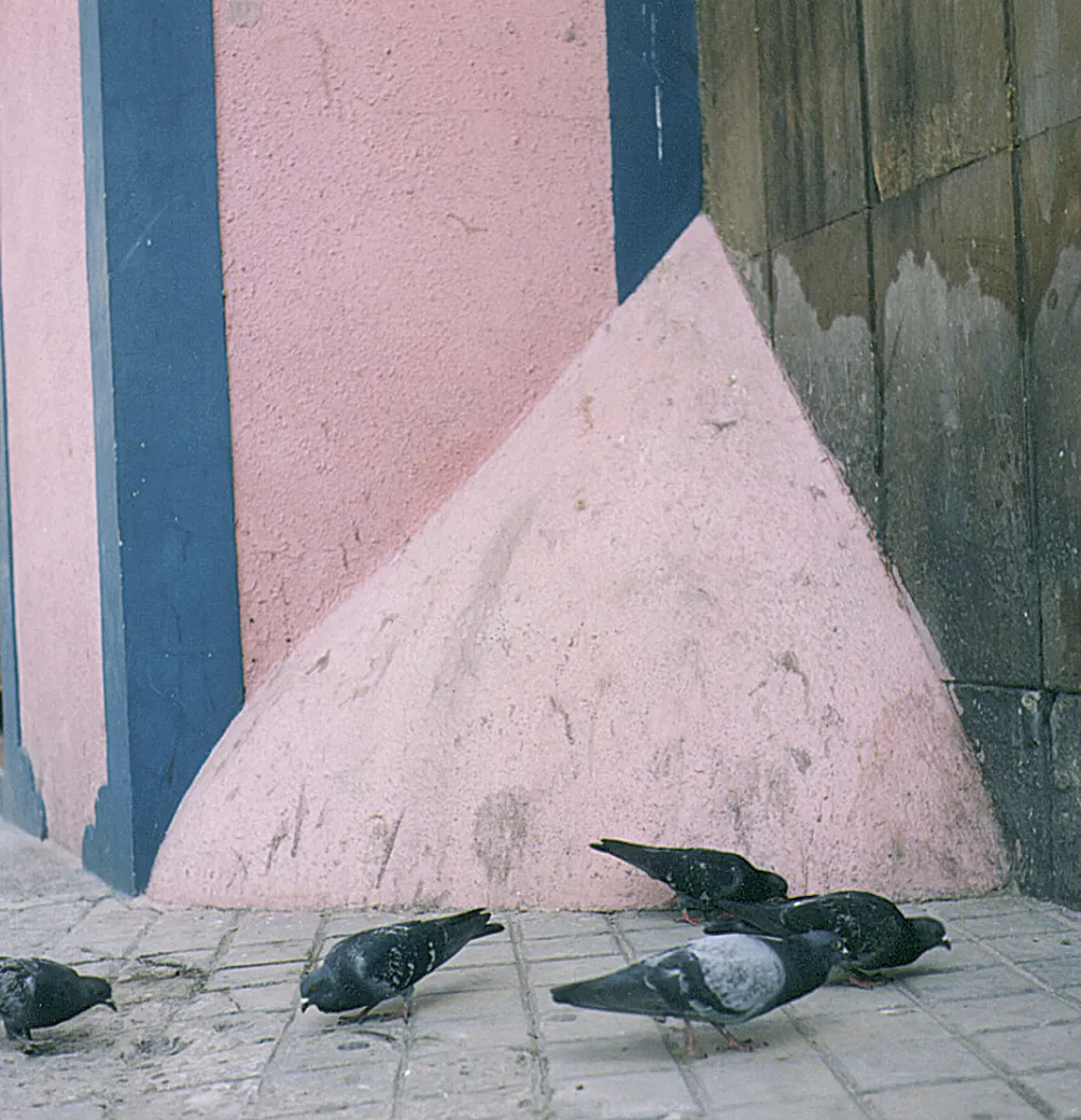
Fat Corners (2000), the winner of the seventh Bogotá Biennial, alludes to a unique architectural situation that occurs in La Candelaria neighborhood, the historic center of Bogotá, and highlights the inevitable relationship that exists between photography and sculpture in the artist’s oeuvre. To prevent the corners of their façades from being used by pedestrians as toilets, the proprietors of businesses fill in and eliminate the space created by the intersection of two walls. This “engorged” corner is a sculptural phenomenon that appears throughout the city. In her work, the artist uncovered events that posit a particular kind of relationship between the public and the private. The street, a public space, is privatized when a pedestrian uses it for an act that our society deems so private. But the experience of emptiness is amplified: this is a space that is filled in, becoming a sculptural event to be discovered. The photography collection that composes Esquinas gordas reveals an event repeated within certain spaces in the city and shows, by registering it, that the sculptural goes beyond the site occupied by a specific form. Placed in an exhibition space, the photographic image, which recorded a sculpture of gesture and movement, generates a new relationship with the viewer, who is invited to recognize in the photograph a repositioning of the sculptural. Notable in both cases is the artist’s role: not creating objects but pointing out an urban sculpture problem. López uses photography not as a register that perceives reality but rather as a tool that seeks to explore different fields of expression.
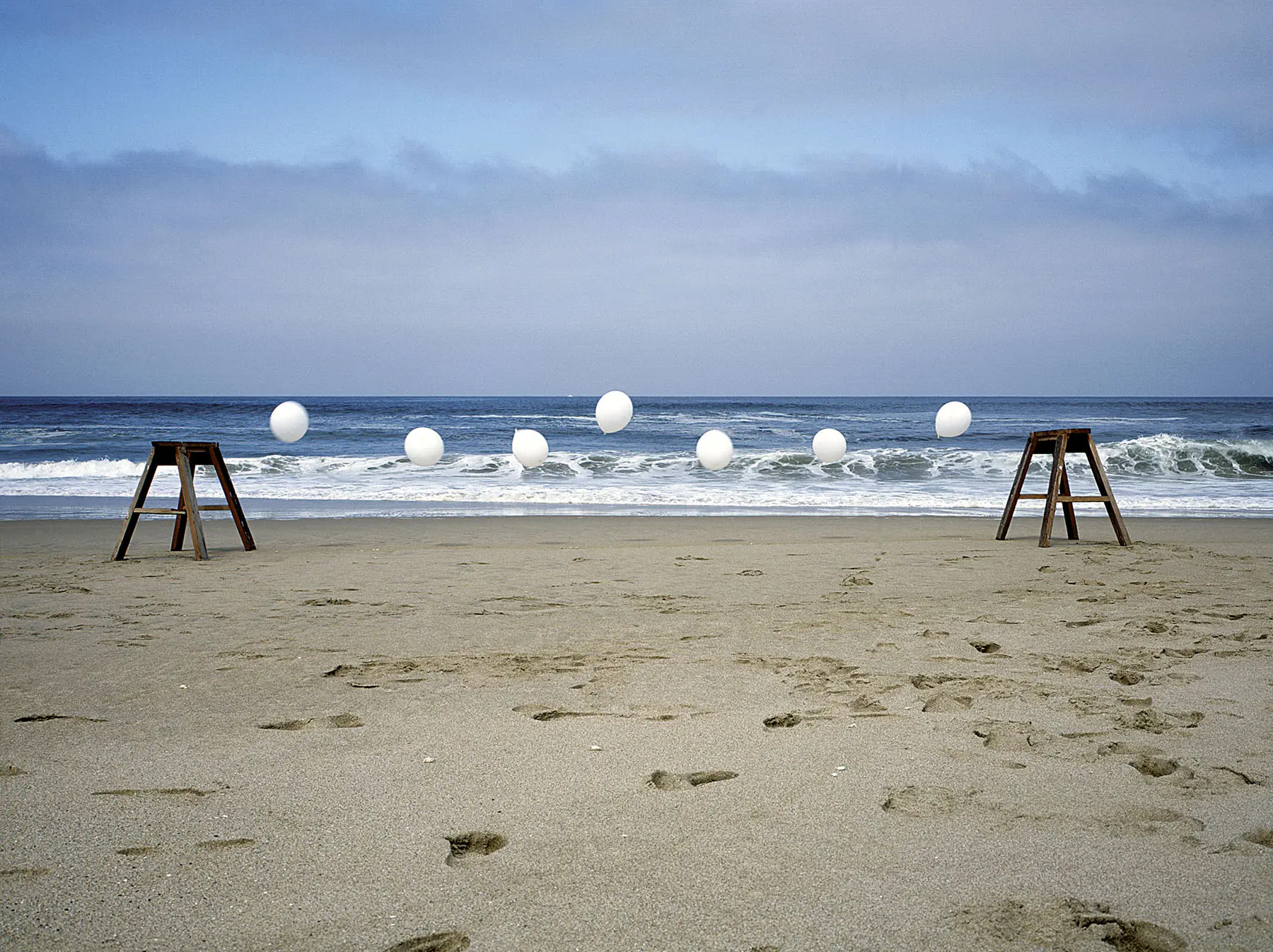
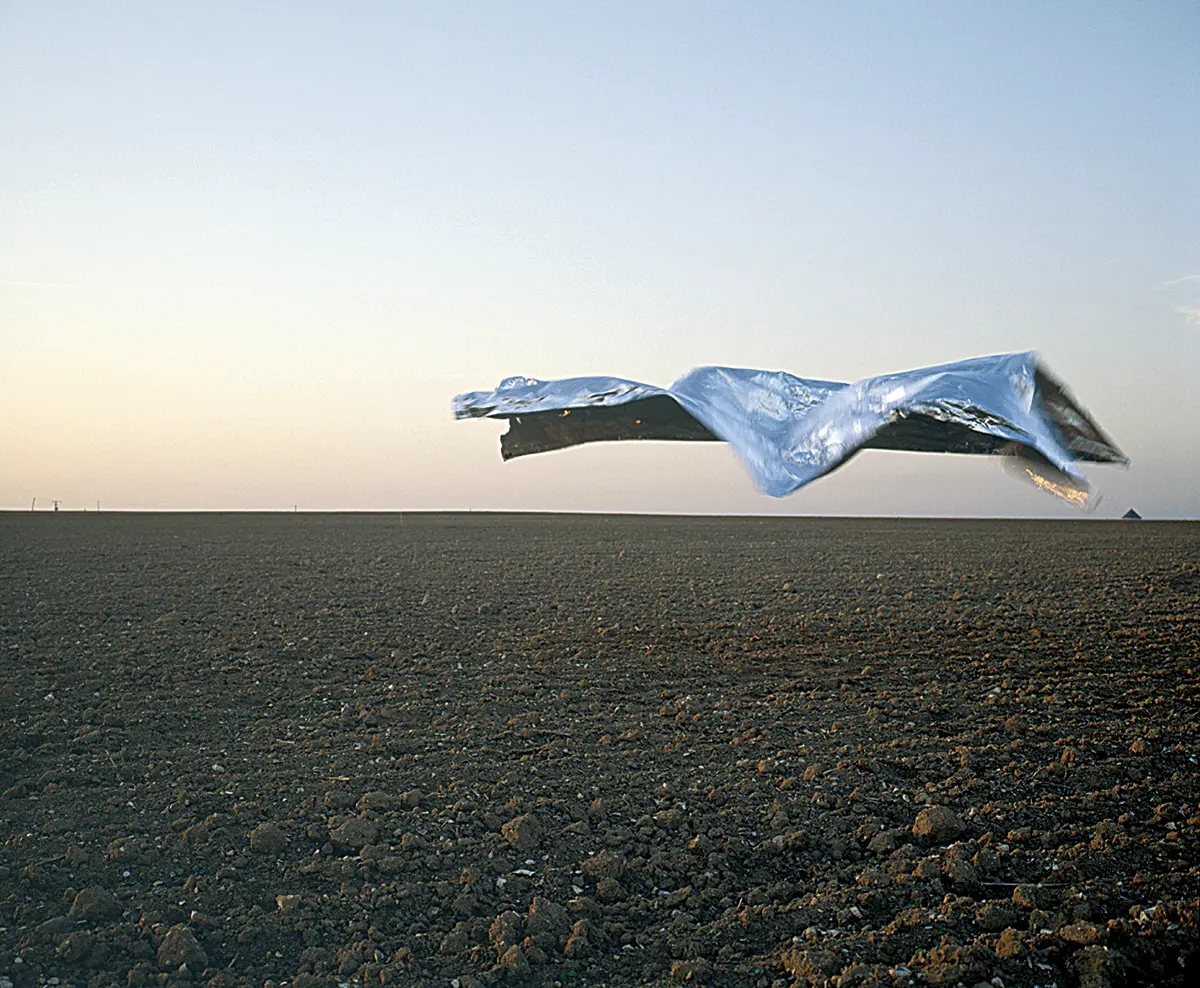
Wind Traps (2002) implies a particular relationship with the landscape. Beginning with English landscapes and with the idea of domesticated landscape, López identified the movement of wind as lines drawn in space, lines that modify objects and change the relationship between gaze and horizon. The observation of body and landscape becomes a space under construction, with ephemeral elements that leave open the possibility of their photographic documentation. The lines can be manipulated; they are not definitive. López makes interventions with precarious materials (blanket, aluminum foil, bulbs of the kind used in children’s parties) that are subject to the surrounding space and change. Her investigation seems to be rooted in Robert Morris’s notions of the landscape’s entropic energies. In this work, the viewer is again invited to perceive the way that the registered sculptural space expands toward the inside of the exhibition space. The notion of emptiness, of what is contained that can’t be grasped, transforms Wind Traps into a particular form of landscape appropriation—linked to displacement, to movement, to a non-place that invites reflection—as it violates the traditional concepts of landscape and of sculpture, questioning values such as form, weight, and volume. According to the artist, photography plays the role of cartography that allows one to point out the landscape, to mark, to fix coordinates, and then, instead of making a plan as a cartographer would, employs the possibilities of multiple editions and the potential represented by photography’s congealed time.4
If Wind Traps reflect a particular relationship with the landscape, Abyss (2005)5 is a reflection that on the one hand questions the romantic and nostalgic attitude found in traditional representations of the landscape, and on the other displays its interest in seeking out that which is not evident, those forces that traverse it.1 López is not interested in the characteristic concerns of artists from the early twentieth century, who attempted to show certain essential elements to characterize the notion of landscape as a geographic and cultural unit, where an imagination of “place” was built in the realm of collective realities. Her investigation proposes a new kind of dialog where the landscape acquires new meaning, a new dimension. The artist says: “What I’ve been trying to insist on over the years is that the problem of sculpture is not a fixed problem, completely situated in a given place where one is able to perceive those properties of form, of volume, but a question that refers to certain sculptural values, values that can themselves be mutable and can be transformed by contextual circumstances.”6
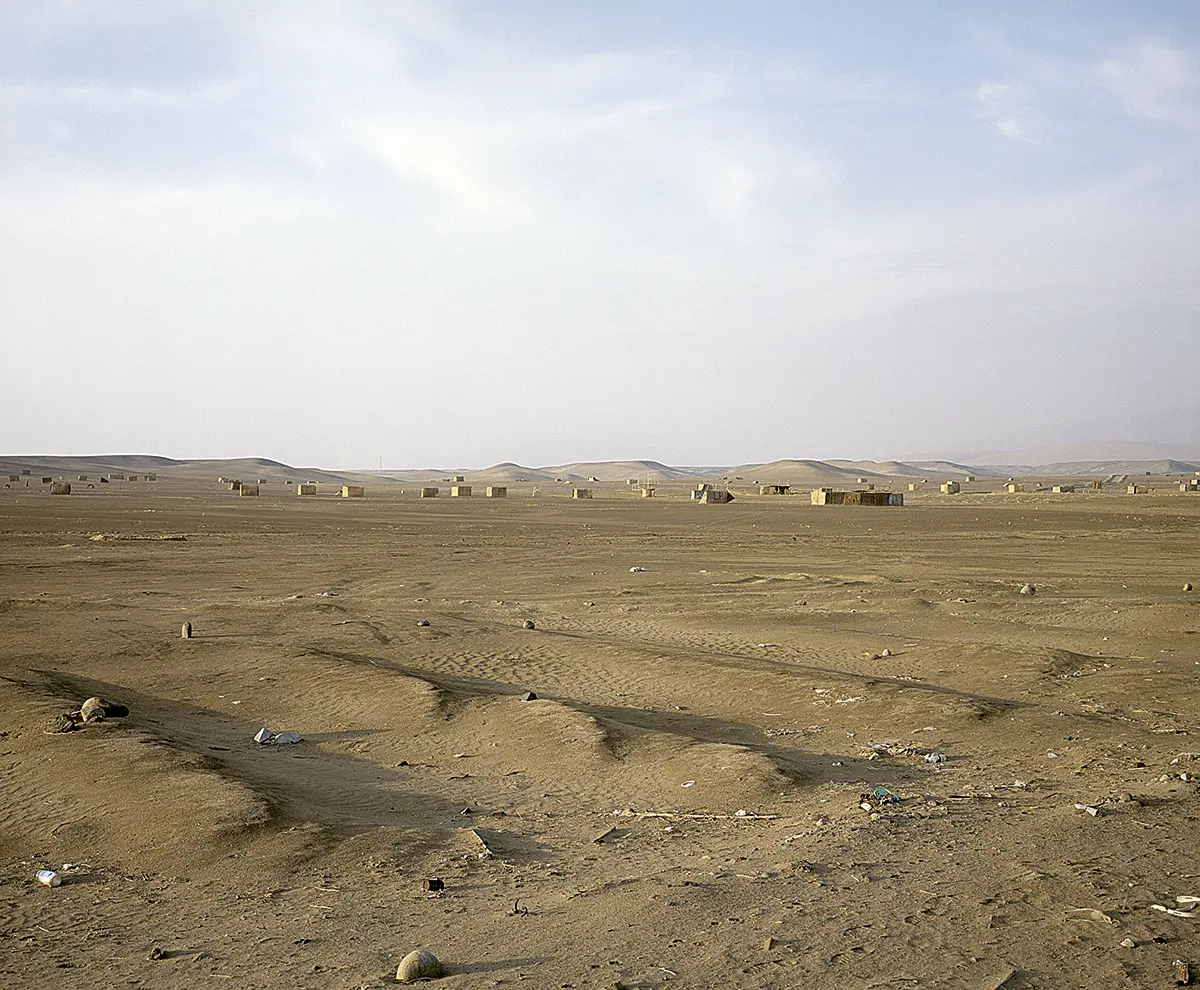
Abyss has a long history. It began with López’s trip to Peru, where the artist discovered, along with the imposing Machu Picchu, a group of precarious dwellings on a beach, Trébol del Pacífico, built by peasants who had occupied the land in order to gain employment in a wind-energy concern that was to be located in the area. The multinational energy company responded to the occupation of the land with the argument that it was now impossible to build the plant. This paradoxical situation left those dwellings as its trace; now empty, they are lined up like orderly geometric volumes in the desert landscape.
In Abyss, López creates a path with her arrangement of gathered and suggestive elements: photographs, volcanic rocks, modeling clay, and rubber bands alongside a little house (casita). The photographs record the state of abandon, the emptiness, generated not only by the spaces that connect one construction to the next but also by the absence of bodies. What is recorded is the memory of something that was there and had disappeared, something that left only a trace, and emptiness. One of the photographs in this work is inverted: the ground is the sky, and that inversion of the landscape makes the observation of space even more complex, challenging one’s perception of weight. The surface seems to bend and crush emptiness. Sculpture can be non-form, the sky a manifestation of autonomous matter.
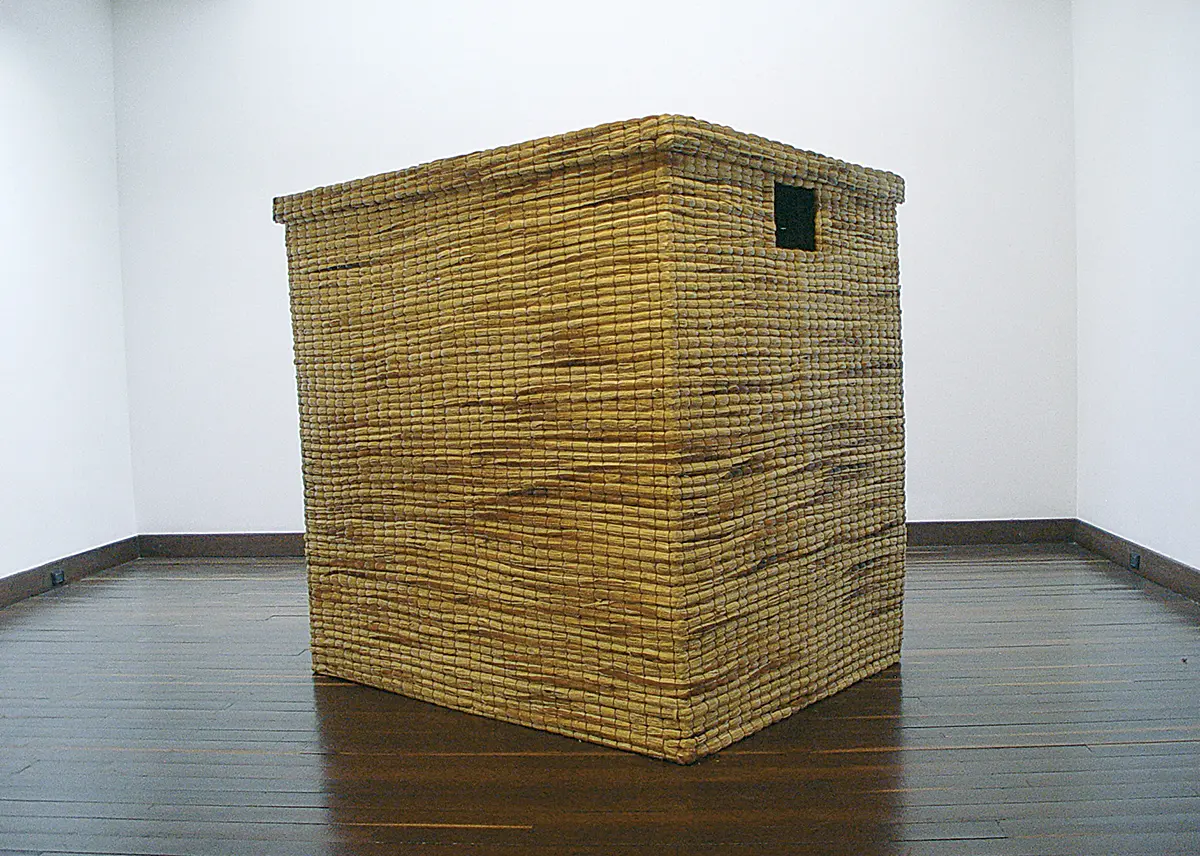
The casita located at the end of the path was built by Colombian artisans that inhabit the area around the Fúqueme lagoon. (Expert weavers of fique, a material obtained from the reeds that grow next to the water, these artisans have long used this material to make baskets for their subsistence.) The casita doesn’t contain anything, it will never be occupied, and the side windows allow viewers to observe the emptiness inside it. This sculptural object reaffirms, along with the path proposed by the artist through the exhibition space, the notion of the emptiness that we inhabit.
In another work, Little Roof, a net made of the same fique as the little house was assembled in the space as a large horizontal surface that, in the words of the artist, “imitates the presence of condensed air in the gallery . . . and the movement generated by viewers between the casita and the photographs propitiate circulation and in consequence a mobilization of emptiness.”7 This emptiness is perceived not only in the photographs that record the desert but also in the relationship with the object. Again the proposed path is key because it defines the relationship between viewer and the work, giving the former the possibility of walking, stopping, and seeing as part of a sculptural proposition.
Insufflare (2007) makes further inroads to the investigation opened by Abyss. The term comes from Latin, defined as “to blow air, gas, or powder into a cavity (of the body).” Again López appeals to a malleable structure, one susceptible to transformation by elements that are part of the landscape: light, temperature, and air currents. The idea is to reveal how the landscape, via the intervention of the aforementioned natural elements, modifies a three-dimensional object that López introduces to it, in this case, a horizontally extended aluminum mesh that changes shape and becomes active. The line that constitutes the horizon shifts and changes as the mesh reveals an undulating line. It is as if the mesh contains other landscapes beyond the linearity of the horizon. We perceive undulations that refer to mountains and to broken surfaces. Matter acts with autonomy, changing shape unpredictably. The horizon line divides the landscape in two, but the mesh responds according to the particular context. As mounted, the photographs become a function of what is represented. They not only document but also transmit the lived experience of the changes, the sequence of movements that the intangible elements generate in the displaced mesh. By suspending the undulating aluminum mesh from the ceiling of the exhibition space, López allows the viewer to perceive in real-time the movement captured by the photographs. The free will of the material is revealed.
NOTES
1. “Contaminados,” in Nuevos nombres (Bogota: Biblioteca Luis Ángel Arango, June–July 1996), 11.
2. From the text of Rosario López’s conference, “Insufflare, la escultura como un espacio en movimiento,” Bogotá, September 2006.
3. Lao Tseu Tao King, Richard Wilhelm, transl. 1978.
4. Interview with the artist, November 2007.
5. Rosario López presented this work at the 2007 Venice Biennale, where she was invited along with Oscar Muñoz and José Alejandro Restrepo.
6. Gilberto Bello and Víctor Viviescas, “Abismo de Rosario López en la Bienal de Venecia,” interview published in the UN newspaper, Universidad Nacional.
7. From the text of Rosario López’s conference, “Insufflare, la escultura como un espacio en movimiento,” Bogotá, September, 2006.
IVONNE PINI
Executive Editor for ArtNexus, Teaches at the Universidad de los Andes and Universidad Nacional de Colombia.