
SKE, the moniker used for over 20 years by
Eliezer Pagan, one of Puerto Rico’s most prominent urban artists and an
internationally-recognized figure since the late 1990s can be located among
the graffiti artists who, like Jean Michel Basquiat and Keith Haring, moved
from ephemerally stamping their art in controversial public spaces to use
different supports that allow their work to be exhibited in galleries and
museums.
SKE (pronounced Skí) was born in 1971 in a proletarian neighborhood within a municipality of Metro San Juan, and since the age of 10, as a public-school student who signed JOKER, was unable to subdue his desire/mission to draw and write his name on any available surface, be it the classroom or on neighborhood walls. But that child was not to stop at the odious phase of just “tagging” his name anywhere he could, because he possessed (and possesses) one of the most important qualities for an artist who wants to grow and stand out: to approach those who can teach him, and to learn from them —in his case, from the discourse of hip-hop, which was gathering force, to friends with similar interests who gave him books that introduced him to “big league” graffiti, to intelligent and transcendent urban mural art. And it is with this drive that SKE, who has been active for more than 25 years, developed into a unique chronicler of Puerto Rican society, one who has achieved a refined and dramatic synthesis of Puerto Rican urban art and the canons both of Modernism and Postmodernity.
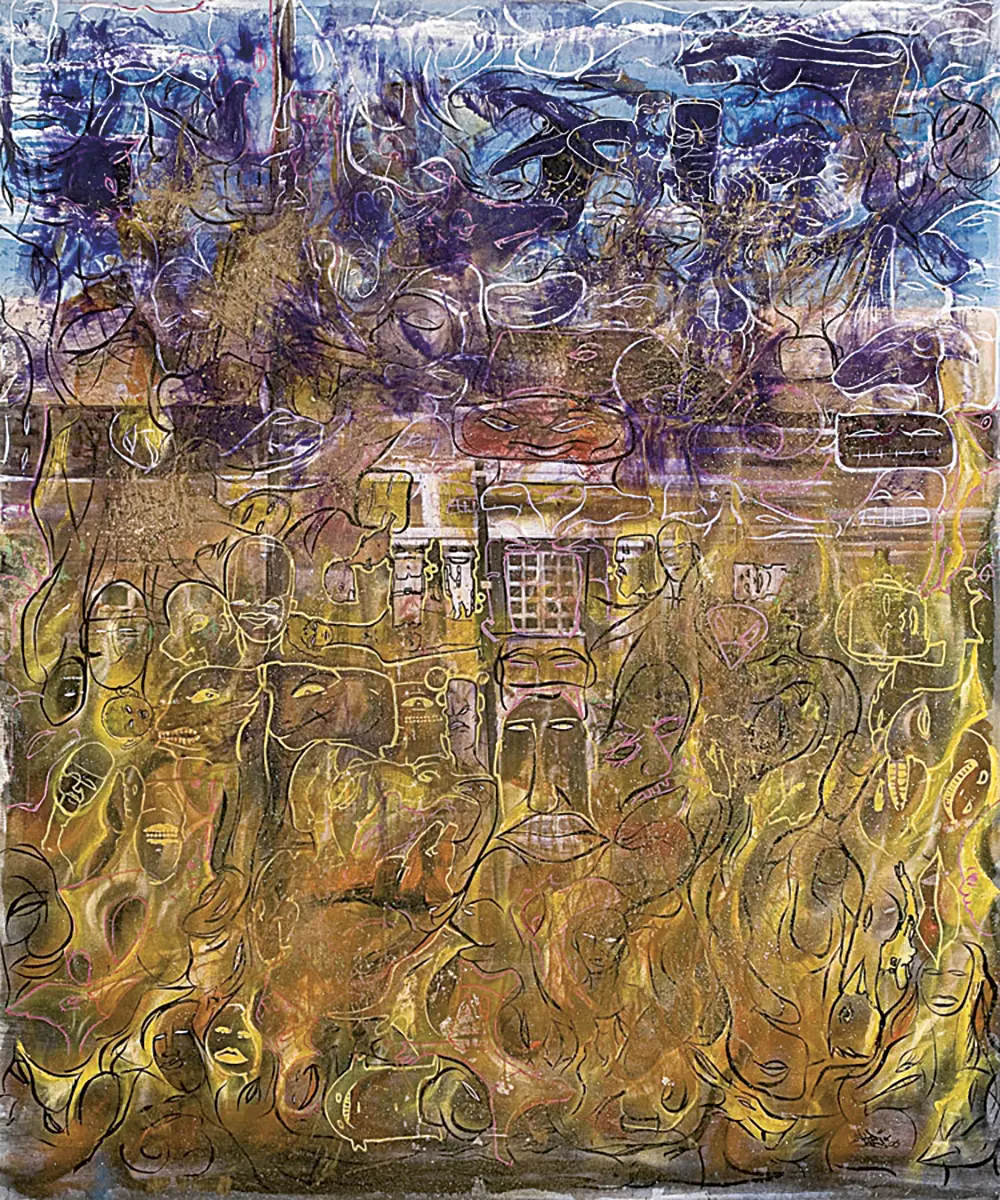
Early on in his career, having realized the importance of aesthetics and the power of his work’s message, SKE set out on an experimentation “journey” through everything that relates to urban art. Key in this process was ROM (Efraín Colón,) an older graffiti artist, experienced and bohemian, who introduced him to much more sophisticated techniques and the themes of “serious” graffiti. At the age of 20, in 1991, SOZE, a childhood friend then living in The Bronx in New York City, invited him to visit the graffiti capital of the world, where a universe of possibilities opened for him.
A few weeks after arriving in New York, SKE joined the well known, international FX Crew, establishing himself as someone whose discourse was extremely suggestive in its depth and possible readings. His work was to immediately establish a dialog with some of the most recognized young urban artists of the United States, and, through the Internet or specialized publications like The Source, he gained worldwide renown; over time, he would be invited to “tag” live in several US cities as well as in Italy, Brazil, and Japan.
What came after that was a well-deserved protagonist role in the history of Puerto Rican graffiti. His complex and bold monumental murals established him as a prodigious and powerful urban poet, capable of combining dissimilar images to create forceful metaphors that summarize many of the socio-economic and political issues that define his existential reality.
Recently, and with the same passion that drove (and drives) his public “tagging,” SKE has decided to bring his work to new and more accepted supports, which will help him achieve a significant presence in more traditional artistic circuits. And this new facet works perfectly for him, because, despite being self-taught, his historical knowledge of art is impressive and is reflected both in his urban art and in his new paintings. SKE not only freely takes from Basquiat and those who came in the wake of this revolutionary artist, but we also see in his work influences that range from Picasso to Gorky, from Segui to Tapies, from Dubuffet to Lam and Matta, from Frank Stella to Pollock and Cy Twombly —influences he makes very much, and very intelligently his own.
In his new work, presented at Galería La Pintadera under the title of First One Man Show, SKE does not reject the connecting thread that had marked his previous production (which combines the building of his name, his hallucinatory worlds, his mastery of classical portraiture, and his very interesting approach to eroticism and sex,) and each one of his current scenarios is a visual challenge that reveals we are faced with something new, original, powerful, fascinating, tempting.
How does he do this? For this show, SKE has been able to bring to life on canvases, wood supports, and mirrors many of his beings/forms/entities/forces/faces/masks through the use of colors, depths, textures, and transparencies that are dramatically attractive, generated by means of different pictorial resources (from brushes to sprays, from burning the wood to sprinkling luminescent “shine dust” of the kind used in car paint) and the magisterial use of resins. Thus, many of the paintings and the five “sculptures” (Quintet, five boldly sensual fiberglass breasts) that comprise First One Man Show is excellent and challenges the viewer in various ways.
One needs to understand that it has been artists like Basquiat and Haring in the US, and courageous “taggers” like ISMO, Sofía, REX, MERO, and, of course, EKE, who with the originality and excellence of their aesthetic discourse have forced art lovers, collectors, art critics in this globalized world to accept (and value) an aesthetic and ethical force that remains controversial but is unstoppable and represents, greatly, the historical era that began in the 1960s (even if we all know that graffiti was born during the Urban Revolution 10,000 years ago, and was present in Mesopotamia and Egypt, in Classical Greece, in Republican and Imperial Rome.)
MANUEL ÁLVAREZ LEZAMA