
To the Argentine public, two recent
exhibits at the Museo Nacional de Bellas Artes were of great interest for the
presentation of works from the Ulm School of Design (1953–1968) and the works
of Tomás Maldonado from the 1950s and 1960s, as well as works from the artist’s
recent return to painting.
When Maldonado left Argentina in 1954 to work in the city of Ulm in Germany, he left behind what he considered to be a regressive and limited artistic practice and he envisioned in design an open opportunity for transforming the human physical environment. To allow the general public to learn about the Ulm School, the Ulm exhibit was divided into several sections: History and visual communication; Industrial design; Film; Interviews with former professors and students, and an assessment of the school’s international influence.
Max Bill was the Ulm School’s first president, from the school’s establishment in 1953. Maldonado joined a team of renowned teachers including Max Bense, Gui Bonsiepe, Hans Gugelot, Friedrich Vordemberg-Gildewart, and Alexander Kluge. When Max Bill left, the school abandoned Dessau Bauhaus-influenced guidelines and opted for a “design model based on technique and science. The designer was no longer a superior artist, but an equal partner in the decision-making process of the industrial production,” according to Otl Aicher, one of the project’s creators. Thus, the exhibition displayed visual representations of this institution’s pedagogic proposals, such as interesting pieces of furniture designed at the school, as well as posters, logotypes, several kinds of typographies, and technical cutting-edge objects for everyday use.
With contributions from institutions and collectors in the country and abroad, the Maldonado exhibit was divided into several parts that embodied a completely different type of interest. One of these sections presented works that Maldonado created in Argentina when he belonged to the Concrete-Invention Arts Association.
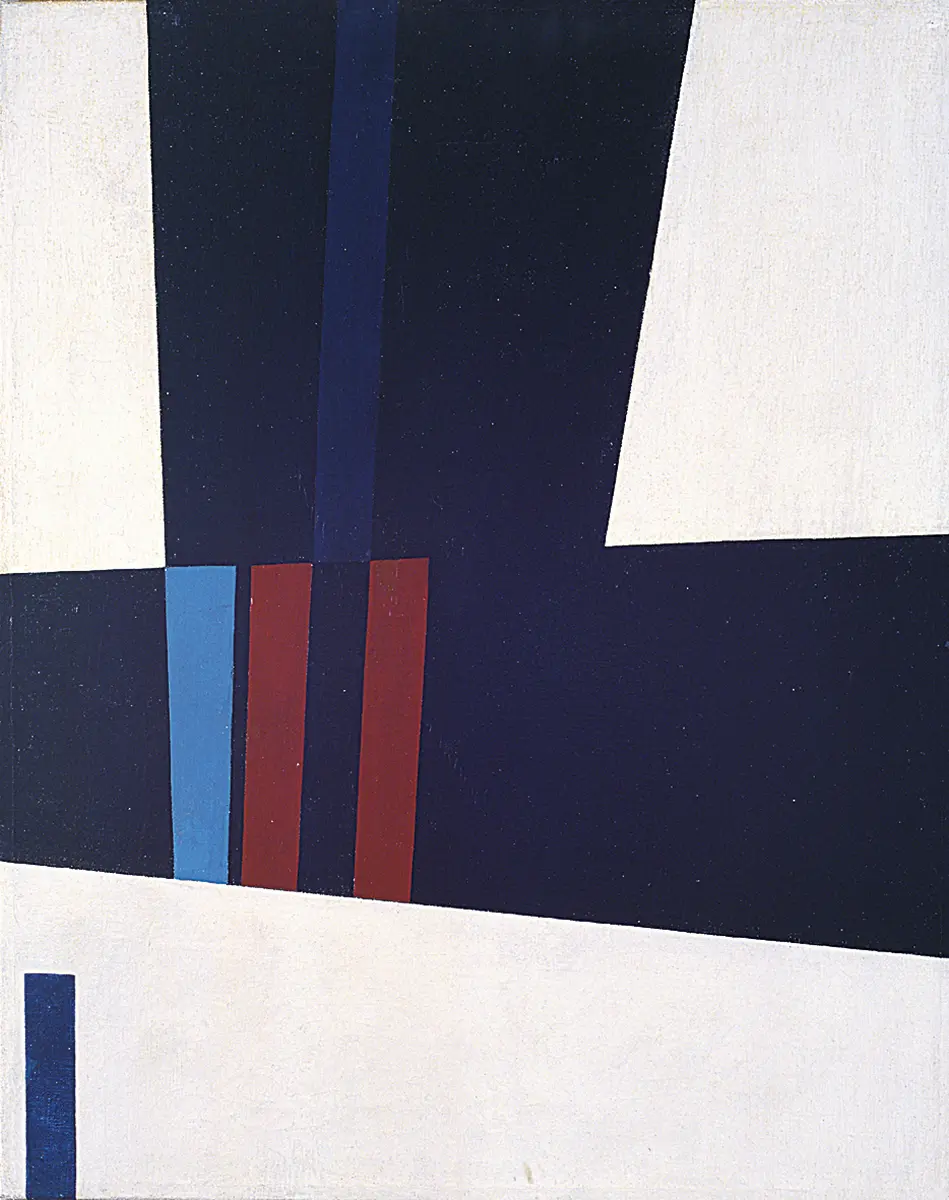
In 1948, Argentinean art critic Córdova Iturburu called attention to the “structured creations with diverse material elements created by the will of inventors gifted with fantasy and aesthetic sensibilities,” and he went on to highlight Maldonado’s work. This was a period when the artist, having returned from Europe, was at the top of his game. The works of Maldonado exhibited from this period show all the subtleties of his research of space, the rhythms created by lines and small shapes, and the use of unmodulated flat colors. The works’ pictorial quality was what made the artist excel from the 1940s, and this remained with him during his years of production in Argentina up to his departure to Ulm in 1954.
Thanks to the collection of works displayed, the general public and art critics had an incredible opportunity to bring together what they observed with the historic relevance that the constructive vanguards had acquired in Argentina in the 1940s.
In one of the roundtable discussions accompanying the exhibit, Maldonado affirmed that the interest in complex symmetry, in the structural and cognitive, and in the examination of language were already present at the Concrete-Invention Arts Association.
The exhibit’s section with books and written texts by Maldonado were also of great interest. Several issues of the Casabella magazine was on display—Maldonado was its editor from 1977 to 1981—as well as books: Vanguardia y Racionalidad (Vanguard and Rationality); Técnica y Cultura (Technique and Culture); Real y virtual (Real and Virtual), and Diseño industrial: un Reexamen (Industrial Design: a Re-examination), among others.
In a brilliant article in the publication accompanying the exhibit, Raimonda Riccini affirms that one of Maldonado’s greatest qualities as a thinker are knowing how to take advantage of the intrinsic cognitive potential of undetermined areas of the disciplines and problems he has debated.
The last section of the Maldonado exhibit showed the artist’s works since 2000 when he returned to painting. The National Museum of Fine Arts presented these never-before-exhibited works in homage to the artist. Almost flirtatiously, the artist described these as works that could be considered anachronistic. They could be seen as such for viewers who like definitions and labels. In actuality, these works possess the same passion, intelligence, and sensitivity as his previous works—the same refined and powerful dynamism. In these works, there is also the presence of joy, a creative delight that is a true celebration of life.
NELLY PERAZZO