
The Abyss as Operational Matrix
The works of this multifaceted Brazilian artist (born 1928, Natal) scrupulously elaborate and complexly manipulate several hypotheses based on the well-defined program that has driven his long career, which conjugates art, technology, intuition, science, playfulness, invention, and constant experimentation. As enigmatic devices and generators of secret meanings, Abraham Palatnik’s Aparatos Cinecromáticos, Objetos Cinéticos, Progresiones, Objetos Lúdicos, Relieves progresivos, neo-geometric paintings, furniture, and other bodies of work illuminate the way the artist has been able to offer a distinctive, differentiating framework for modern and contemporary artistic creativity.
The very nature of his optical, luminescent, chromatic, and textural works, which are essentially bizarre and “other,” immediately provokes a vast interpretive tension that exists as a complicit, mobilizing production inscribed in our questioning. Without that approach from the viewer, which renders the machine active, the enigma and the secret would remain. It is impossible to invest the artistic artifact with meanings from a position of certitude. In this sense, Palatnik summons art into a magnetic, intermittent space, one that is foundational to the impalpable. His ordering will turn on earthly chance, spurring a triad of successive actions: perceiving, inventing, and playing.
As the poet Ezra Pound put it, “Art attacks the absolute in the domain of singular life” and, because of this, it achieves an extreme form of communication. Palatnik’s poetics, “salvaged” from the Latin American and international avant-garde and post-avant-garde, clearly appear as a point of inflection and reversion toward the analytical expansion of the various systems of art with which it continues to operate.
Born in the entrails of modernity, Palatnik’s aesthetic philosophy—and, in consequence, his specific potential—unfolds in an order that cannot be fixed or stabilized, rejecting what Adorno termed “that crazy illusion of truth.”
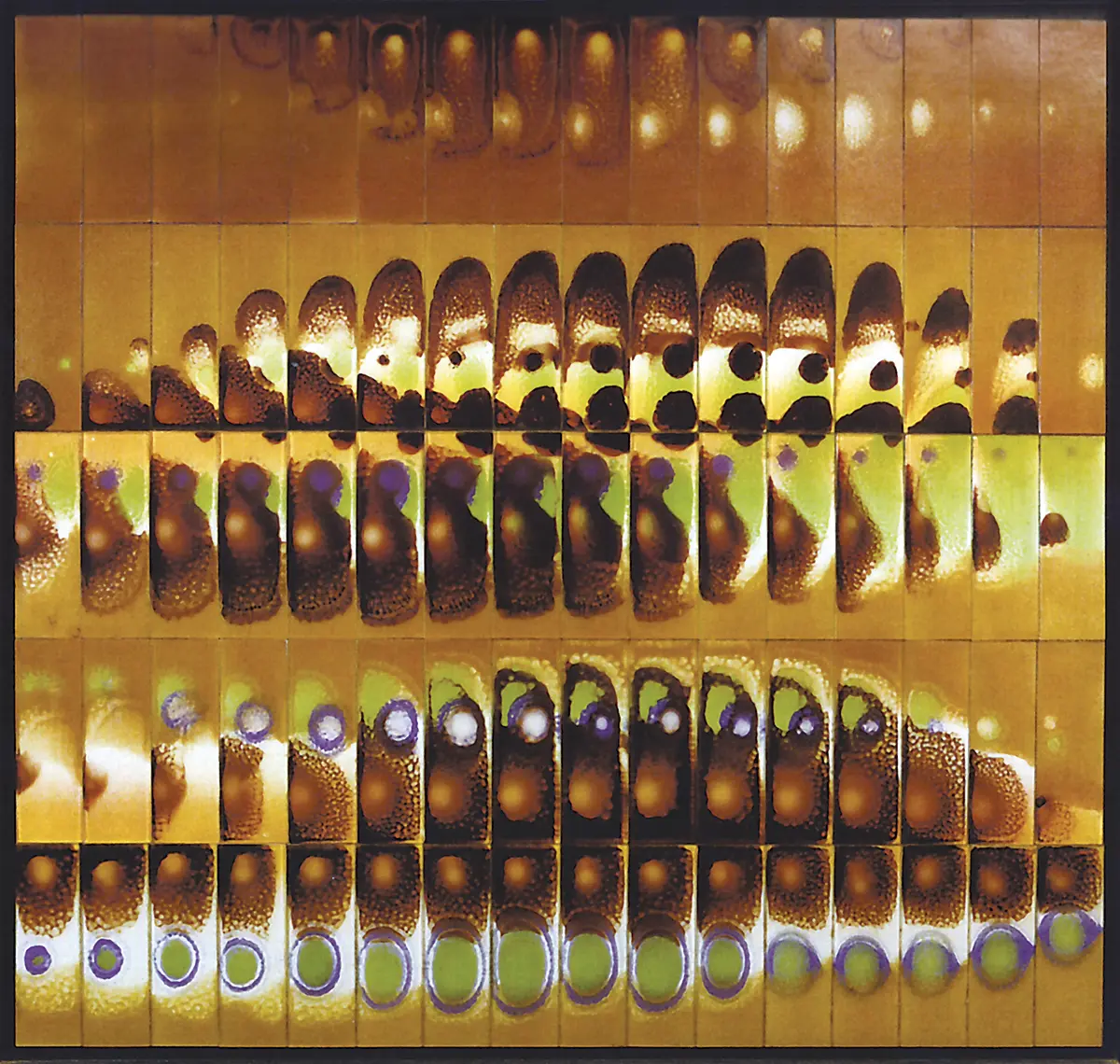
Let’s briefly review his story. For that, we must refer back to Palatnik’s first Kinetic-Chromatic Apparatus, presented on the occasion of the first São Paulo Biennial (1951): a single work of art “planted” in front of the precipice. It was the materialization of that which cannot be conceptualized. Indeed, Blue and Red in a First Movement did not fit with any of the disciplines convened for that temple of contemplation that was the Biennial, much less in its maiden edition. Palatnik’s work broke into the scene with unsettling audacity and novelty. Built from motors and lamps, it substituted the natural dimension of pure pigment through light refraction, with centralized electrical contacts that controlled the speed and duration of each light beam. What one saw were colored projections, flashes of light; Palatnik painted the surrounding space with a particular luminescence. It was extremely difficult for the event’s officials to incorporate the work. But the first Kinetic-Chromatic Apparatus was exhibited in the space reserved for the Japanese delegation—which never reached Brazil—and won an Honorable Mention from the jury. Many Latin American critics were quick to echo the reception of this unprecedented work, including Argentina’s Jorge Romero Brest and Brazil’s Mario Pedrosa. The latter was the author of the work’s title since it was necessary to define it somehow; after a second viewing, the jury reached the conclusion that the work needed to be part of the collection of São Paulo’s Modern Art Museum.
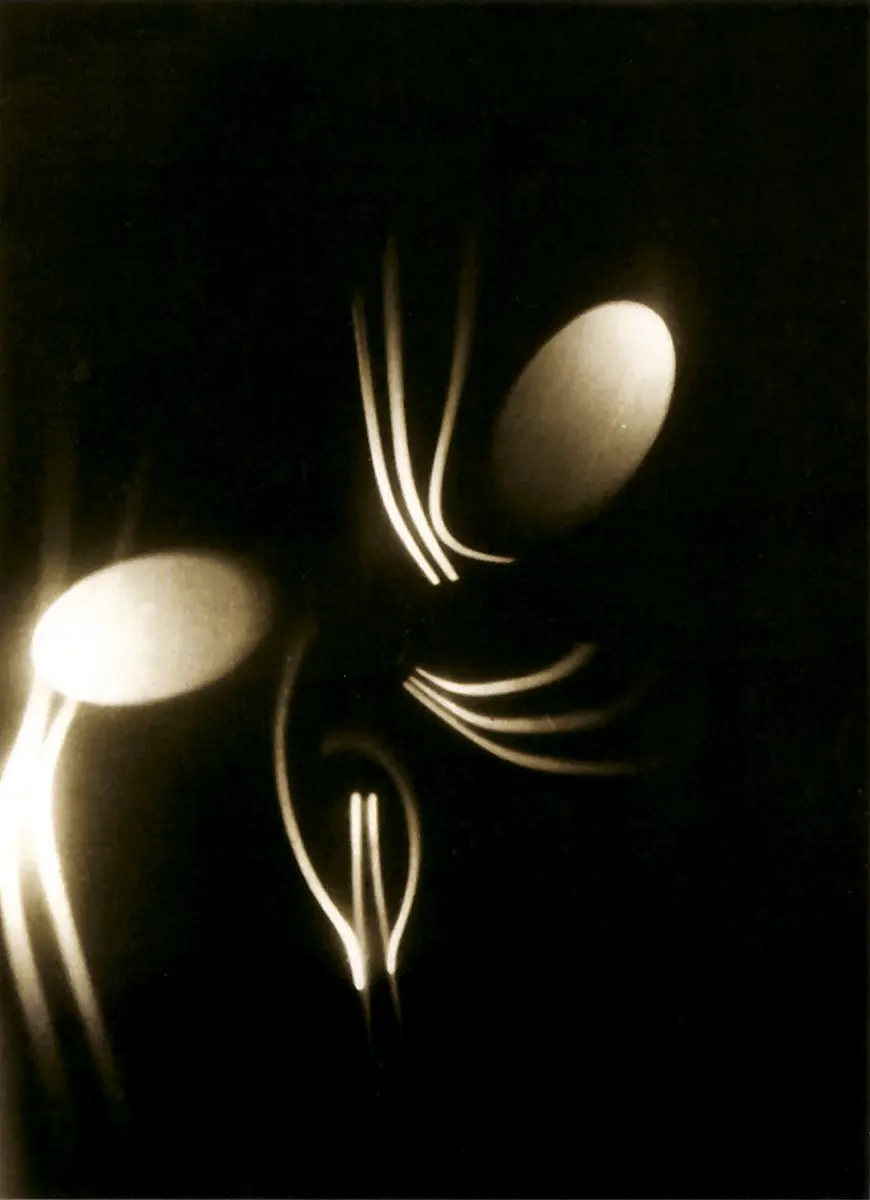
At the threshold of the unimaginable, Palatnik created a “cognoscitive world” that was perceptually strange, forged in the muteness of the outsider, in constant flux, resonant with multiple voices, and based on profound synchrony with Einstein’s relativism and quantum mechanics. Heisenberg’s and Bohr’s contributions that received the Nobel Prize were not alien to all this, taking advantage of the aesthetic legacy of the new physical order, which becomes enmeshed with the fortuitous and the indeterminable. From that standpoint, the entire series of Kinetic-Chroatic Apparatus has to this day radically eroded the paradigm of the measurable by vanishing “the given,” “the predetermined” as “physical evidence.” These pioneering works situated the viewer in a “background-less” terrain: at the edge of the secret and the enigma of a highly seductive, borderless ratio. Palatnik is a creator/inventor with ideas closely connected to Goethe’s theory of color, which was proclaimed in The Elective Affinities: we dream in order to be able to someday “see.”
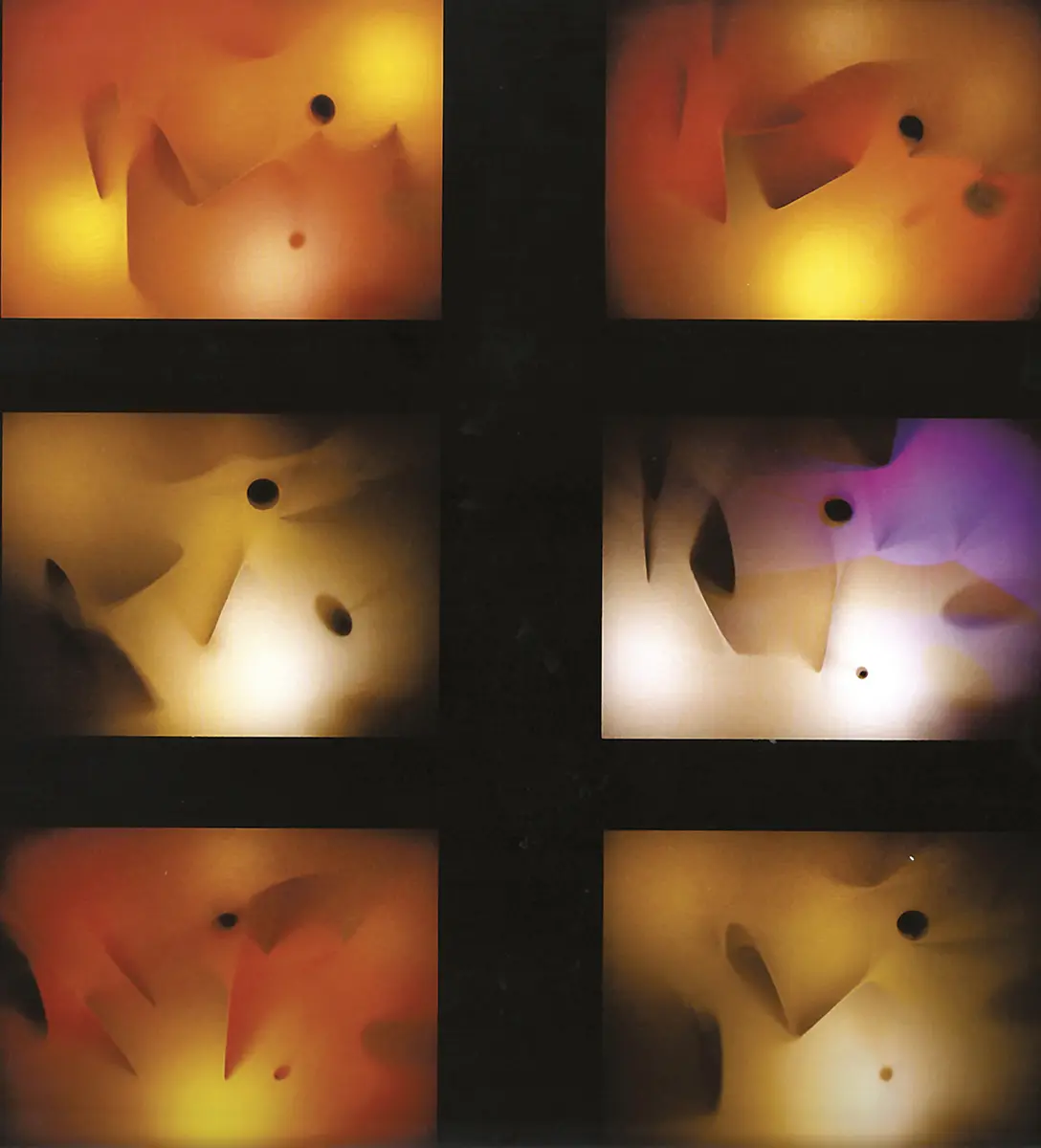
For example, we can cite from Palatnik’s copious body of work: the increasingly more complex and elaborate prototypes of the Kinetic-Chromatic Apparatus (1955) in the Gérard Loeb collection, which generate a sequence of seven images created by synthetic cloth, wood, metal, lamps, and motors; the 1960–99 work of the same name that generates five-light sequences and is now in the Gilberto Chateaubriand collection at Rio de Janeiro Modern Art Museum; the one dated 1960 in the Malba Museum Collection at Constantini Foundation Buenos Aires; and the oldest of the series, created in 1954, which produces twelve different images of strikingly full color and is now in the Nara Roesler Gallery collection in São Paulo.
This subtle, infra-light matter, which doesn’t exist beyond a discontinuous emission of movement, light, and color, has a theoretical substratum that the artist conveyed in a manifesto titled Technology and Art (1984). Here, Palatnik emphasizes the need to observe nature as a wide range possessing organic and inorganic configurations both simple and complex, and subject to a “humanized,” non-mechanistic technology that provides a potentially active entry into the ever-shifting dynamics of natural forces. To follow Palatnik’s reasoning, the natural and the artificial complement each other and are, thus, vital components of our culture.
Nevertheless, we make mistakes when it comes to perceiving, seeing, to scrutinizing. We continue to be driven by stereotypical codes and descriptions; if the entire world in which we are immersed and in which we interact with others is codified to a high degree of complexity, we are left to “dismount” the old sensory means of comprehension through the means of art allied to technology and science. To that effect, Palatnik proposes that we find new relationships of form, contour, outline, pattern, sequence, structure, musical configurations, mathematics, geometry, and even other modes of thinking and conceptualizing. This open and non-dogmatic position brings him closer to theories of catastrophe, chaos, and disorganized systems, to the mathematical models of morphogenesis, and to fractal theory. None of these are alien to an intuitive component, as he puts it:
The action of a certain form of intelligence might already be integrated into the process of intuition. A complex problem blows our minds fuses, yet the solution leaps forth unexpectedly, and all of a sudden we find logic and order in various irregular events and facts in the midst of disorder. Important scientific facts have been prefigured by an intuitive perception. Without intuition, we would have no artists, who essentially give us a point of contact with the unexpected.
The “meaningful intention” of the Kinetic-Chromatic Apparatus posits a delicate interval of sequences that combine to make an ephemeral presence of image, color, and movement, which are perpetually present without fully being there and indicate an absence of what was seen and experienced, which is nothing but a pure trace, mark, or echo. In these works, the illusion of a definitive deciphering, of the possession of truth, is no longer ours. The important thing is that Palatnik points to the negation of all limits inherent to the definition of the “condition of the work of art” and labors for its intrinsic expansion by locating himself “beyond art” in his persistent creative energies. The greatest works of art have traversed modernity and been retroactively aligned in this elaborate contemporaneity; they have exercised and continue to exercise, at the analytical level, their own self-affirmation.
The theoretician, artist, and co-founder of Arte Concreto-Invención (1945), Tomás Maldonado, as the director of the Superior School of Form in Ulm, in 1967, recognized the fundamental contributions of his Brazilian colleague to kinetic art and to Neo-concrete art. He saw Palatnik as one of the “greatest precursors of the return to an aesthetics of light and movement in the early twentieth century.”
Toward New Modulations of the Senses: From the State of the Possible to the State of the Existing
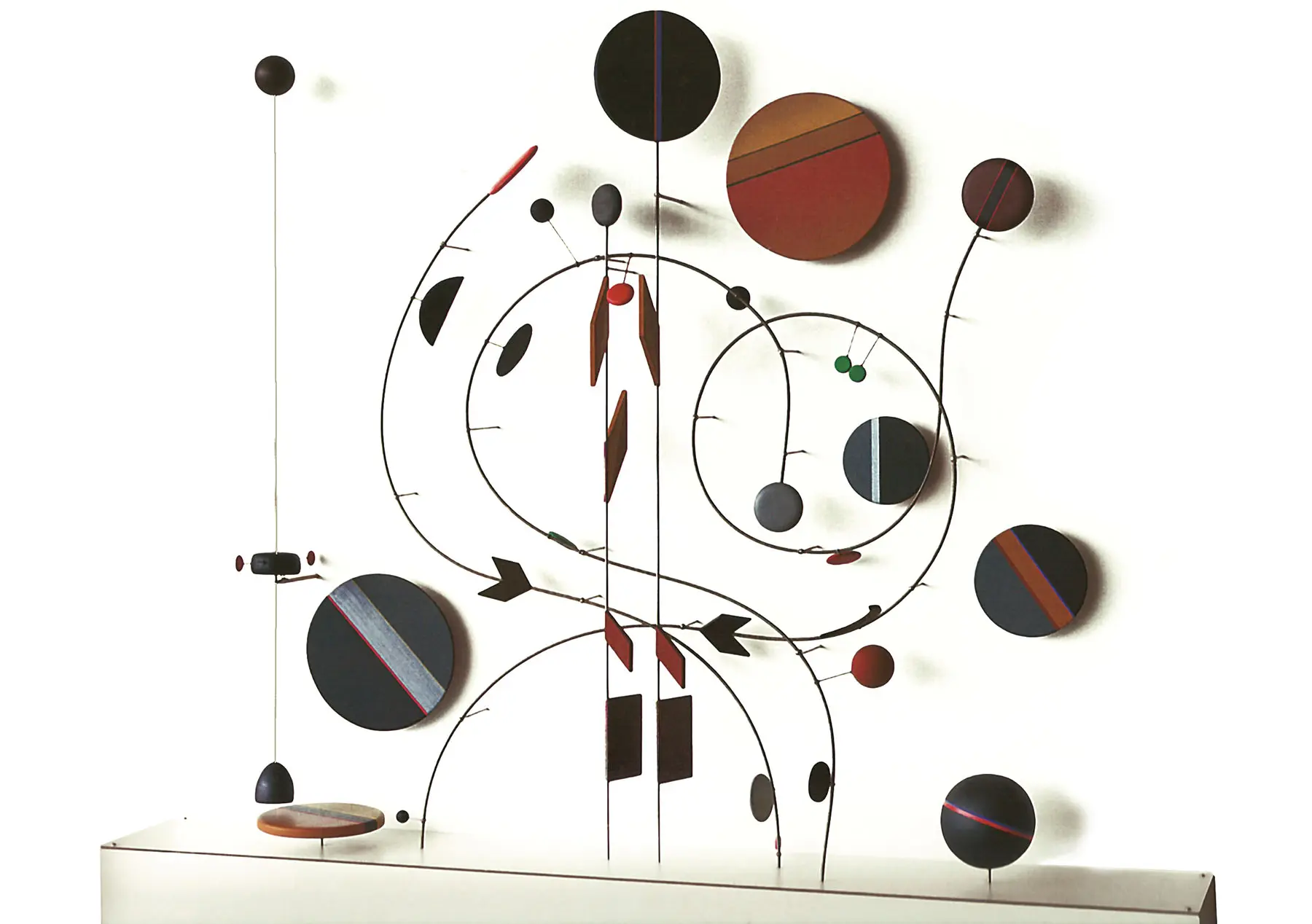
The unfoldings and modulations developed by the artist in different series are disturbing in their uniqueness and carry a different, emerging tremor. The Kinetic Objects explore rotational and displaced perspectives of movement, based on electrical circuits and wired speedometers. In Formica and white wood structures like tableaux objects or tableaux reliefs, very subtle and almost aerial geometric configurations execute a continuous, rhythmic dance as if they were “three-dimensional pictorial machines.”
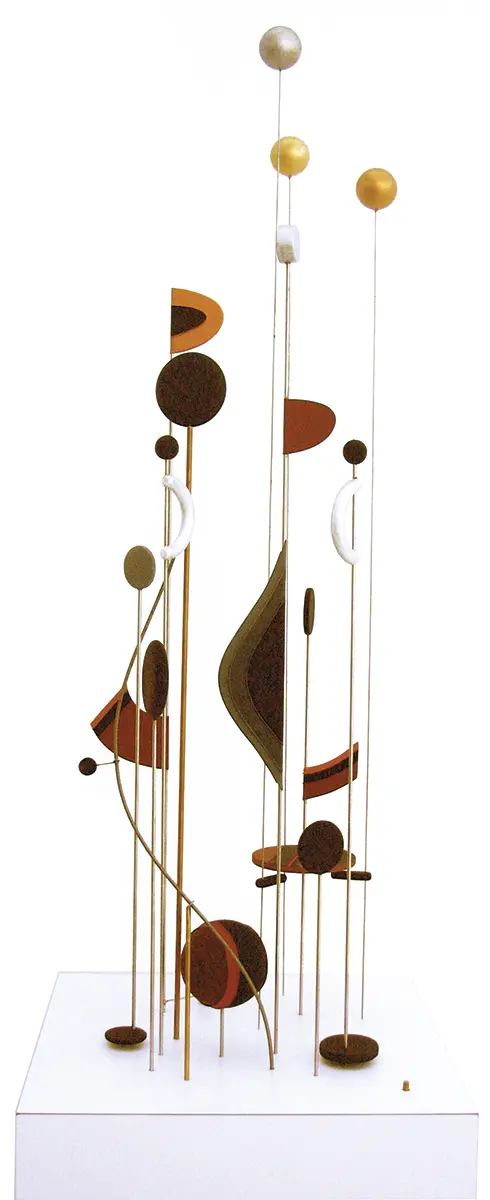
Palatnik’s Kinetic Objects develop their own singular trajectory; they appear as playful aesthetic devices, the crossbreeds of aesthetic and practical aspects, nourished in the dynamic of an aesthetic of production and an aesthetic of reception. For the creator of the Kinetic-Chromatic Apparatus, that which is perceived doesn’t need to be remembered, indicated, underscored, or emphasized; rather, the artist’s task is, above all, to stimulate the subject to “see” with different eyes all those substrata of an invisible reality that exist beyond appearances. In that sense, Kinetic Object C11 (1966–2004) and Kinetic Object (made of wood and dated 1986) are extremely relevant, as they bring us closer to the diffuse borders between technological art and programmed art. In this sub-series of works conceived in 1964, thin spikes and metal threads support minuscule discs and ellipses and concentric spheres painted in rich, flat colors. They elaborate on the potential of constructing magnetized fields that require the viewer’s active participation to complete the work. Using negative and positive poles, Palatnik creates assemblages and boxes that enclose different instances of movement with magnets in order to attract or reject the geometric shapes via haphazard or random games.
The artist recently participated in the group show Poetas da Cor (Poets of Color), where he presented, among other works, some of his Kinetic Objects. As part of this tribute to Israel Pedrosa at the Niteroi Modern Art Museum (MAC), Rio de Janeiro (through June 29, 2008), Palatnik was represented alongside figures of the stature of Eduardo Sued, Almir Mavignier, José María Dias da Cruz, Ione Saldagna, and Aluisio Carvao.
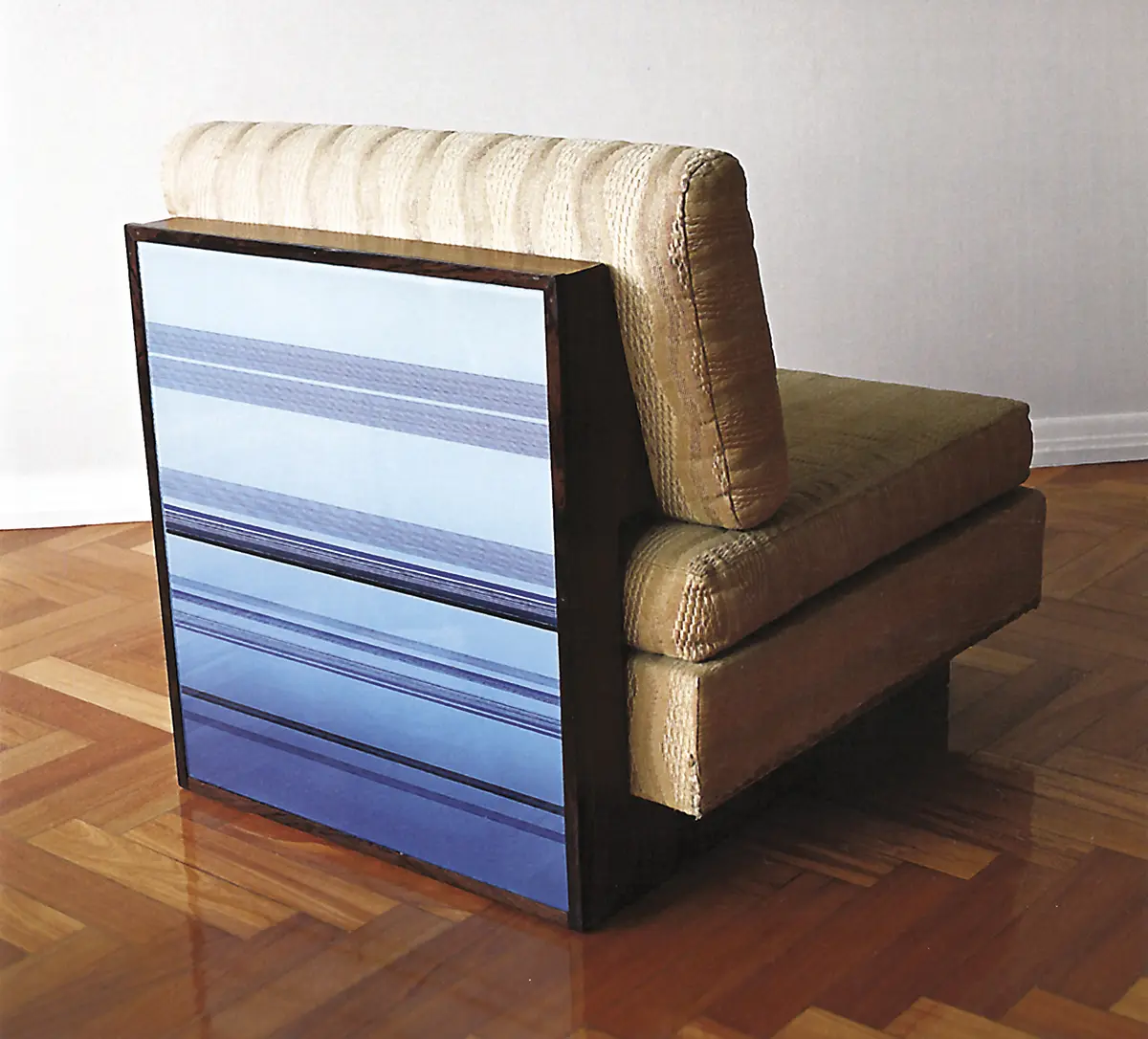
Distant from any communicative immediacy, something so widespread in the current visual arts, Palatnik’s work filters dense processes of meaning, which have been forged in experimentation and self-reflection. This led him to produce his memorable Progresiones both in wood and in polyester resin, his Progressive Reliefs, and works that mix functional and artistic aspects, such as his furniture and design objects.
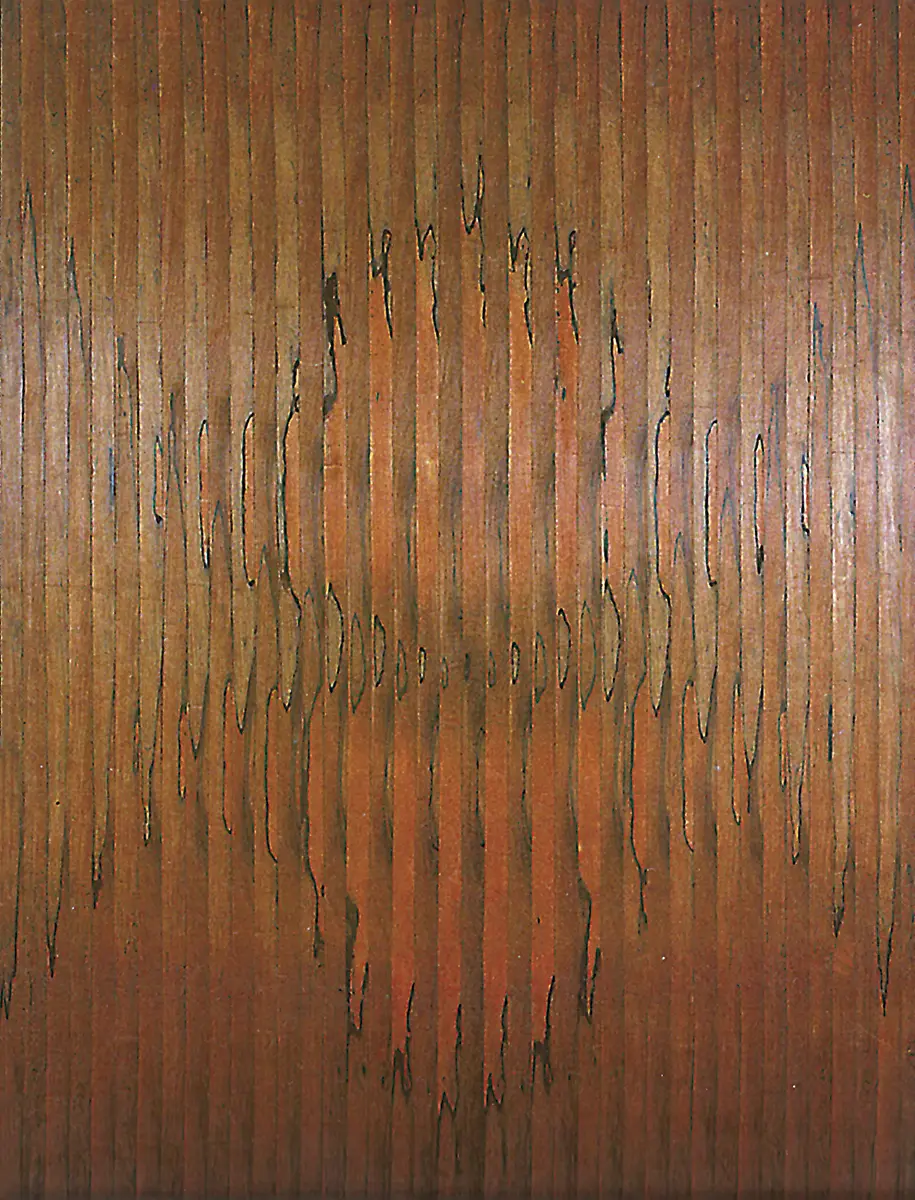
The Progresions belong to another system of art, one not precisely kinetic. The earliest works in this series were produced in wood, with the artist taking advantage of the visual patterns inherent to the noble material. Once again playfulness impacts Palatnik’s works; he “lets them be themselves” through the emphasis of color hues, blotches, tones, graphic elements. The gradients of progression have counterpoints of symmetries, asymmetries, expansion, containment, etc.; the fine wooden sheets are coupled into intricate apparatuses of undulation and optical structures. Of note are Progression 62-A (1971) of jacaranda wood and some works in polyester resin, like RS-14 (1976), a truly kaleidoscopic painting-object of exultant chromatics.

In the Progressive Reliefs, the artist’s modus operandi favors the interaction of color, value, and line, and seeks to make the surfaces of the painting objects dynamic. Palatnik creates the material analog by affixing double or triple layers of cardboard to form a paper agglomeration that emphasizes the sequence of cuts and the incidence of light and shadow—which results in holes—from the differences of undulating densities. These are reliefs at different depths, which promote another kind of optical structure, one no longer connected with the search for an incessantly baroque aesthetic but one that pulls out all the stops in the outlay of expressive and formal means, like any baroque object worth it's salt. Works like Progressive Relief (1996) bear witness to this new option in Palatnik’s art: a sublimated, colorless dimension of movement and light.
Fragmentation, tantalization, and perception create tension in Palatnik’s works. In them, the dynamic configuration of light and color invites us to explore the ways in which the artist systematizes a kind of sensible archaeology of every day, where “states of things” coexist with “states of the soul.”
* All images illustrating this text are courtesy of Galería Nara Roesler.
CLAUDIA LAUDANNO
Ph.D. in Art Theory and History of Art from the Universidad de Buenos Aires (UBA). Art critic and image semiologist.