
Paisagem Mínima (Minimal Landscape) was the recent exhibition of sculptures by the Brazilian artist Artur Lescher at Alejandra von Hartz Gallery. Although the artist has been present in a number of groups shows in fairs like Art Basel Miami Beach, Art Chicago, and Pinta, this was Lescher’s first solo appearance in the United States. Lescher uses a variety of materials to rejoice in the modeling of abstract mental forms that later find a place in the three-dimensional world. The works are carefully placed in space to allow light to play with the minimal appearance of the landscape, in which comets, lakes, rivers, wings, and even independent waterways are represented.
One of the main feature of Lescher’s work is its studied articulation of line. A sober line that grows shrinks, or adds to its volume is interrupted to capture an adjacent shape, or disappears toward the edges of the figure itself, creating an ethereal appearance. Some of the designs in this show resembled organic models and brought to mind Constantin Brancusi’s sculptures, whose mostly curving planes refer to the life cycle. In regard to his work theory, the Romanian artist once said: “What is real is not the external shape but the essence of things. It is impossible to express something essentially real if we just mimic the exterior surface.” Brancusi’s abstract bronze Bird in Space emerged from the process of observing a bird about to take flight. In the same way, Lescher eschewed the literalness of representation in search of a sculpture with contours that were more undefined and reflected the irrevocable, suggestive capacity of the material.
Although at a visual level one could establish a formal connection between Lescher’s art and 1960s minimalist art, the allusive power of so many of these works contradicted this assertion. Only Lescher’s untitled structures built from interlaced wood fragments recalled a condensed object-based aesthetic, like that of Donald Judd and Tony Smith. Not even Roda Quadrado (2006), one of the show’s outstanding works for its markedly geometric character, fell within the formal patterns posited by the minimalists: there remained a pointed emphasis on narrative elements such as the illusory mobility of the square, which lingered in the mind of the viewer. While the work had a simple, laconic, and even uniform appearance, being made of a single material, the symbolic content of movement undermined any minimalist intention.
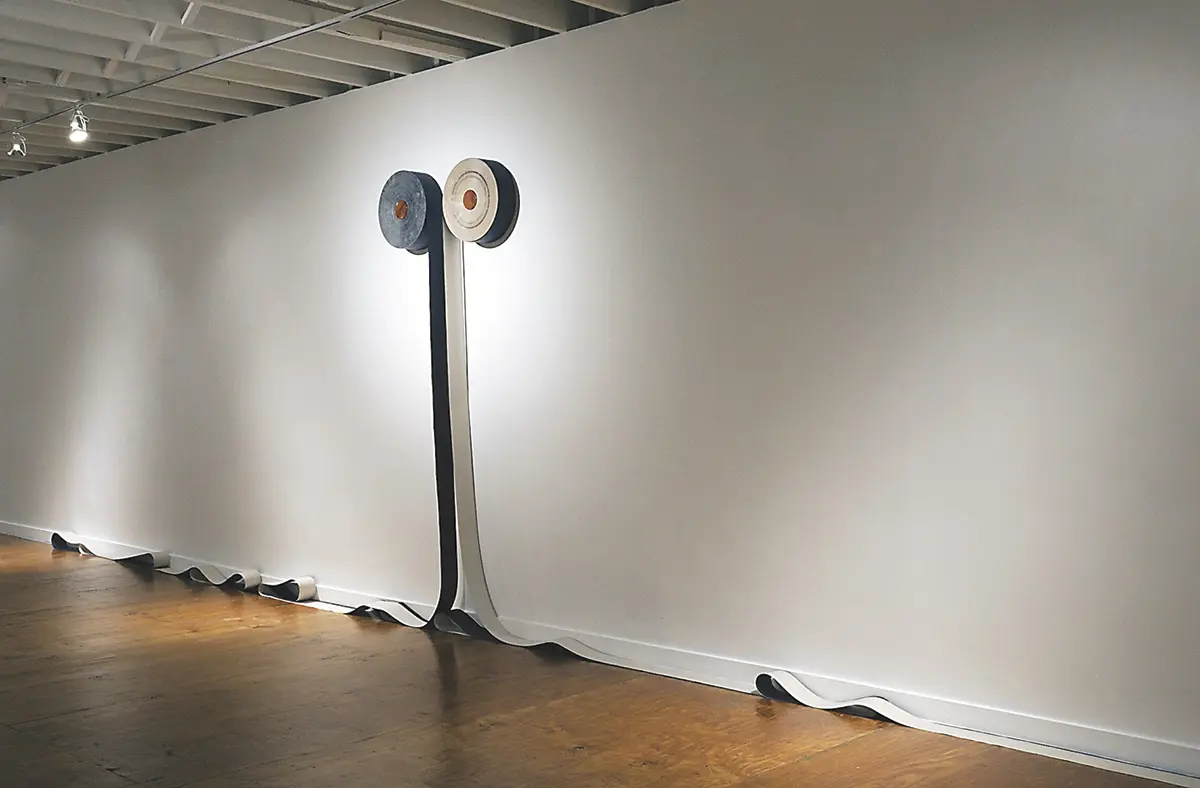
O rio (2006), placed on the wall opposite the entrance, was one of the show’s most notable works. The viewer discovered a secret sensuality hidden between the folds of the two-color laminate, an overflowing water torrent. Was this work an object, an abstract installation sculpture? Within the landscape sculpture recreated by Lescher, O Rio possessed the kind of ambiguity one found in Eva Hesse’s Hang-Up, an informal combination of units that appear connected on the wall or strewn on the floor and which transmit a sense of modern life’s absurdity, incoherence, and folly. Made of wood and monotype, Lescher’s work evoked the surges and oscillations of a river, caused by a gyrating mechanism. Despite not being a kinetic sculpture like those created by Jean Tinguely (here, a movement emerged as a product of mental vibration), this work, like Paul Klee’s oft-quoted Twittering Machine, began from a profound analysis of Nature’s own processes of alteration and transformation.
Lescher tames the substances he uses to build objective shapes—note the slight difference between an object and the mold that imitates or insinuates its features. The oval sheets on the floor, for instance, brought to mind water reservoirs, mirrors, and skateboards. The conical figures suspended by cables could have been kites, traces left by a jet, or shooting stars. The solitary, elongated white piece pointing toward the ceiling gave the impression of having been made of chewing gum instead of resin. The silhouette inserted into the wall reminded one of a bird’s wing, but also lichen, a shark’s fin, a mutilated ear, or one half of a paper heart.
Artur Lescher works his shapes with a certain naïveté in order to sketch or design an architecture that doesn’t rest on excessive ornamentation, utilitarian concepts, or inhabitable spaces. With the sober invention of elliptical volumes that challenge gravity and balance, his work contributes to the transfiguration of space.
DINORAH PÉREZ-REMENTERÍA