
In the concurrent exhibits by Carlos Estévez and Gustavo Acosta at Pan American Art Projects in Miami, each artist went beyond the limitations of his artistic language. In the case of Estévez, this implied the Renaissance ideal of an artist who is as comfortable seeking the mysteries of light and color as the functioning laws of bodies. This accomplishment meant moving from exploring the field of painting to constructing black boxes in which painting complemented the diorama-like assemblages of found objects. As the accompanying catalog pointed out, the exhibition Hermetic Garden was related to the “cabinet of curiosities.” It reflected Estévez’s fascination with collecting objects and then combining them with fabricated ones to build art pieces in which theatricality—life represented through artifice—becomes a toy to be dissected and deciphered.
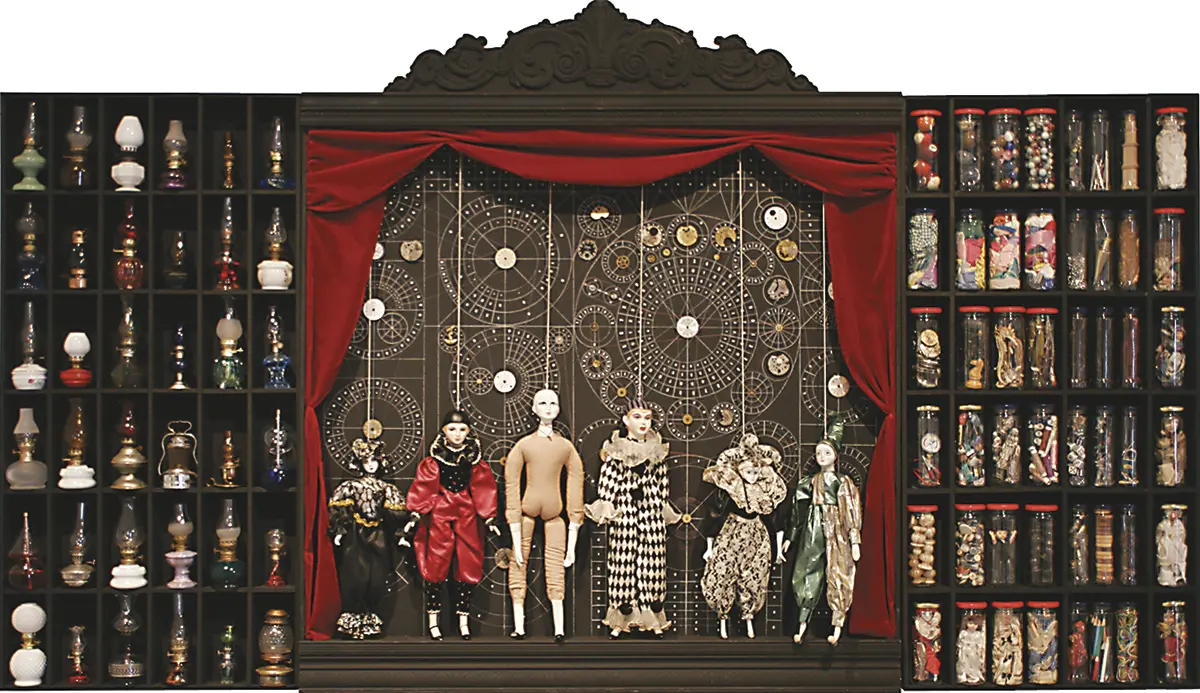
Although the strings controlling the movements of marionettes, which are central figures in Estévez’s work, appear less often in recent works, they were nevertheless present in Theatrum Mundi and in Planetarium Domesticum. The six characters in the first piece were also harlequins, figures that entertained the courts and confronted power with the only viable resource, laughter; although they depended on the applause of the courtesans, only they were able to speak truth to those in power. In this exhibit, they were placed amid lamps (symbols of knowledge and revelation) and jars containing spheres or sharp objects, as well as small human figures not attached to strings but rather caught inside the pressed glass that flattened their beautiful clothes. In the second piece, there was one figure only, connected to multiple gears of destiny represented by numerical tables, rotating planets, and hourglasses.
Exploring the human figure was not only performed in connection with the cosmic (as evidenced in pieces like Mysterium Femeninum) but also with architectonic structures. In Estática Milagrosa (Miraculous Static), glimpses of ancient constructions surrounded the harlequin, who balanced above a series of elements piled on top of each other. Similarly, a woman’s figure appeared as a cathedral in Feminología Práctica (Practical Feminology, a term that plays with the notions of the feminine and the phenomenological); in this piece, the sharp objects were medical instruments. In the work La Presaga (The Fortuneteller), they became dangling knives hanging in the background over blue wheels, like the multiple swords of Damocles above the bold female mystic that sees through a third eye. Labyrinths and cosmic wheels, photographs of places, and bottles of potions evidenced incursions into the complex substrates of the conscience.
Gustavo Acosta has always searched the walls of urban landscapes, looking into their architectonic traditions for spaces in which to follow not only traces of collective wounds—like the red marks that appeared on the old buildings of Havana, which the artist recreated in gray while living in Barcelona, his first city of exile—but also the nontransferable effect of each city.
In this exhibit, Acosta went further than ever before. He not only recovered colors—an effect of Miami’s special quality of light—but also transferred them through aerial views of places and urban objects. With this process, the artist coupled the architecture of science fiction (and the ghosts that emerged from their disasters) with constructions symbolizing the technological power of the U.S. From a formal point of view, the work It’s on Fire functioned as a geometric object that immobilized an enormous rotating structure with sparkles of gold on an abstract black background with red patches. The disaster expressed in the work’s title and colors was washed away by the formal beauty of the piece, which actually represented the tragic fire of a thrill ride in a theme park. It was about the disasters that can happen in the most innocent places of everyday life.
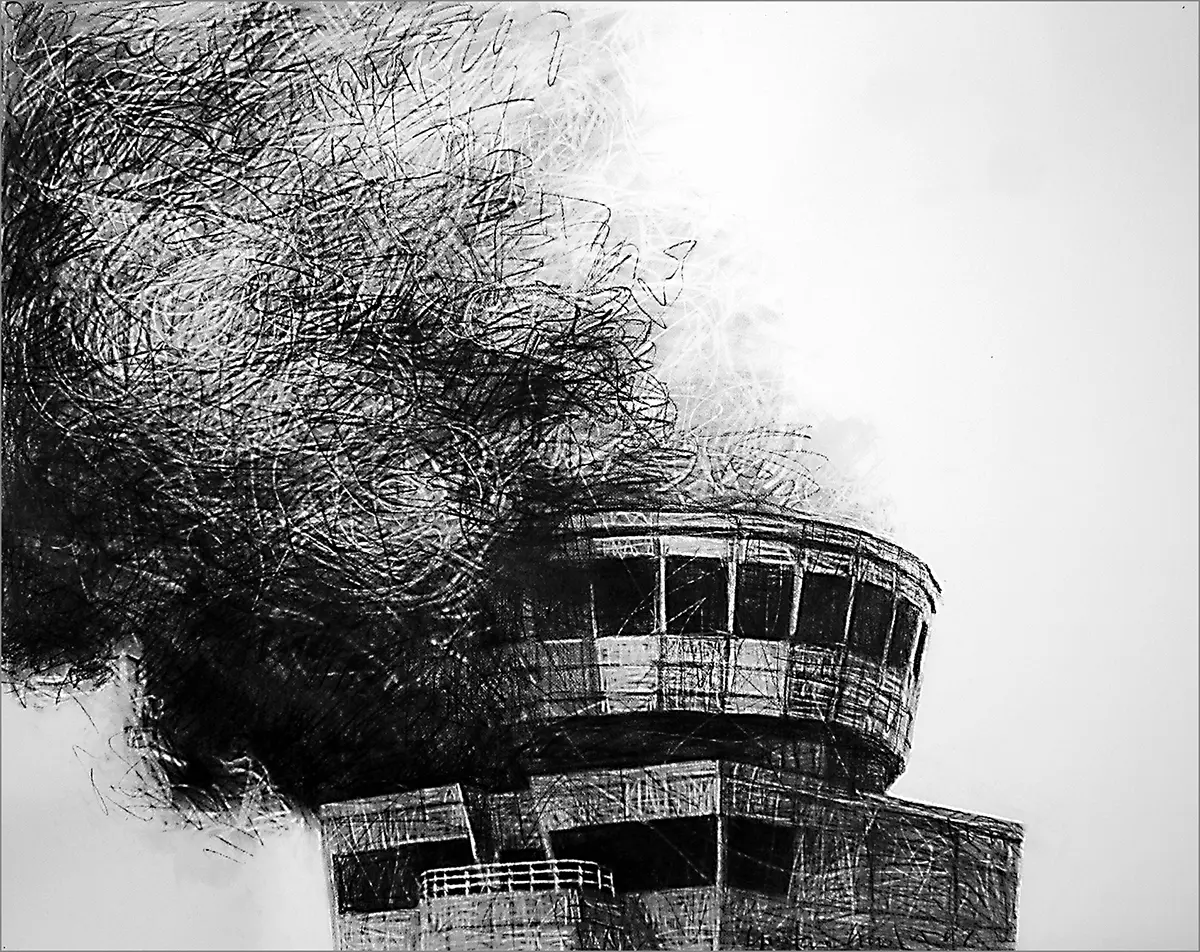
For Acosta, the fall of the Twin Towers—or, more specifically, the disbelief upon witnessing a collapse that had only been imagined in the field of science fiction—generated a different way of looking at things, one that became tied to an aerial perspective and was reflected in the title of his exhibit: Hypothesis of Madness. In works such as The Doors of Perception (a title referring to the novel by Aldous Huxley, the author of Brave New World), the vision of urban conglomerations led the artist to a kind of abstraction associated with collective fears. Forms became blurred, and areas of shadow, points of light, and fiery traces were intensified. The precise networks of the piece Hypothesis of Madness were interrupted with blasts that escaped any control, prefiguring a chaotic element amid apparent order. Blazes, ashes, and burning constructions were also present in monochromatic drawings from the Holy Land series. Here, smoke replaced the clouds in the sky, enveloping the space with destructive force. In both cases, it was possible to establish a connection with the mood that inspired Goya’s Black Paintings. Although the world is on fire in Goya’s series and even the tranquil figurative scenes of houses convey a pervasively disquieting feeling, a cry against dehumanization prevails amid the fascination of catastrophic events as spectacles.
ADRIANA HERRERA