
Carlos Motta’s exhibition The Good Life at the ICA in Philadelphia consists of a video and photographic installation examining public perceptions of concepts such as democracy, leadership, social inequality, and the effects of U.S. interventionist policies in Latin America. The project takes place in twelve Latin American cities where the artist conducted video interviews on the streets, making reference to a classical ideal of democracy formed by dialogue as a direct exercise of citizenship, something most of us only know through history books.
The Good Life (2008) follows a documentary and open-ended approach common to Motta’s other video-based works such as Memory of a Protest (2007): a video shot during a protest held by a Chilean human rights organization against the School of the Americas, known for training Latin American soldiers in torture techniques. Similarly, The Leningrad Trilogy (2006), features interviews and scholarly conversations about a 1954 book of photographs of St. Petersburg, Russia, in which the historical monument is a reified model for a politically correct socialist past. These three video projects highlight the role of civil engagement in the production of collective memory in societies that have survived totalitarian governments.
Motta extends the concept of civil engagement to his documentary
approach by showing only the interviewees and not himself as an interviewer.
Interviewees speak passionately about their life experiences, led by a central
question posed by the artist: “What is your opinion of democracy as a form of
government?” Motta emphasizes speech as action, showing that civil engagement
is a vital element for a healthy democratic process. He references cinema
vérité, a documentary approach to film that has influenced South American
filmmakers since the 1960s when many countries of the continent were under
military dictatorships. The influence of cinema vérité led to the advent of
Cinema Novo; a movement associated with the Brazilian filmmakers Glauber Rocha
and Nelson Pereira dos Santos. Cinema Novo, a quintessentially political
medium, created narratives that were based on real situations of poverty,
hunger, and oppression.
For The Good Life, Motta adopts many characteristics of Cinema Novo, such as using real people and conflicts to foster social consciousness. Motta’s interviews were held outdoors, in plazas, parks, and sidewalks. A compelling interview, for example, features Andrés Cruz Vázquez, a sixty-two-year-old merchant from Honduras, who claimed that for democracy there must be love, work, and peace and that democracy is used by powerful countries to sustain their own systems. The idea of including love in a living civil society is refreshing; love, as part of an oppressive totalitarian or fundamentalist government, seems preposterous.
In another interview, a Colombian artist states that the concept of democracy has been flawed since the time of the Greeks because it tries to convey a sense of equality, which is not representative. Civil participation cannot be democratic, since knowledge is not democratic. For many Latin Americans, the active struggle for democratic rights is strongly embedded in their memory after decades of military repression. These experiences are not forgotten, and even in an apparently globalized world, where young generations appear oblivious and cynical, many are still moved by past and present political engagement.
The Good Life, as an installation, is spatially centered to foster
interaction and movement. The nine-channel video installation is mounted on a
four-part, two-tiered wooden structure adapted from the theatrical public space
of the Athenian agora, where citizens conducted business and participated in
the legal and judicial decisions of the city. Motta symbolically transforms the
monitors featuring the statements of passionate interviewees into the active
citizens of the city, projected onto the wider forum, where the gallery
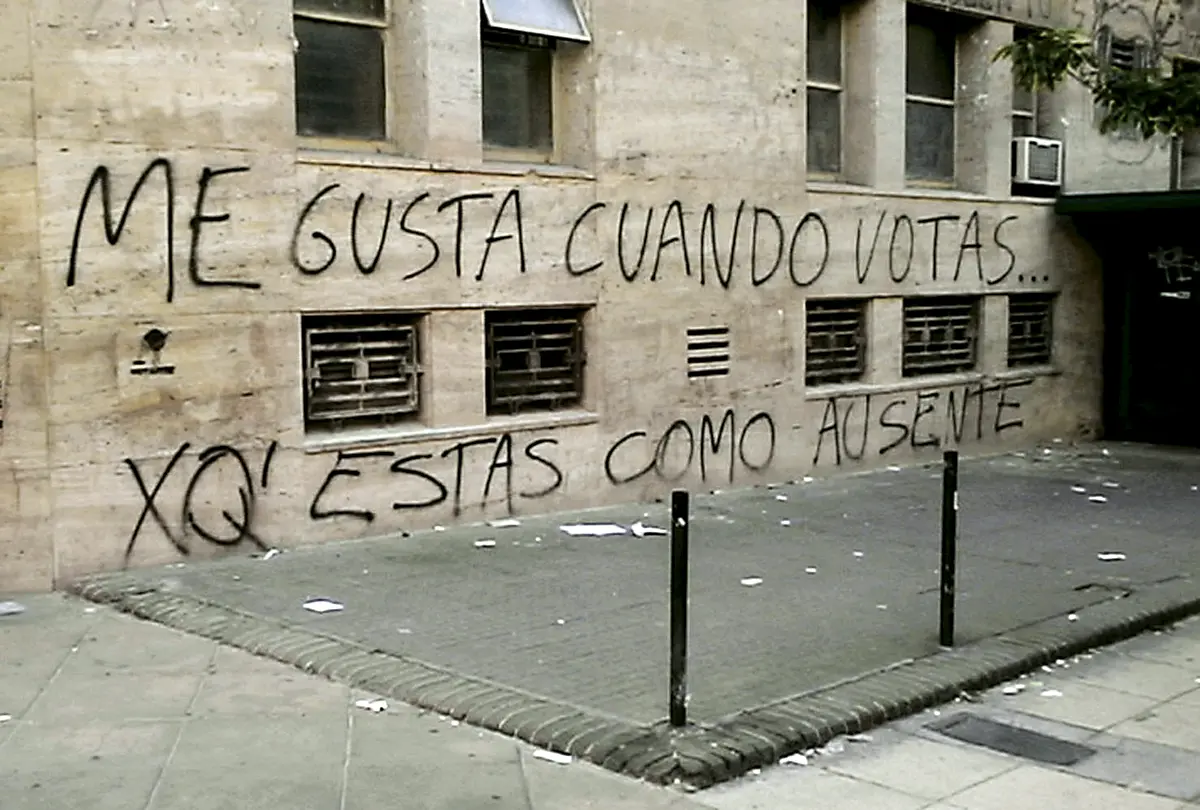
visitors interact with the works. A series of photographs arranged
asymmetrically on the room’s wrap-around walls creates a kind of enclosure.
Hundreds of stills from the videos, arranged in different categories, including
political graffiti, religious processions, and public monuments, demarcate an
active relationship between religious, cultural, and ideological iconographies.
Rethinking the concept of democracy in a physically and intellectually engaging manner trumps all other issues; social equality, foreign policy, and leadership are all part of a well-functioning democracy. Even though Motta’s title, The Good Life, suggests a democratic ideal, he is quite aware of the problems of this model in a pluralist society, especially due to the push and pulls of constantly shifting power structures. His reference to the theorists Hannah Arendt and Chantal Mouffe is a statement of how knowledge and participation are fundamental to the constant rethinking of the meaning of democracy. What is perhaps more productive, but less ideal, is conceiving of democracy as a mere exercise of its potentialities, not as a goal in itself. Motta’s exhibition does just that.
DENISE CARVALHO