
In the catalog of an exhibit she gave in 1966, Catalina Mejía affirmed: “Painting just like every other artistic discipline has the virtue of surprise […] Life becomes routine and things lose their magic in being in front of us all the time; they stop surprising us. Art gives us back that surprise; it transforms things, change the world, and recreates it for us. Through modifying the things surrounding us, art does not just repeat, life but it invents it anew; the old saying ‘what is said is not important, how it is said is what is relevant’ has never rung more true”.
There are a couple of elements in these affirmations that are still present in Mejía’s work. One is the importance placed on the element of surprise that is generated in the spectator. Another is the reinvention of reflections as a significant creative device.
Why this affirmation? Visiting the exhibit Los Otros (The Others) is to find elements used before by the artist that is now approached from another perspective. Mejía had already explored the identity theme when she worked on her 1986 Series Postales (Postal Series), works fashioned from acrylics, in which she emulated the information that would appear on the back of a postcard, namely, author, date of work, dimensions, title, and the name of the company that printed them, thus rendering the work to which this information referred as invisible, because it instead presented a reference that playfully evoked it. The person observing that image was required to resort to imagination and memory to recreate the image to which this information referred, by solely relying on a designation and some localization codes.
In the current exhibit, a series of more than thirty color photographic portraits show individuals with their backs turned to the camera. The patterns usually applied to identifying any portrait are not available here. Although the photo’s format is the same used in a photo ID, with the same white background, by showing the person from the rear the spectator is invited to observe and construct multiple readings. It also becomes a matter of the manner in which to observe this person from this position, how to use the information available, and speaks of the subject, his body language, clothing, and hairstyle. The photographic portrait here, unable to convey the traditional elements of identification to “know” the subject as he is, is presented with the possibility of free interpretation, of having to imagine faces, inventing these to play at discovering identities generated from the observer’s experiences and not from the picture.
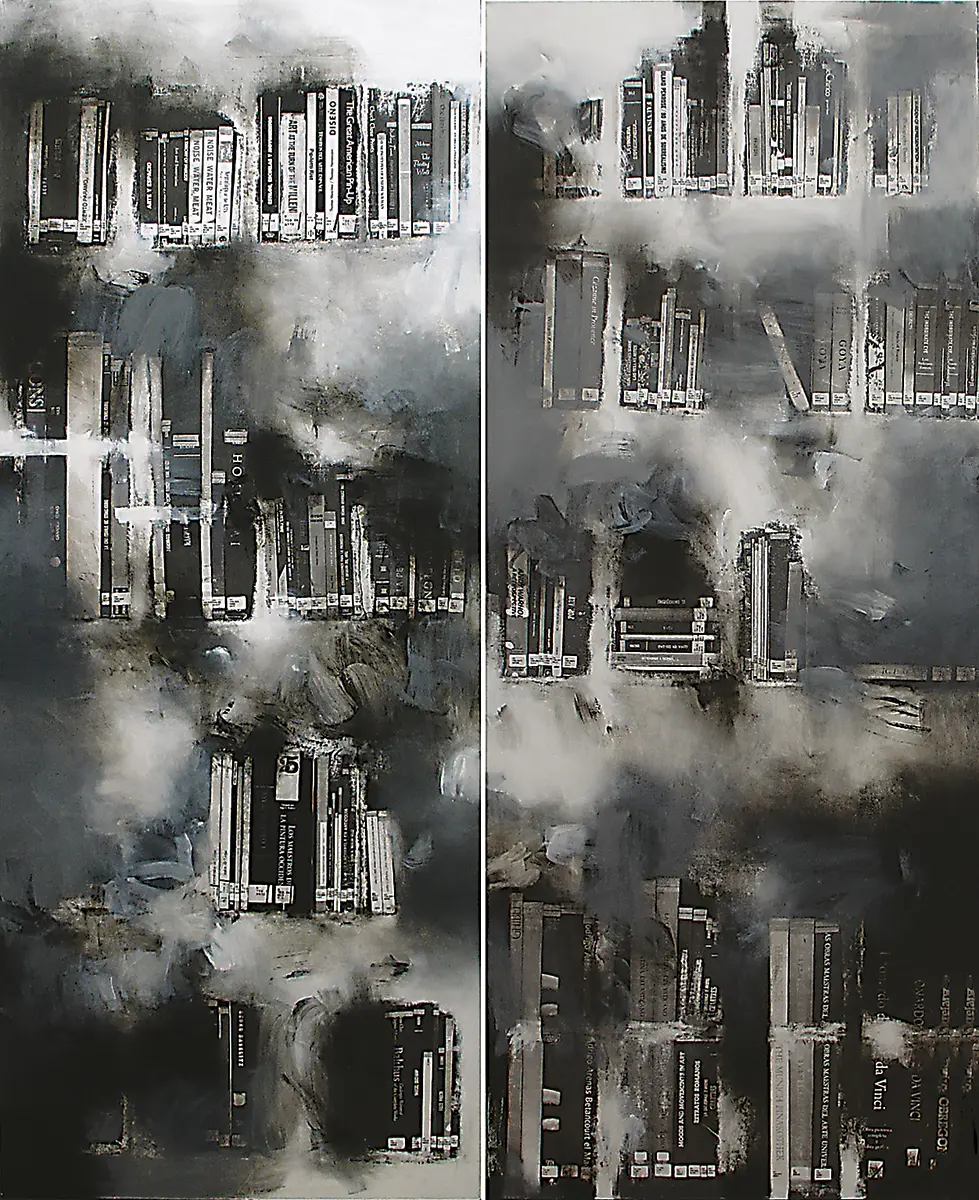
The other part of the exhibit centered on an element the artists had previously investigated: the library. In her 1989 libraries, she was already using photocopies glued to canvases and intervened with paint in a search to create the environment of the space. Although this theme now reemerges, it has a different meaning: while in the previous paintings, the act of painting was of central importance, here the book titles are key as they become invisible.
It would appear that in this surveying of texts containing potential narrations on art history, the artist reflects upon the diversity of interpretations prompted by the artistic act. It also reminds us that while libraries are a space for knowledge, they are also only physical places that can be used both for learning or entertainment.
These libraries also underscore the importance photography possesses for Mejía. As the artist, herself acknowledges, the utilization of photography in her proposals is tied to her early visual education, which began in black-and-white photography labs, a process that implies shooting, developing, and enlarging the image, but most importantly, handling and understanding light and the role it plays. The influence of photography is also evident in the colors employed by the Mejía; blacks; whites; sepias; grays, all so prevalent in her palette.
Photography and painting always act in parallel in these works, without neglecting another important protagonist: the collage, which according to the artist, frees painting from its representative burden and allows for playing with the real.
Her eleven painting-collage panels convey a harmonious relationship between this handling of expressive brushwork and the symbolic work here that is permitted to touch the reality, a particular reality in this case: that narrated by history books. Mejía had shown this preoccupation in other, previous works: the work is a sort of suggestive superimposition of images; it is through the eyes of those beholding it that the substance of the image is revealed. These enormous art libraries are melting pots of time periods, artists, currents that prompt in the spectator the possibility of different interpretations, guided by his experience, sensibility, and having to resort to memories, memories that can turn into pure fantasies or an attempt to become fragments of reality filtered through information provided by the images.
IVONNE PINI