
Forty works, some sketches, and documentary material composed the retrospective exhibit of work by Daniel Lezama (born 1968, Mexico City) titled La Madre Pródiga. This body of work encompassed ten years of artistic production. The exhibit was held at the Museum of Mexico City, which belongs to the local government. This implies that, thankfully, the official Mexican sector is beginning to acknowledge Lezama’s relevance for the first time. His work has generated diverse reactions; some say it is pretentious while others affirm that Lezama is the best painter of his generation and proves not only that painting is not dead but also that it is more contemporary than ever. Others simply believe he is yet another of a group of great Mexican artists who are better known abroad than in their own country.
And the motherland is one of the most prevailing symbols in Lezama’s work: the homeland as mother and the mother as origin—motherland, Mother Earth. Although Mexican identity is the point of departure, it coexists with juxtaposed eras, traditional heritage, and conterminous and disconcerting contemporary situations. The exhibit’s curator, Erik Castillo, defines Lezama as “the inventor of the vast machinery of iconographic mechanisms that have found in Mexico’s vernacular saga not only a merely creative pretext but also its the only crucial point of reference.” Thus, the curator proposed a thematic division of three chapters based on three of Lezama’s works: Fundación de la Ciudad (Foundation of the City), Nacimiento del Amor (Birth of Love), and Origen de la Pintura (Origin of Painting). One of the curatorial texts explained that these three chapters represented the legends of the origins of the city/state, love/desire, and painting/art, respectively. Nevertheless, from the layout of the paintings in each thematic section, it was evident that the narrative plots implied an evolution that undoes the commencing fables and moves toward images of destiny.
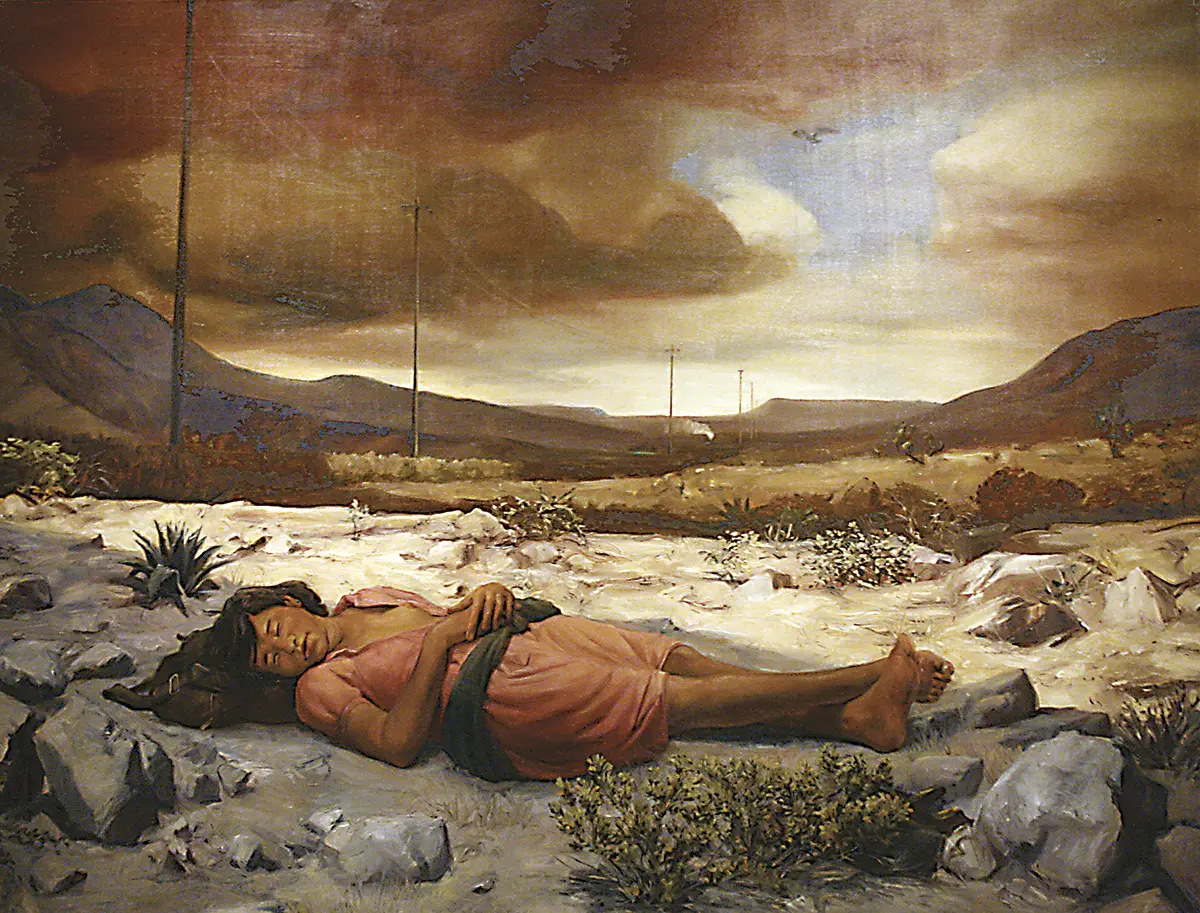
Another characteristic of Lezama’s work is the large format of the paintings, which turns each work into a passage for its characters toward an uneasy sensation; they move toward a powerful dialogue in which each heavy and meticulously rendered part shouts truths and analogies while whispering dreams and contradictions as well.
The show also highlighted the social element in Lezama’s work. While the artist portrays secondary-school girls, he also depicts prolific women, small children, charros (Mexican cowboys), automobile mechanics, and an entire array of historical and mythological characters. He does this with a modern twist that gathers together Mexican toys, pulque (a Mexican alcoholic drink from the fermented sap of the agave plant), and religious, pre-Columbian, and Mestizo elements. A certain academicism is always present in Lezama’s work, conveyed through his brushstrokes, his excellent renditions of the human figure, and his use of themes such as vanitas and triumph, several allegories, and allusions. The female nude is not rendered in a Renaissance-like manner; rather, it is based on the ever-present principle of the life-giving mother, the earth, the origin—the exuberance of fertility, of nourishment, of the prolific flesh.
In the catalog accompanying the exhibit, Erik Castillo states, “Lezama´s proposition contradicts the stereotypical nationalistic identity proposed by the Mexican School in the first half of the twentieth century, which is now scorned by the anti-nationalist agenda of the globalized post-avant-garde scene. Although Lezama’s painterly practice has sometimes been likened to the poetics of Neo-Mexicanism, a closer look reveals a world of difference between both productions.”
The synthesis of the past ten years of Lezama’s creative activity could be observed in La Madre Pródiga, a huge work specifically created for the Museum of Mexico City. In this painting, all the artist’s symbols and thematic obsessions converge, as well as the concept of what is Mexican and part of his own identity, without being nationalistic or parochial. Also present in this painting are historic points of reference, legends, and myths, such as volcanoes in the background, the cloak with the image of the Virgin of Guadalupe, and the white house on the extreme right in homage to José Clemente Orozco. This work would appear to summarize all of Mexican history, from pre-Columbian times through the mestizaje (mixing of the Spanish and Indigenous races) to modern times. It is a vertiginous and assertive painting that ranges from the mythical imagination to the raw realism of everyday living in the frustrated modernity of contemporary Mexico with all of its contradictions and weaknesses. Lezama’s work draws the viewer in it offers no concessions, and its expressive and thematic force may cause a certain aversion. Or, the spectator dares to submerge him/herself in its iconography, the seductive power of its compositions, the confusing mysticism of its polyvalent characters, and the representation of its unrelenting comedy, in which past centuries and present time converge.
ISAURA RUIZ