
Fernando Toledo’s recent paintings are lyrical visions of everyday realities of modern life in compositions that make a strong first impression due to their color contrasts and human forms, natural components, and universal symbols. Over the years, he has explored themes such as immigration, love, corruption, and environmental destruction in works that have never ceased to be visually harmonious. He has a particular sense of color—a way of harmonizing unusual tones—achieved as a consequence of his many years of working and experimenting with oil paints. Although he has at times defied pictorial tradition by creating drawings directly on museum walls, by painting on cloth banners, or making installations about minefields and contaminated waters, his two-dimensional works still carry the greatest expressive force.
In his most recent series, titled Landscapes to Recover the Horizon, Toledo evidences his concerns regarding urban devastation, unbridled construction, and the economic interests that are so damaging to the harmonious cohabitation of city dwellers. As in recent years, these canvasses display combinations of charcoal drawing with acrylic paints through which he achieves exceptional contrasts and an increasingly personal artistic language. Gone from this new series are his earlier humid tropical forests with their sinuous branches and deep colors. The strong, dark blood reds he favored in the past have given way to combinations of lead grays and intense yellows with strong turquoise areas to represent imagined skies or seas. When the natural world is present, it is in the form of trees and jungles in tones of gray, like dried-out images of the overwhelming green abundance typical of the few preserved natural areas in his adoptive country. In Metropolitan Park, for example, a great black and white forest cross the composition from left to right, and from the bottom edge, an area of intense yellow emerges like an amorphous and threatening plague. In the background, between the trees, one can see block-like buildings that seem to attack nature from the rearguard. The danger is imminent.
Toledo, who during the 1990s was a three-time winner of prizes in the Panama Art Biennial had already shown an interest in urban issues in the past. In 1998, he received an award for his Homeless Series, a work of drawing and painting with inks, pastels, color pencils, and charcoal on photocopied architectural plans. By working in this way, the artist explained, he managed to complement the technical information from the plans with his own artistic information, thereby creating a work of art and a reflection upon “the relationship between man and his urban environment, his feelings, his dramas, his dilemmas regarding achieving a better life in the place where he lives or coexists.” Toledo described drawing as a language that allows him “more spontaneity and more sensitive strokes”, a description that can be applied to his artworks of 2008, where the subtle trees from ten years ago have turned into colorless forests, and the silhouettes of men have been replaced by multiple architectural structures.
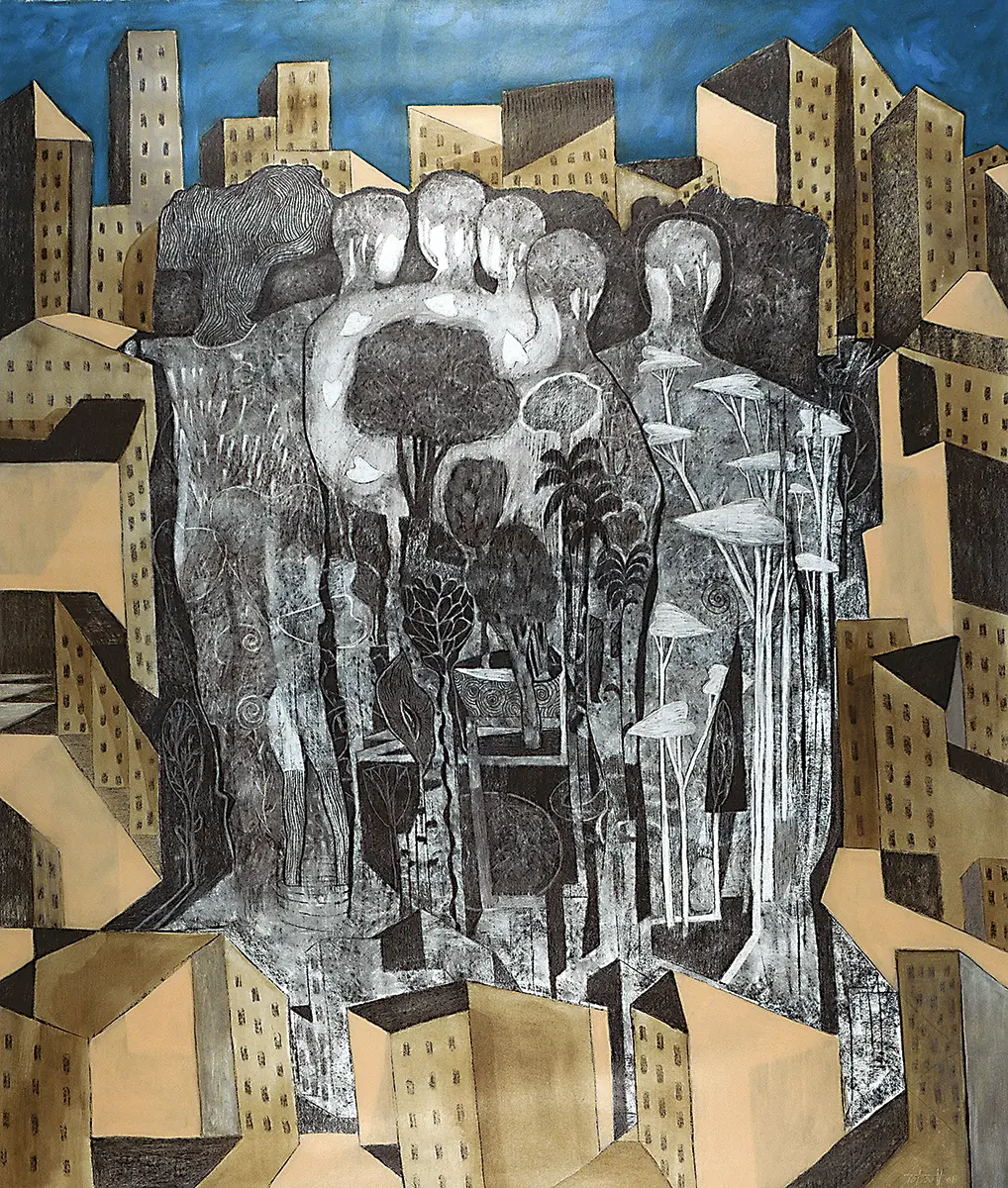
In Garden City, a cluster of schematic buildings surrounds and completely overwhelms a small group of people who occupy the middle of a tight urban space. Inside the human silhouettes grow trees, completely devoid of greens, enveloped in a blur of city smog. In the upper section, a cloudless blue sky enriches the composition significantly, by insinuating a better world. Although the caricaturesque buildings are somewhat reminiscent of certain canvases by the Argentine painter Seguí, Toledo is an artist with a different concept of the city, as a place in which common man has no active participation, but rather is drowned out by the unrestrained proliferation of new buildings. In Toledo’s cities, the human figure is almost a memory, a tenuous presence, within an urban space characterized by frenzied growth and ironic “progress”.
The same kind of cynicism is apparent in Sustainable Horizons, a city where trees only sprout from the roofs of skyscrapers, creating a unique and depressing skyline. Nevertheless, in these new works by Toledo, there is beauty in the way the artist contrasts the coldness of construction with the warm poetry of nature, the flat colors of the backgrounds and the skies, with the careful rendering of the trees, and minute detail versus mere suggestion. Toledo is careful in his handling of the basic components of a successful composition, while still expressing what he feels. In the manner typical of contemporary artists, he shows concern for the current situation and the problems of the world around him.
MÓNICA KUPFER