
Things happen around Flavia Da Rin’s photographs, which have traveled to and been admired in places around the world and were recently exhibited in her second solo show at Ruth Benzacar Gallery. As seductive as they are unsettling, Da Rin’s images appear often in newspapers and journals and are highly regarded by specialists and by the general public. Da Rin (born 1978, Buenos Aires) has seen her images selected for biennials and exhibitions like the one at Fondation Cartier in 2005, where, from among the almost thirty artists in the show J’en rêve, one of her photographs was chosen to be distributed throughout Paris on street billboards.
Captivating and ambiguous, these images proclaim a naiveté and linearity that turn out to be false. From the beginning of her career, Da Rin has circumscribed the space of photographic invention and of draftsmanship mainly to her own image, which is always shifting and placed in front of real or imaginary spaces.
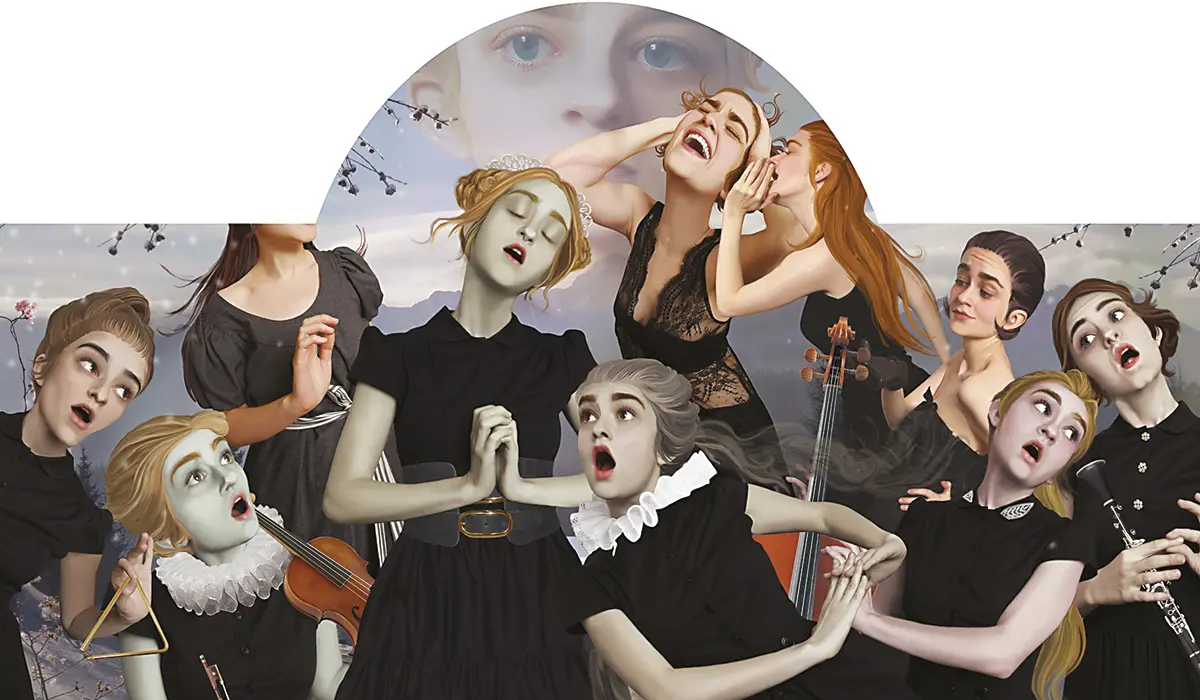
Besides the many hours of work in front of the computer, Da Rin’s works include performance-like mechanisms. It was the artist herself who appeared in each of the works in her recent show, El misterio del niño muerto. Da Rin costumed and photographed herself for the series’ seventeen multi-size and multi-format pictures (including three in black-and-white, one drawing and the rest in color), which overtook the viewer with their power of fascination and their forcefulness. Treated digitally according to the demands of a narrative that is fully known only to the artist, Da Rin’s body and face changed genders and ages, generating the child of the show’s title, the little ghost, the family members, muses, black fairies, widows, girls, and the ladies that come to a funeral only to show off.
The representations moved between high and low culture, and even though the dominant images in El misterio del niño muerto alluded to the history of painting, the artist manipulated their references and transformed them almost into comic-book characters, exaggerating their features and accentuating their expressions. Similarly, her portraits were built on a principle that is rooted in photographic traditions. Yet Da Rin doesn’t seek the “decisive moment” in her shots; rather, she makes them, confirming the diversity of a hybrid medium.
In these works, humor, and desolation were structured around an infinite transformation, connected to the idea of the artist as the maker of multiple narratives that kept her own image in the foreground. Images of related girls and women paraded in this delirious story: euphoric, dazzled, tearful, beautifully dressed and accessorized, and with hands that were as expressive as their faces.
In different instances, the dying child presented a face that was so sad as to be scary; he appeared blowing the candles of what must have been his last birthday cake—large shadows under his eyes, pale as a ghost, an apparition swimming in the arms of an adult.
In these times, when nobody wants to grow old and even death wears make-up (as trivialized in videogames and films), Da Rin dared to confront this unusual topic without rejoicing in its sinister aspects, underlining the cynicism of certain characters and the supposedly high exaltations of others who smile, sing, and project welfare. Do they imagine the joy of paradise? What do we see when we see these fascinating images? Are they part of a macabre joke?
Da Rin stated: “When I finished the series, I started to think about it's meaning. At a certain point, I thought that, as I am close to turning thirty, by representing the agony of that poor child (partly inspired by Oskar from The Tin Drum, by the prematurely aged boys from Akira [Katsushiro Otomo’s anime film], and by gothic children), I was also speaking of my need to distance me from the ‘young artist’ label, which is no longer interesting to me.”
Using “death” in the title of a show, moreover the death of “a child,” is rather risky. But Da Rin emerged victorious from her bold and fruitful proposal; in her images, there were more enigmas than certainties. Her works generated equal doses of tenderness and consternation, alternately provoking anxiety and calm, and letting the viewer’s own imagination take flight.
VICTORIA VERLICHAK