
The Forum Committee of the 2007 Medellín International, Prácticas Artísticas Contemporáneas: Espacios de Hospitalidad, invited fifteen Bogotá-based artists to present projects inspired by characteristic features of Medellín’s social and urban dynamic. The invited artists were Adriana Bernal, Adriana Duque, Liliana Sánchez, Maria Isabel Rueda, Rosario López, Fernando Escobar, Ícaro Zorbar, Juan Fernando Herrán, Juan Mejía, Luís Fernando Ramírez, Wilger Sotelo, Saúl Sánchez, Miler Lagos, Pablo Adarme, and Ricardo León.
From among the proposals submitted, the jury composed of Ana Paula Cohen, Maria Inés Rodríguez, and Oscar Muñoz chose five: those by Luís Fernando Ramírez, Adriana Bernal, Juan Fernando Herrán, Miler Lagos, and Liliana Sánchez. Bogotá’s Culture, Recreation, and Sports Office, in turn, gave five artist fellowships as a way to establish its presence in Medellín’s 2007 art event. The artists traveled to Medellín, developed their projects, and the results were in the exhibition presented at the Casa del Encuentro at the Antioquia Museum and at the Santafé Gallery in Bogotá in April of 2008.
Inviting Bogotá artists to visit Medellín as part of the latter city’s art event was a salutary and simple methodology: each artist’s outlook was broadened from observing a different place for some time, and in turn the host city felt the outsider’s gaze on itself. Hopefully this method will be adopted in other cities and events in a country that sometimes invents immensely complex calls for artists.
The design of this call also came with a twist that was not as simple but was very interesting, even if not explicit: the notion of the envoy. It would be great to re-invent what was sent from Bogotá to Medellín and to discuss what is currently understood by “envoy”—what we understand as producing what is sent in representation—and the function of such envoys: to make something visible, to make us visible to something, and to make visible what takes place in a place.
Derrida’s article titled “Envoi” is a gambit toward the validity of a representation, as long as he or she who represents “stuffs” his or her thought into the word and what it implies. Derrida invites those who represent to think about the word “from.” He invites them to become aware of the fact that “from” is already an envoi, a dispatch.
In his article, Derrida speaks of representation as a making-present, as the power-to-make-come-again, and that power-to-make-come-into-presence-again in a repeated fashion is what defines the “re-“ that precedes “presentation.” Derrida talks about representation’s power to interrogate the position of the power-to-place, to locate, to situate. From Bogotá—which could also be “To Medellín,” depending on one’s point of view—is a title that contains all the derivations the dictionary records for the word envoi. Thinking about this term, we lighten the load of the object that is “in front of me,” and then it is sent: it becomes a vector of information and it is delivered to someone.
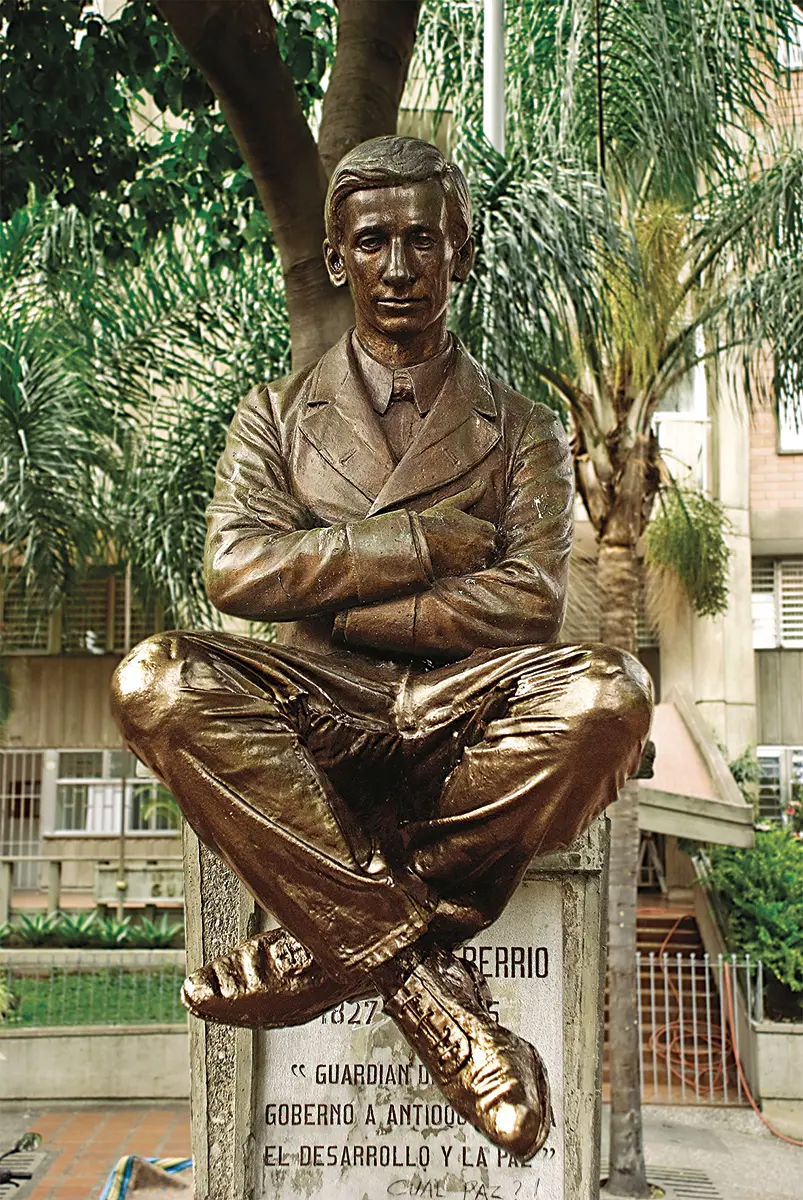
Two works sent to Medellín was its own representation. Miler Lagos took photographs of some bronze sculptures he found in Medellín’s public spaces. These are interesting constructions: sometimes the feet traverse the bronze in a surrealist manner that “sits” even more on the ground a character already sitting on a chair in front of a kind of desk, which in this way becomes a strange torture device. This sculpture was begging to be photographed! Another one was a photograph of the Esquina de las mujeres monument that Lagos found close to the Botanic Gardens: a bronze table on which the busts of illustrious Antioquia women had been arranged. In truth, this form of representation is not devoid of interest; what remains is the question of how we represent, of what representation brings forth, subconsciously, from the past, and of making visible “that which is given/takes place.” Inmersos was a good name for the public sculpture of a city at times submerged and quiet under so many forces of repetition, which perhaps in these photographs was a little unsettling.
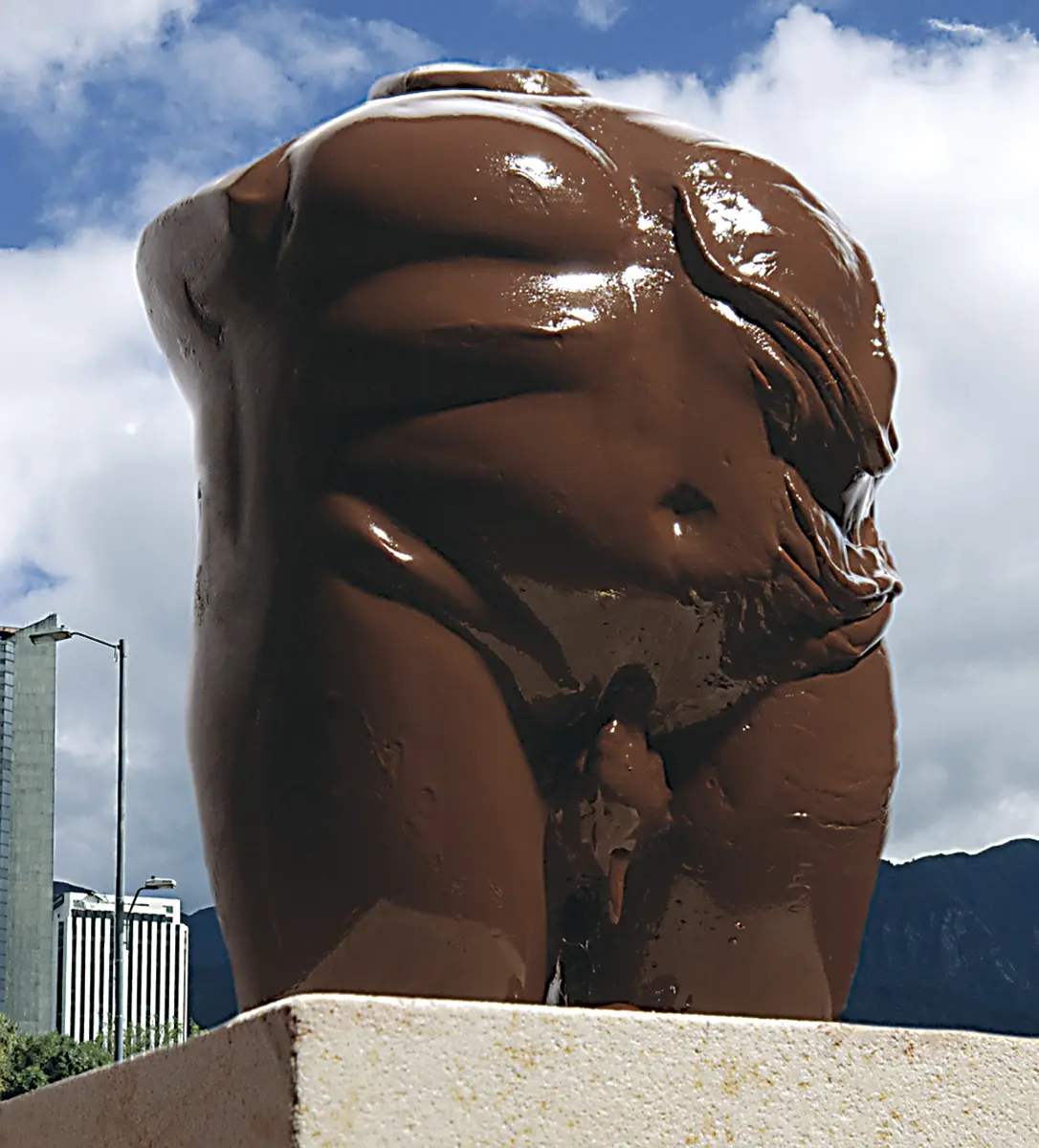
Adriana Bernal’s Chocolarte project was a series of large-format photographs of chocolate-covered Botero sculptures. The photographs were preceded by a text: “A tribute to Bernardo Salcedo and his great sense of humor. My project is inspired by a phrase of his: ‘Botero’s sculptures look like chocolate figures.’”
Bernal thinks that both Botero’s sculptures and their replicas sold in the street are a part of the city’s visual environment. Thus, she used them as molds for chocolate sculptures, which were melted a little, and “installed” digitally into the landscape of different cities. Bernal had already developed “ephemeral postcards” of this kind with other cities like Berlin and Tunja, representing the representation that makes presence come again and, in the case of Botero’s sculptures, questioning the position of the power-to-place, to situate. As envoi, these two works by Lagos and Bernal would be perfect to begin a discussion panel about public space in Medellín, Bogotá, or any part of the world, where each experience will help question and build that “possessing the power to place.”
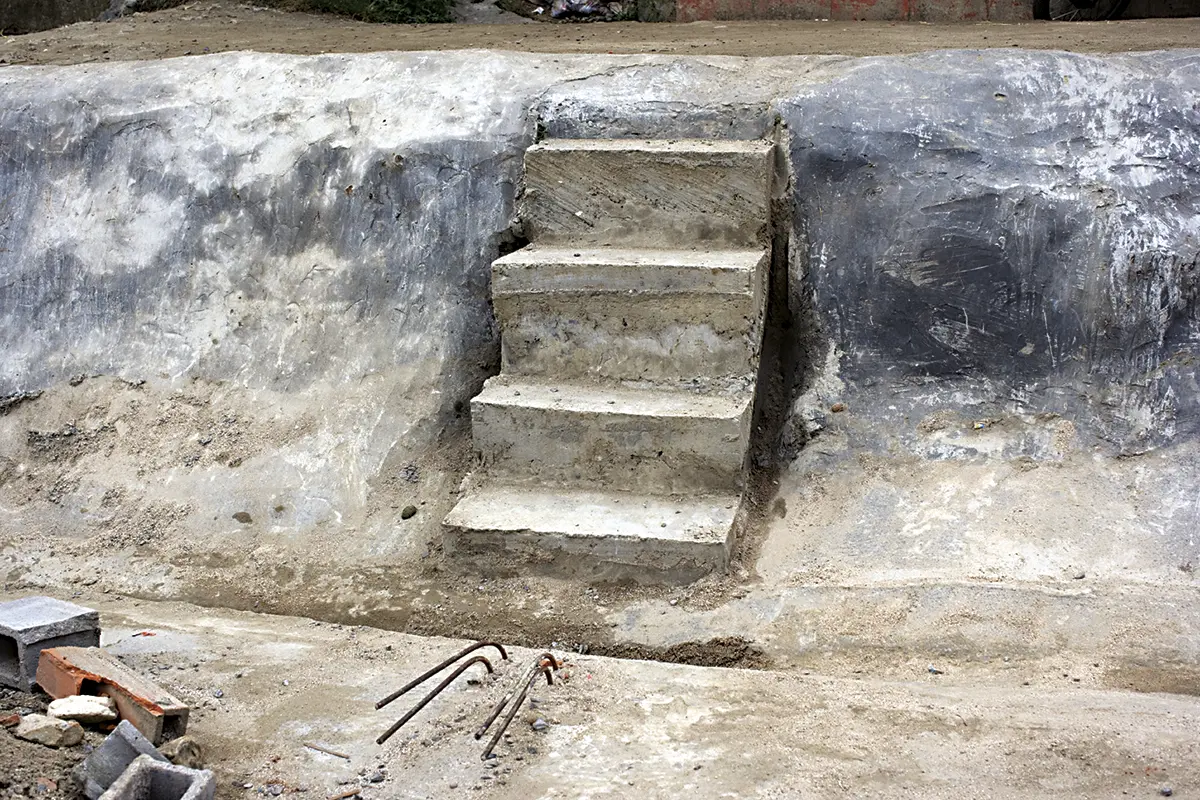
Escalas is the word used in Bogotá for “stairs” (it is escaleras in most other variants of Spanish), and it was the title was chosen by Juan Fernando Herrán for his project. The artist said:
“In the construction of place, there appear structures that in the first instance solve practical problems such as access or shelter, but which simultaneously consolidate as symbolic elements that reflect the imaginations of the inhabitants and their notion of progress.”
The project was a photographic series of staircases in Medellín’s poor neighborhoods, which in their construction expresses a will to survive, an insistence to occupy their place. In Herrán’s large-format photographs, one saw dirt stairs tenaciously climbing up a hill; vertical staircases reaching the edge of a column; abandoned, unfinished staircases, purposeless or waiting for a thousand purposes; a jumble of triangular staircases, half-finished and graffiti-covered; stairs as dumps; stairs as toys; stairs as kitchen shelves; cement staircases that lead nowhere. These photographs were very precise in making visible what takes place in a place: stairs of the bricolage, of abandonment, of cement desires that for the most part remain unfulfilled.
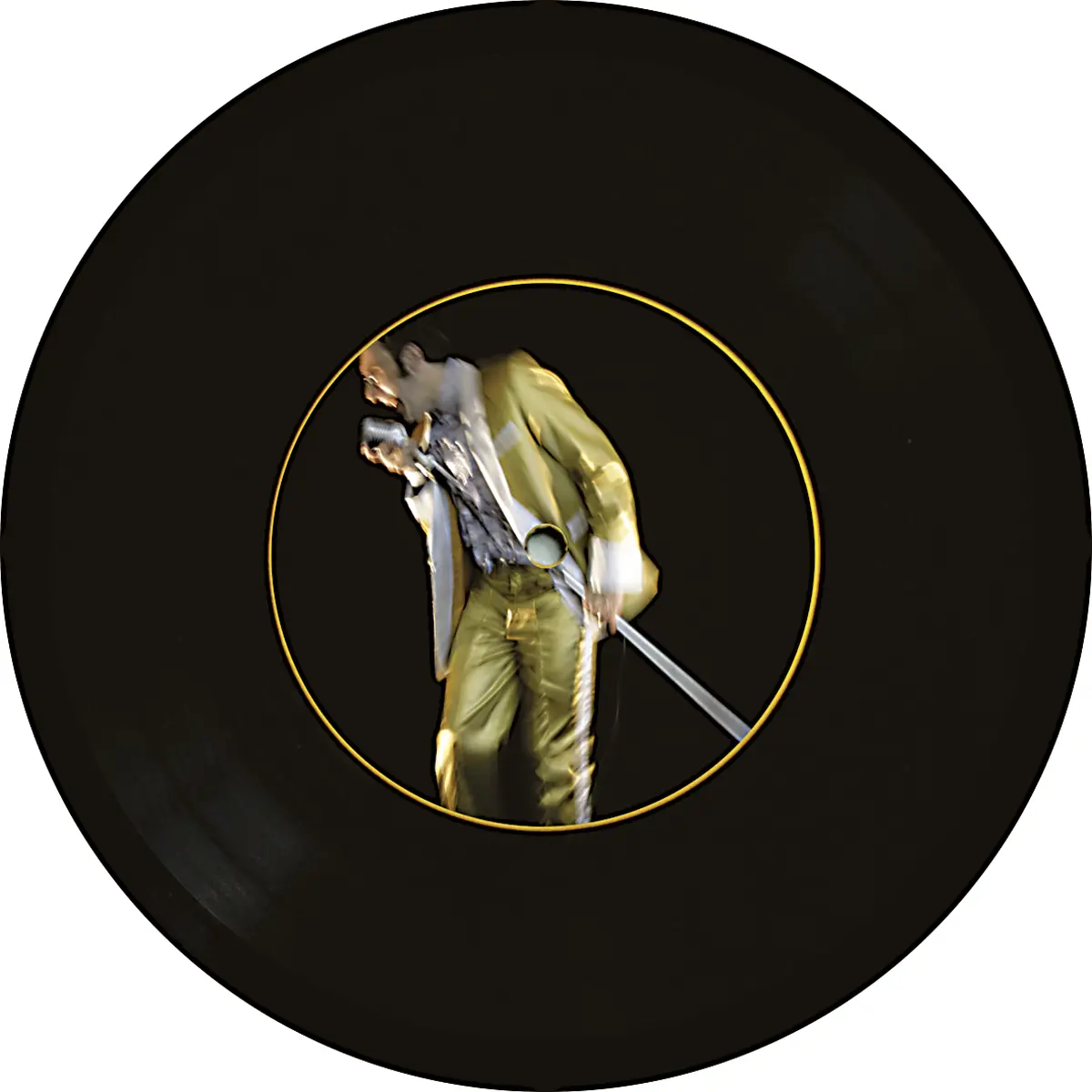
Herrán’s work also raised a question about modernity and desire, and it seemed that the work by Luis Fernando Ramírez did as well. An architect by profession, Ramírez for some time has posited questions about modern architecture, its somber predominance, and its evasion of a sense of place. In his work, he has continued to animate the modern project with formal shifts carried out by the inventiveness of self-construction, the invasion of tropical vegetation, and more recently with a mixture of rhythms. His project investigated record companies based in Medellín, which promoted a kind of tropical music that mixed bolero, cumbia, mambo, twist, and porro—a genre whose main figures were Los Golden Boys and which was Colombia’s preeminent dance music in the 1960s, an efficient mixture that “whitened” its origins.
Ramírez’s work Golden Lamé Cumbia (El plumaje del rey) contrasted the Golden Boys from Colombia with the opulence of Elvis, the King of Rock and Roll. Thus far it was a documentary project. But a strong subjective content also appeared one that was close to The Revenge of the Nerds. Like an architect, Ramírez built high-rises with shaving blades or bars of soap; he sang the cumbia mix with the golden boys both local and foreign, wearing a lamé smoking jacket in a video that spun at 33 rpm. He sent a message of construction methods: don’t cede dominance to the heroes too quickly but rather remain absorbed in their contemplation and assume the power to dislocate.
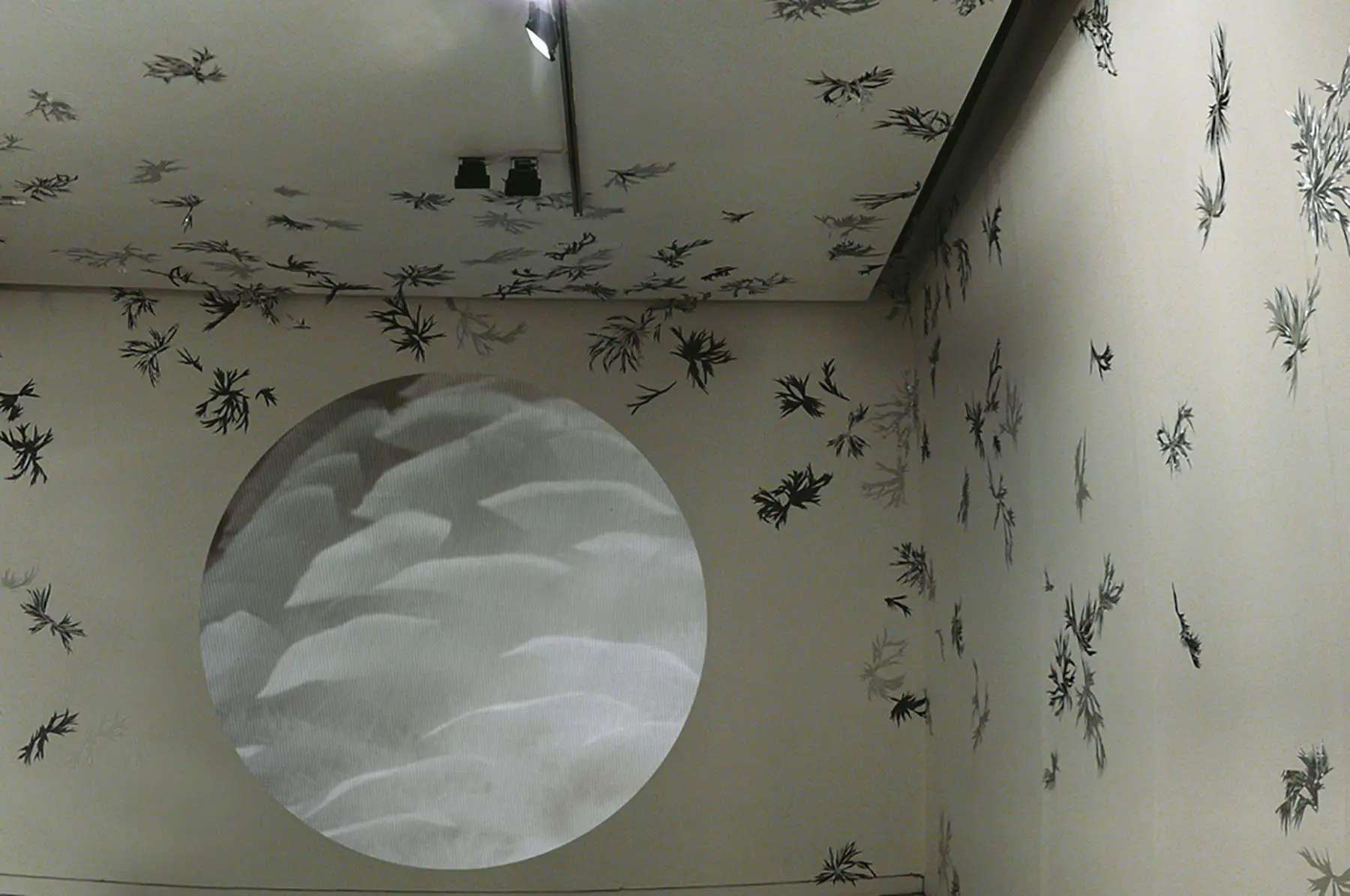
Liliana Sánchez presented the work En mí hay multitudes. According to the artist:
“The starting point for this work is the image of the broken dove in Parque San Antonio, destroyed in a car-bomb attack in 1995. This image posits in the first instance, as proclaimed by the continuity of its presence in the park, the need to keep alive the memory of Medellín’s violent past, yet beyond the event itself what it offers to my gaze is a symbolic interplay between the city’s own tension and the particular rhythms of its mobility. This motivation and the symbolic use of the event give way to the configuration of the work.”
The work was a video of a bird and its feathers graphically repeated on the wall. I must confess I didn’t understand it. After reading the text, perhaps I can say that today it is difficult to understand metaphors. The envoi is precise, a vector of information. Metaphors overlook anything, even me, here, at the precise moment when they seem to traverse me.
NOTE
1. Jacques Derrida, The Retreat of Metaphor, Enclitic II (2), 1978: 5–34.
NATALIA GUTIÉRREZ