
The nature of domestic items like tables and chairs lends them to portraiture and re-interpretation. They bring an aura of physicality to art. Their familiarity suggests a buried context, rich with associations. In postmodern art history, furniture and our relationship with it have become an increasing focus of deliberation. Addressing the intersection between the aesthetic and the pragmatic, the exhibition Informed by Function was presented at Lehman College Art Gallery from February 6 to May 15. The exhibit was curated by Claudia Calirman and Susan Hoeltzel and explored the “dialogue in sculptural objects influenced by the vocabulary of furniture, design, and architecture.”
Recent precedents and contemporaries include Doris Salcedo’s1 extended wooden chairs, which bear associations with missing people, and Columbia’s long-term social unrest. In a material contrast, the Argentina-born Leopoldo Maler2 goes high-tech with his insertion of furniture into dreamy installations. In a show at Nohra Haime Gallery this year, Maler projected the image of a person onto a bed to reflect the tension between absence and representation. At Sikkema Jenkins & Co., the Brazilian sculptor Saint Clair Cemin’s3 lacquered stainless steel chair called Witness (2008) seemed to waver and wriggle, as if it was alive, achieving a climax of contrasts.
These implausible syntheses of the utilitarian and the purely visual provide new insights into our territorial locus. The sixteen artists included in Informed by Function treated their subjects with incision and wit. The chair was the man’s (and woman’s) best friend in the show. Eleven artists presented sculptures that reconfigured, redesigned, and redefined the concept of a chair.
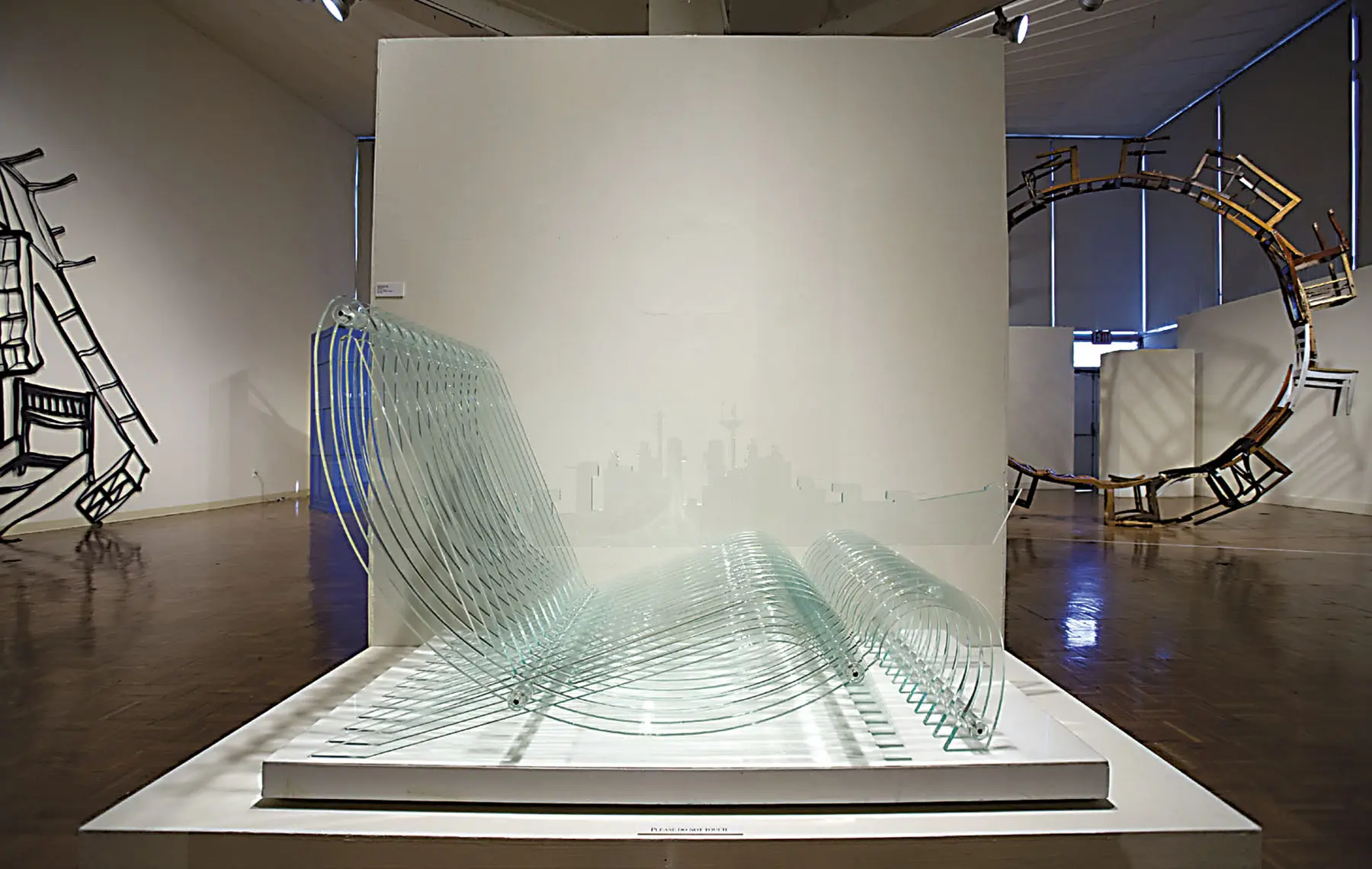
With its appealing connotations of affluence and leisure, the lounge chair was the subject of two sculptures. The cost of the good life was questioned in a Plexiglas lounge chair called Secret Meeting (2006) by the Cuban artist Alexandre Arrechea. A battle ship emerged from the translucent, wavy lines, negating the personal space that had been initially implied. Despite the allure of the lounge’s compelling form, the jarring insertion of a warship raised doubts about the validity of one’s worldview. Is complacency culpable? Conspiracy and concealment, repression and surveillance—these are the “secrets” that Arrechea exposed with his crossbred chimera.
Maillot Maillol by Michelle Jaffe conflated the shape of a chaise lounge and a woman’s bathing suit. The functions of the chair and the suit cleverly commingled and jolted our expectations. Sloping straps turned into supporting struts. The abbreviation of a bikini was telescoped into a steady area of repose. The work’s title was inspired by the heavy but gracefully reclining female sculptures by the French Modernist Aristide Maillol (1861–1944), such as The River.
Other chairs included Forrest Myers’s Parker (2006), and unbridled ball of wire in the approximate shape of a big armchair. This appealing sculpture resembled an activated Abstract Expressionist pencil drawing. The chairs in William Stone’s Corrected Chairs defied their original purpose: three chairs were stacked in a collapsing fashion, each with legs shorter than the other. They fell away like a slow-motion film and at the same time rose up like the trees they originated from.
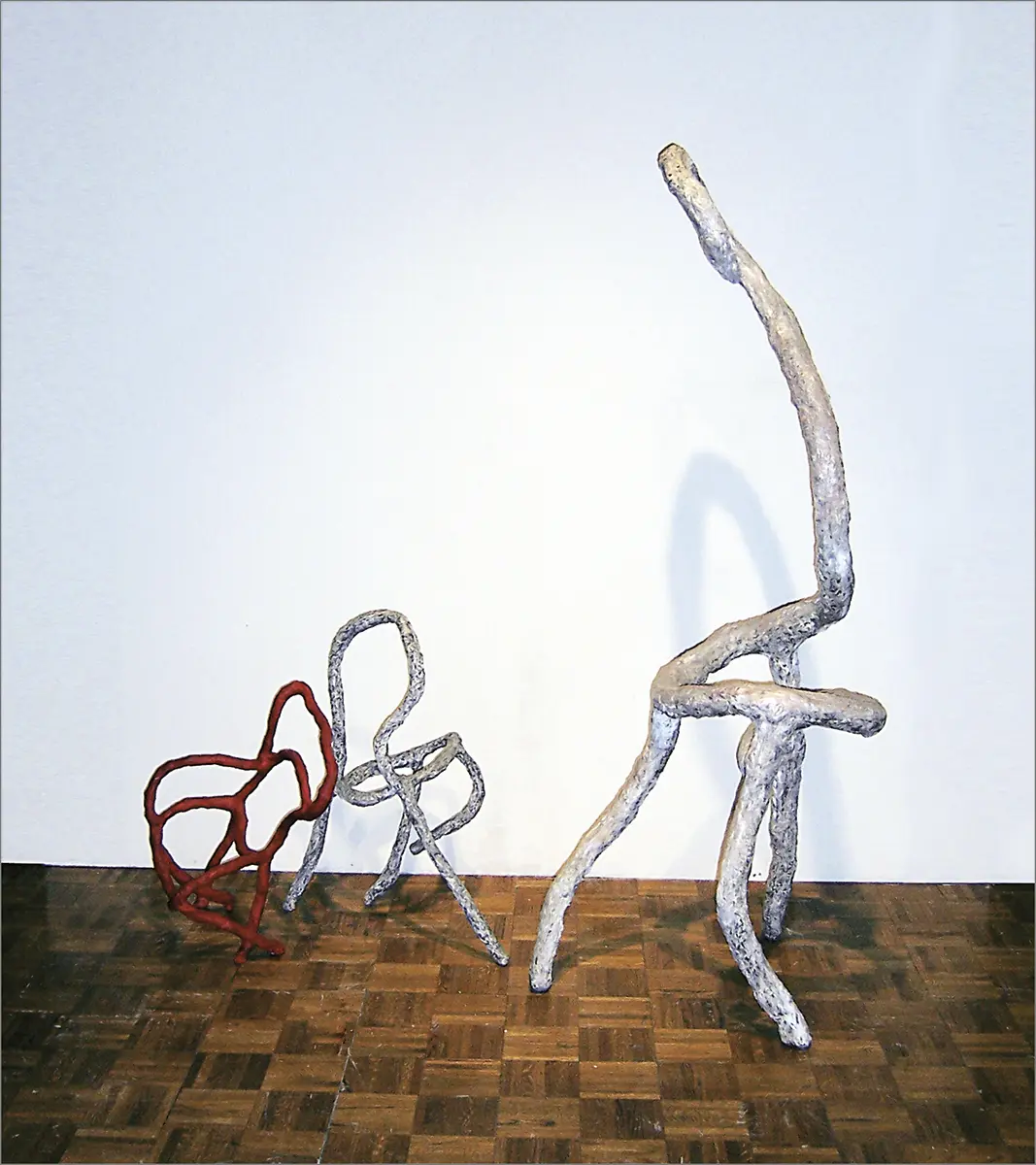
Perhaps best known for her super-elongated sculptures (which can reach as high as fifty feet), Marcia Grostein animates simple forms. Her trademark pseudo-animal shapes seem to rise and unfold from a single line. The sinewy constructions compete with the treetops for ascendance. In this show, Grostein presented three elements: a three-legged “chair” seemed to gallop ahead of a couple of admiring stragglers. The fiber and epoxy pieces conjured dissimulation as their stability was undermined by the dynamism of dance and its dramatic posturing. One sensed a wilderness at the boundary of rationality—inviting the thrill of the unknown and the promise of danger.
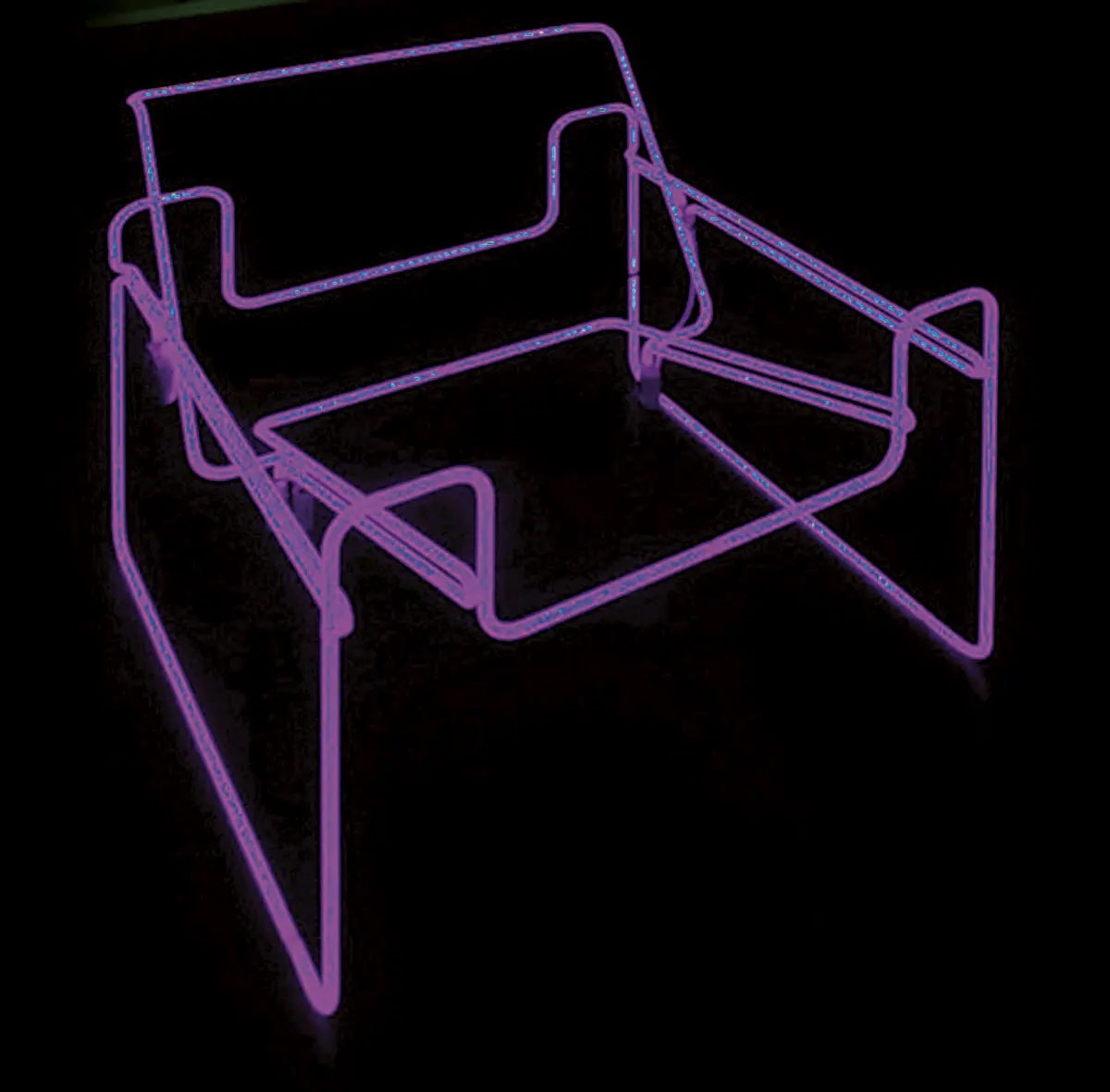
Danger sat squarely in the Black Electric Chair by Ivan Navarro. Behind a curtain that led to a room painted black, and empty neon chair confronted the viewer. A sense of morbidity was conveyed by the luminous purple light, giving pause to one’s admiration of the beautiful presentation. The disjunction between one’s concept of efficiency and the recognition of criminality established the work’s dissonance. While echoing Warhol’s silk-screened electric chair, the work further distinguished the iconography of the state, specifically the horror of Chile’s brutal and murderous repression. Floating in the dark, the chair troubled the viewer with its seductive sorrow.
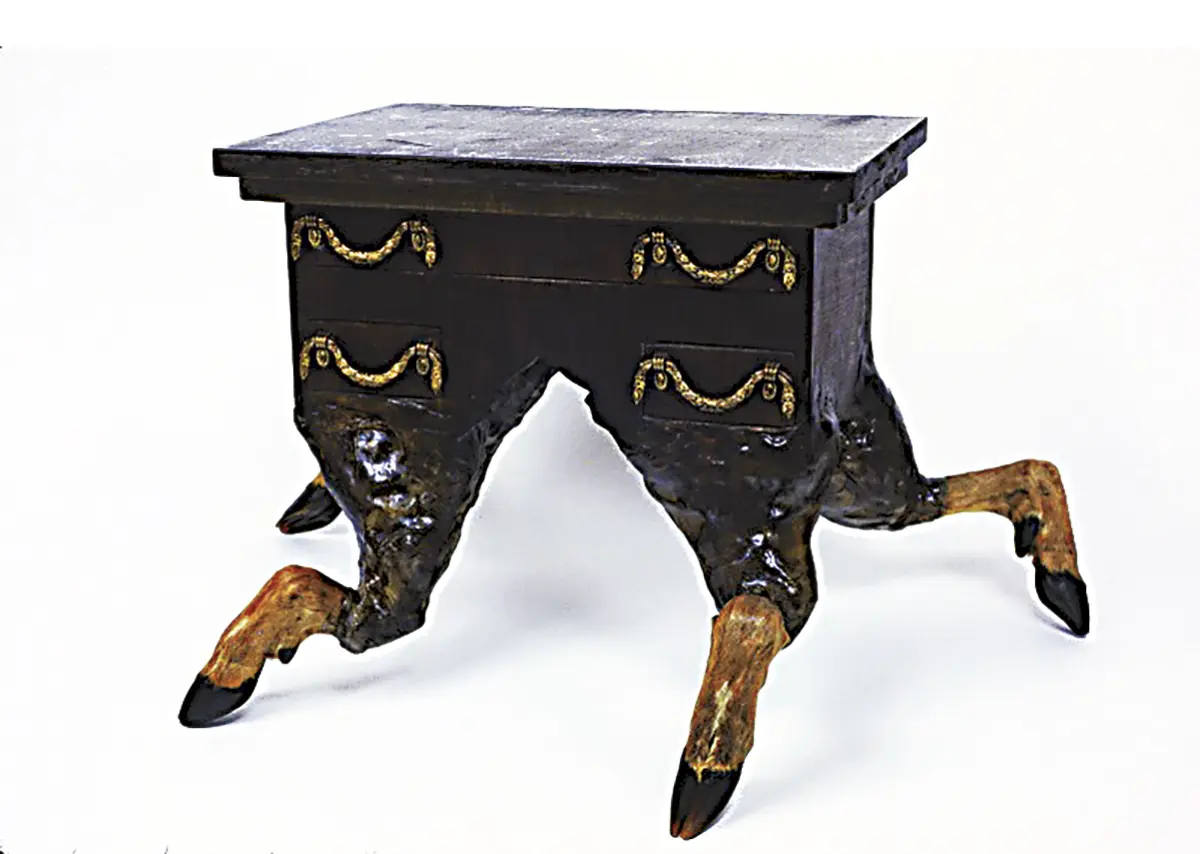
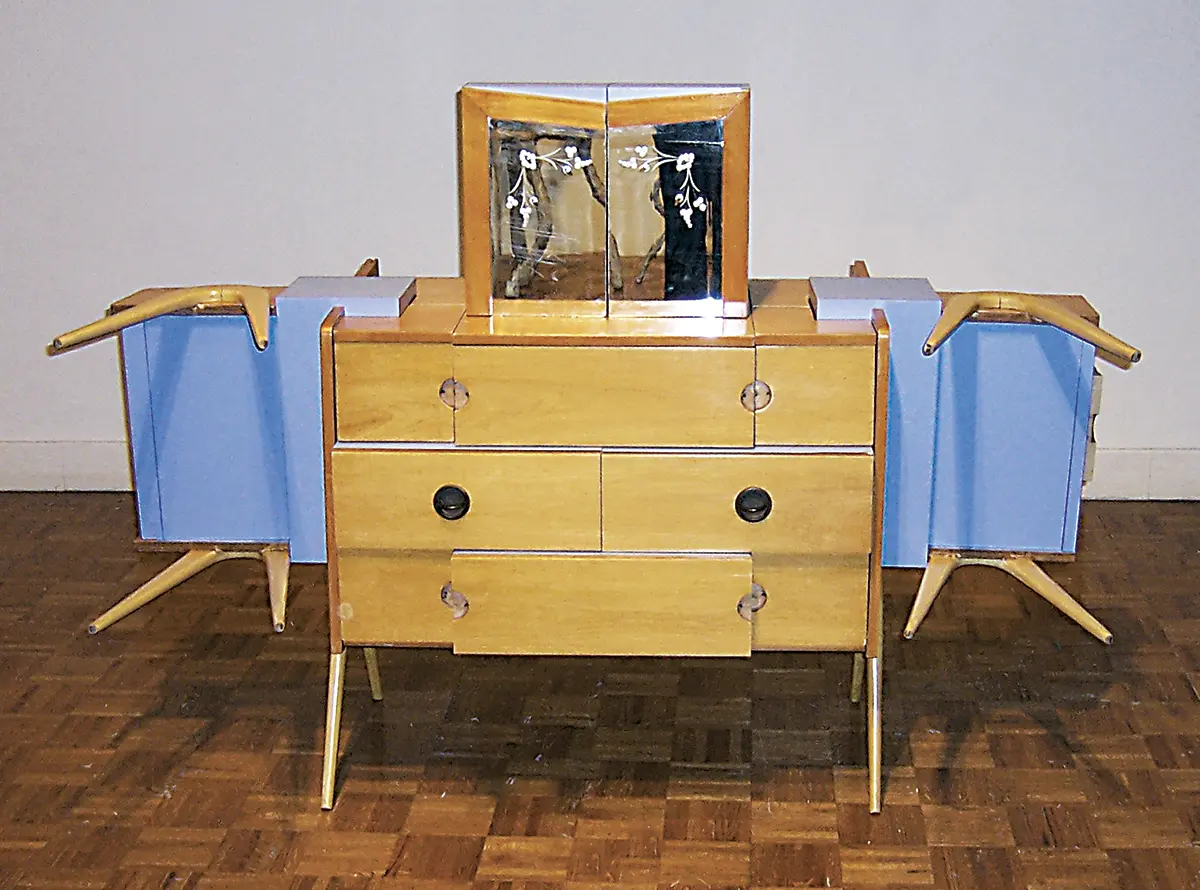
Also troubling was Pedro Cruz-Castro’s Hybrid III (2006). A small dresser was outfitted with deer feet that sought to flee in all directions. The stodgy and solid set of drawers weighed cruelly on the splayed, shiny hooves. In this metaphor for the classic battle between civilization and nature, one was reminded of extinct species, climate change, and our own collision course with destiny.
Several artists integrated mirrors in their works. In Persian Illusion (2008) by Madeline Weinrib, a carpet of mirrors and gouache invited one to take a virtual ride. Mixing traditional motifs with modern designs that contrasted the abstract with the organic, the piece embodied exuberance. Reflecting light onto the wall, it recast the negative space from the mirror into a diaphanous veil.
Like the sawed-off architecture of Gordon Matta-Clark, Friedrich Kunath presented half of a piano in Where in the world are you now. The musical instrument appeared whole as its image was duplicated in a large mirror placed against its cut end—as if to say, “I miss you, so I’ll make you up.” The illusion was effective but transitory and only worked from one angle. Yet the piano played on, maintaining the fantasy: one could hear Glenn Gould’s performance of Bach’s Goldberg Variations.
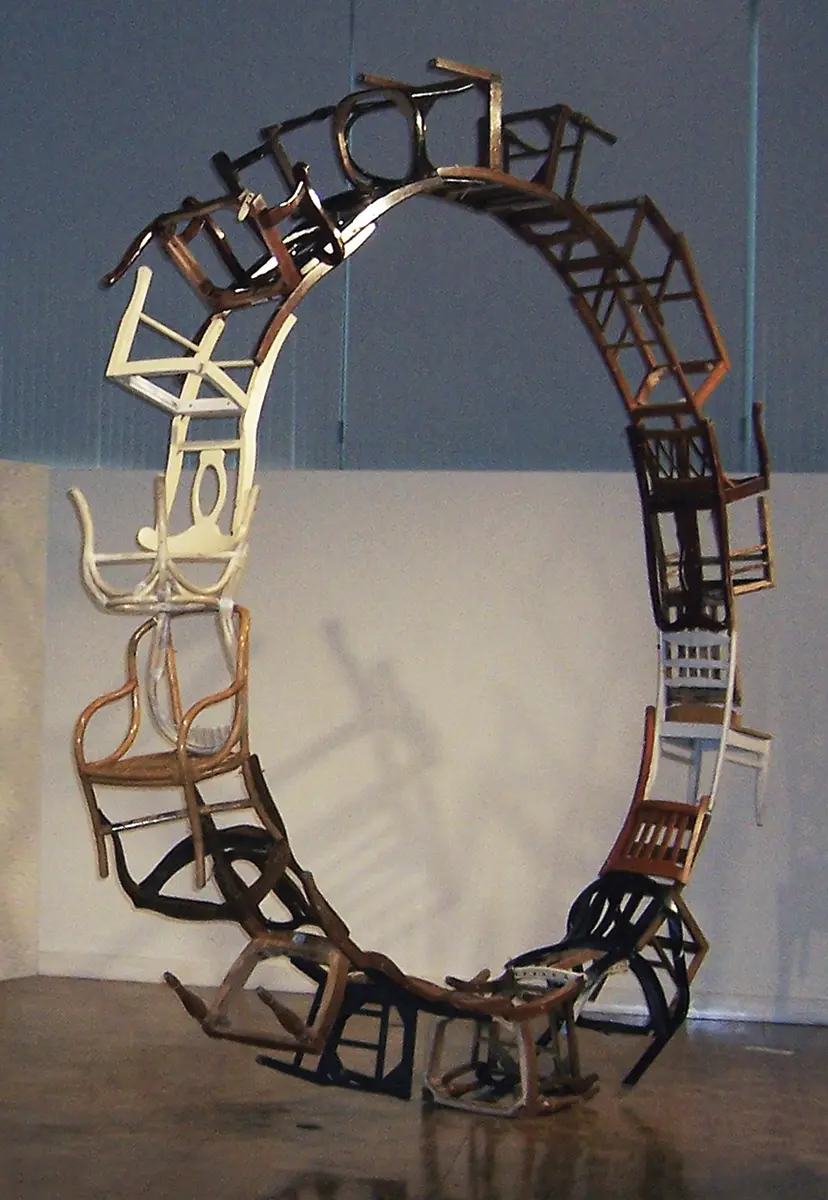
In another reference to music, Marc Andre Robinson created Throne for the Songs That Will Come by Themselves and of Themselves (2008). Made of a spectacular upright wheel of discarded chairs, the piece commanded the space. Its scale and simple geometry were compelling. Its environmentally friendly “found objects” and the traditional methods using glue and pegs gave the work an aura of warmth and progress. And yet, like all really good artworks, it also proposed the opposite. One felt simultaneously enthroned and threatened. Perhaps the ring of seats meant to evoke a Catherine Wheel, a medieval torture device, along with the concept of fortuitous or inevitability. We are all at the mercy of fate, but art tempts that fate. And these works were most tempting.
NOTES
1. Read the text on Venice Biennial in ArtNexus No. 66, written by Carlos Jiménez.
2. In this same edition, read the review on Leopoldo Maler´s exhibition written by Graciela Kartofel.
3. In this same edition, read the review on Saint Clair Cemin´s exhibition written by Richard Leslie.
JEFFREY CYPHERS WRIGHT