
Platonist philosophers as well as their Alexandrian and Neo-Platonist followers employed the term “demiurge” to refer to a creator-god. Later, during the first centuries of Christianity, the Gnostics adopted this term to refer to the active principle of the world, to the universal soul known through mysterious and intuitive ways. El Artista como Demiurgo (The Artist as Demiurge) was the title of the retrospective exhibition of works by José Tola (born 1943, Lima). Curated by Jorge Villacorta and held at the Instituto Cultural Peruano Norteamericano, this exhibit comprised four decades (1969–2008) of works by this renowned Peruvian artist, who in 1986 was awarded the first prize in painting at the Second Havana Biennale.
Solidly schooled at the San Fernando Royal Academy of Fine Arts (Madrid, Spain), Tola began his artistic trajectory as a painter of refined drawing skills and a generally austere use of inlays and colors. The works belonging to this period (dated in the retrospective between 1969 and 1982) show anatomically deformed characters that, according to Villacorta, were “hallucinated during states of gothic exasperation,” and that represents a unique treaty of the fantastic and grotesque. These works, which rapidly drew the attention of the local art world, generating both praise and condemnation, showcased an artist radically committed to the exploration of the abysmal human condition and an uncompromising search for the appropriate visual language for such a quest.
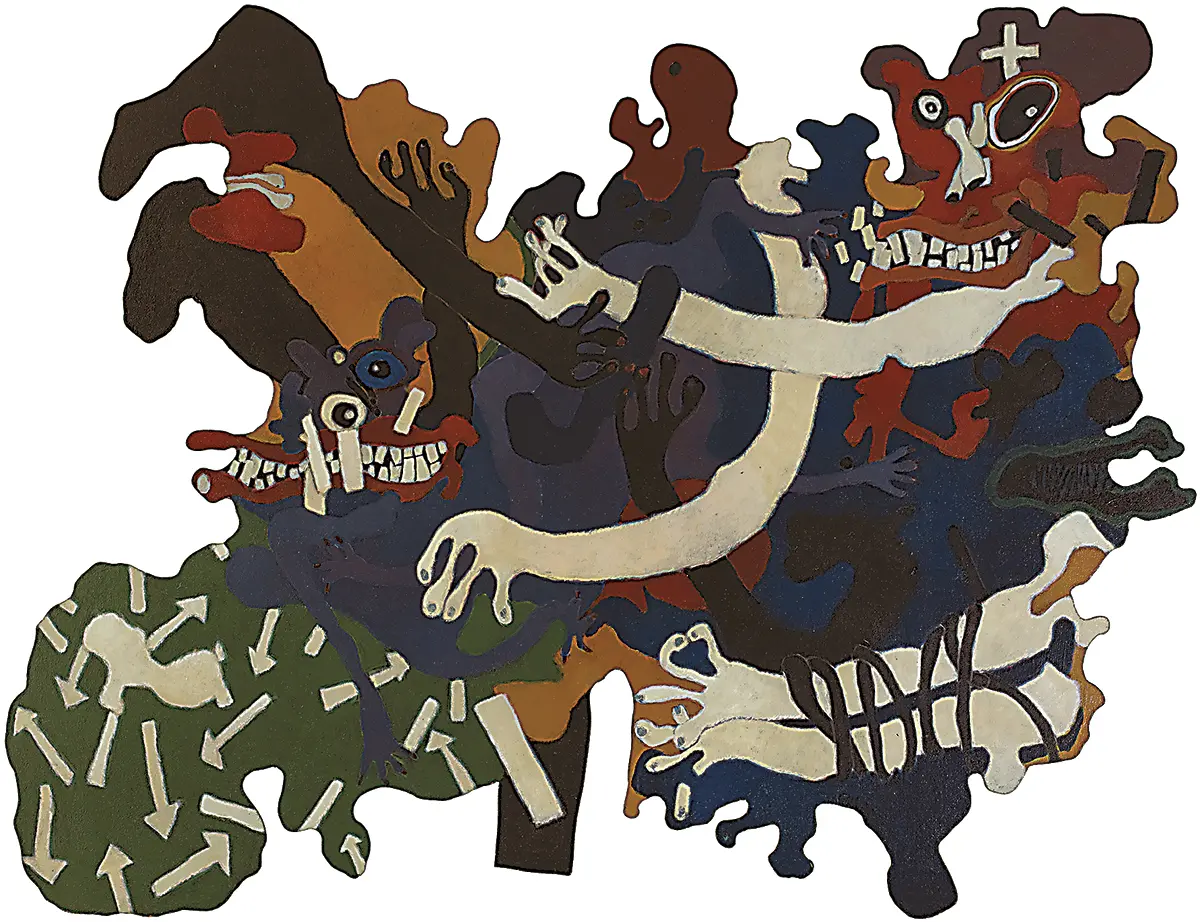
Despite achieving the acceptance of the small and conservative Peruvian art market, Tola left behind figuration and the conventional frame of reference in 1984. He then began a period of severe formal questioning that was disconcerting for its initial hermeticism. This resulted in the creation of works with irregular borders inhabited by human forms (like twisted hands, crazy-looking eyes, and menacing teeth), flaming colors, and spaces populated by elements of an iconography still being used by the artist today, but which is in a constant state of expansion (with crosses, arrows, enveloping lines, wefts, and grids). During this period, Tola achieved international recognition, such as that in the Havana Biennale, and he continued radicalizing his proposals with the exploration of new materials. He incorporated resins, metals, diverse pigments, and found objects onto wooden supports, finishing them with burned polyvinylchloride (PVC) pipes. This magnification of violence in Tola’s process and in the final images (with characters involved in orpheic falls or Christian immolations ever increasing in volume and horridness) paralleled Peru’s concurrent internal war. Tora was able to create a unique record that was true to his unwavering central interest in humankind, thus avoiding the temptation of articulating a literal or ideologically slanted discourse.
With their “appeased” textures and intense enamel colors on wood, the works in the notable series titled Los Eunucos de la Guerra (The War Eunuchs, 1989)—and later pieces such as the three 1994 cutouts shown in this exhibit—foreshadowed the next phase of Tola’s work: the reappearance of the quadrangular format and the return to oil painting. One defining characteristic of this artist’s work is formal transformation, the ability to turn in different directions, that despite the diversity of expressive resources maintains a resolute preoccupation for extreme existential states, in which even joy is enunciated with the severity of the deepest suffering. Thus, the works created by Tola from the mid-nineties presented the viewer with the prolific “demiurge” in full possession of his visual rhetoric. The artist presented an abundant catalog of mental states and interpersonal links, as he emphasized the poetry of titles such as Esa Delgada Soledad con la que Me Miras (That Thin Solitude With Which You Look at Me), or Te Vas Tan Sola Como Llegaste (You Leave As Lonely As When You Arrived).
The return to easel painting was not a renunciation of the earlier experimental period and this was confirmed by Tola’s recent works. In tense harmony with the surrounding canvases in the room, El Juego de Dios con el Azar y el Tiempo (God’s Game with Chance and Time, 2004) was an extremely complex piece. In addition to dissimilar objects, one saw Tola’s experimentation with the glasswork technique and its possibilities to create visual light and interplays of color. Equally dense in its formality and technical audacity was the piece Non-Omnis Moriar (2003), an assembly to which the phrase “mixed media” would not do justice; a better approximation to describe this thesaurus of Tola’s lexicon was its beautiful Horacian title No Morire del Todo (I Will Not Die Altogether).
To summarize, the roughly fifty pieces that were exhibited spoke of the persistence of Tola’s work, of his coherence amid transformation, his versatility in multiple languages of artifice, and of his demiurgic purpose: that of a creator who chooses the abyss of existence as the place from which he removes, with implacable tenderness, the veils from our human condition.
LUIS AGUSTI