
Conceptual and multimedia work by Leopoldo Maler is intensely expressive both intellectually and emotionally. It presents the spectator with transformations and processes of transformation. Since the late Seventies, Maler has been working with the concepts that visual arts involve not only painting but also several other fields that taken together become a constant, expanding, interdisciplinary media. Despite the variety of expressions developed by Maler, his works have mainly been characterized by his interest in the human body, his strong central nucleus, and his avoiding focal dispersion. Subsequently, he gave us Flaming Typewriter – exhibited in Argentina, his homeland – followed by Dedos con Fuego (Flaming Fingers), created during the Seventies and exhibited at the Pecannins Gallery and Silence, shown at the Camden Festival in London in 1971, we arrive at the present when in 2008 Maler reinstalls Silence in a recent exhibit at the Nohra Hamie Gallery in New York. More than one-quarter of a century after it was originally presented, Silence remains current and impeccable due to its sharp and subtle expressive synthesis. Maler, a law student during his formative years, delves into several territories: installation; neon light tubes; film; sculpture; performance; large-scale sculpture; collective projects; radio; TV, and teaching. Is it necessary to add anything else?
Neon light tubes become the metallic frame of a hospital bed. On its flat mattress, a video is projected in an unusually horizontal fashion – as the other work Maler exhibited many years earlier in Great Britain. A uniformed nurse completes the video installation. She sits next to the bed fulfilling her mission in a Florence Nightingale-like manner. Only one discrete but meaningful element disrupts the nearly complete darkness in the exhibit room: the word "Silence" in blue neon light vibrates on a sidewall. Aside from the elements already mentioned, there is also in the video projection an old woman on the bed, who turns, shifts positions, and chants while she awaits the unavoidable death that stalks her. She is the virtual, intangible human body, impossible to caress and with no blood running through its veins. These life-and-death themes, signified by cold electric blue and intense black, establish a relationship of contents that has not changed since the beginning of time and that has also remained a persistent aspect of Maler’s work from the time he first presented it in Europe.
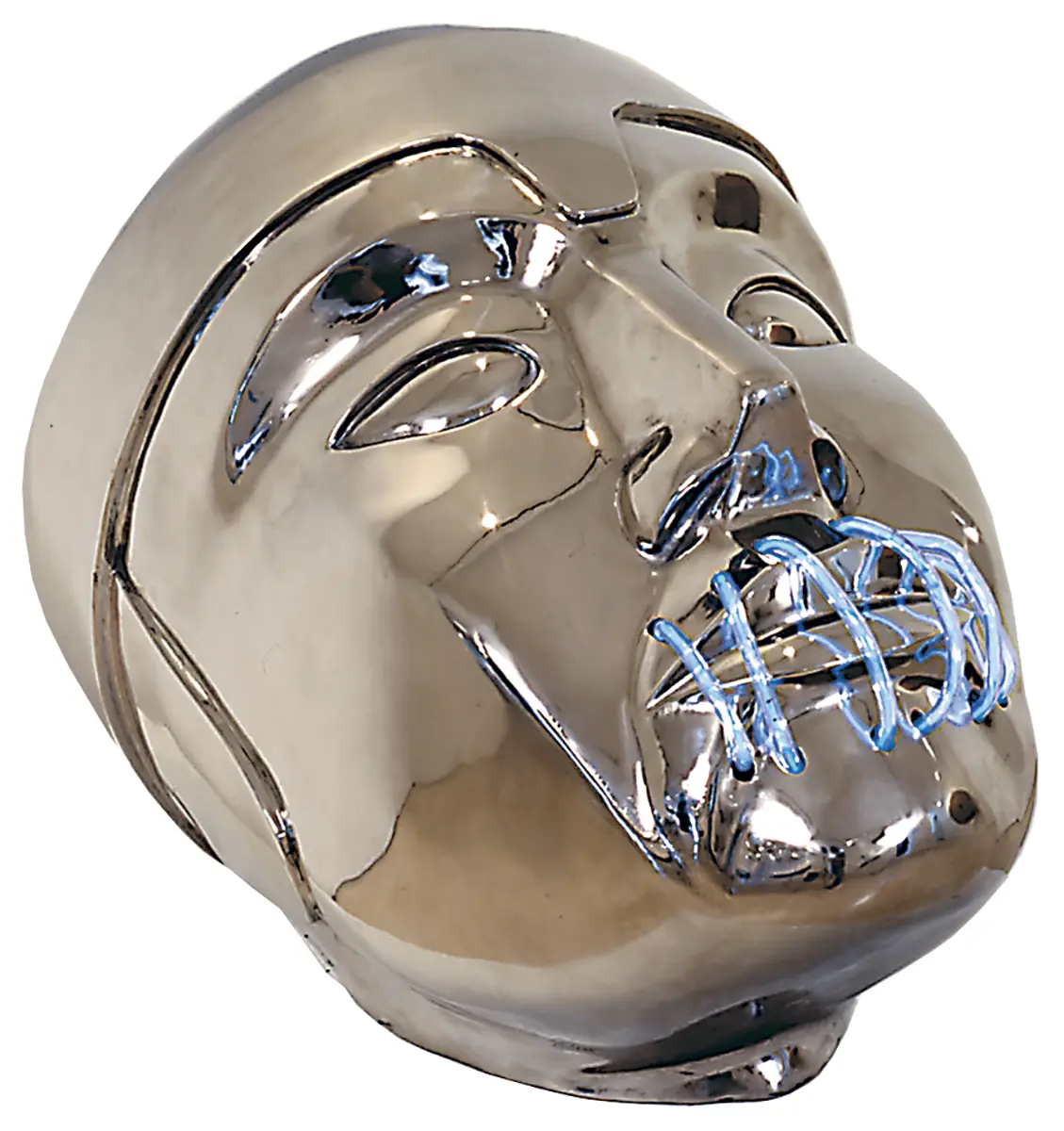
Among the works included in this exhibit at the Nohra Haime, there is another piece, titled Witness (1990), which also contains esthetically rendered references to the human body and silence and which points to Maler’s conscious stance in relation to individuals deprived of their liberty. It comprises a head cast in steel, with neon to zip the lips closed. This is a forced silence, an involuntary quiet, a silenced silence, a deadly, executed, persecuted silence, the silence of a witness who could testify to what he has been forced to hush up, Life? Cruelty? The irreverent reiteration of cruelty? There are several kinds of silences: one brought on by death, another that is a temporary silence…
Astral Ellipse is a piece that was a work-in-progress for a long time (1984–2000). Here, Leopoldo continues to allude to human beings, now by means of a black-and-white relief fashioned of nails, wood, and fiberglass. A blackboard in the background presents handwritten measurements, calculations, and formulas. Superimposed upon it is a smaller square with the emerging profile of a woman’s head. Two groups of nails are placed on the silver and white panel in a formation that extends toward the feminine form, creating a pointed shape.
Within this text, there are several references to “the body”. Maler approaches the body as the element that most affects human beings. He is far from solely conveying this subject on each occasion with a few minor tweaks. His aesthetics are personal, risky, and aimed at linking sensitive perception with the intellect. The body is the target of the political pressure of any given period in history; it is charged with bearing everyday struggles; it is the body that survives or perishes, that procreates, and that does battle. During the Seventies in Argentina, artists incipiently took advantage of techniques and technologies; they broke from traditional artistic approaches and linked the art scene with the street scene. Artists in the Argentina of the Forties had already employed Kinetism, neon lights, and water, as had those belonging to the Madí Movement, who produced important video art, dance, films, installations, performances, and objects.
These initial moments were intensely original, fresh, and charged with a certain expressive primitivism in the face of the strong intellectual predispositions of the time. None of these artists, or the Conceptualists in the Seventies, delved into shallow artistic expressions; to the contrary, they gave priority to sensitive perception, and continue to do so. Maler has always kept his distance from sterile conceptualism, his work attained through the use of modified tools. Which strings does this artist have to pull to include that great duo (life and death) and to imbue it with a recurrent and vital presence in exhibit spaces? Powerful sensibility can attach itself to the intangible video image. In Silence, the confrontation between the seated character and the supine character results in a highly intense duel between the two, notwithstanding their lack of communication or verbal exchanges. Both characters are structurally supported by a pair of opposites; the excluding neon bed, and the inclusive, communal chair. The technological correspondence between the women in the video and the neon bed stands in opposition to the non-technological nurse and chair; these are duos that are triangulated by the only word present and legible in this video installation: Silence.
GRACIELA KARTOFEL