
Isometric Projections is the title of the most recent exhibit by Marco Arce. It includes works such as Esqueletos (Skeletons), Cabezas (Heads), Caras verdes Concéntricas (Concentric Green Faces. Beginning with the titles, one could establish the changes by using isometric systems in Arce’s work, who until recently was creating emotional free-hand drawing-paintings, collages, and other media.
In earlier exhibits, Arce had demonstrated an interest in the doodle, the lineal, and the organic that arise from personal sensations; some works utilized intense colors that sometimes deal with social reflections, employing elements to compare and contrast, to elicit sensuality and eroticism. In this current exhibit, Arce introduces the spectator to a world that is also baroque but one that derives from a different origin: Places that have been traveled through; autobiographical exercises, and the creation of digital media. Certain texts by Arce – El Conejo y la Cara Enojada (The Rabbit and the Angry Face), Proyección Isométrica (Isometric Projection), and El Conejo y la Cara Enojada II (The Rabbit and the Angry Face II) – which accompany his artistic endeavor are ambiguous autobiographical narrations. The artist psychically undresses in a chained process of very difficult realities and dreams. Marco refers to fearful dreams and tragic family moments and tells of his curiosity to ascertain the manner in which these sensations are connected with one another. He also speaks of his relationship with death, which drastically turns a traditionally Mexican theme toward the personal, infusing it with intensity and originality.
“This series possibly concerns the exorcism of a bad childhood memory. When I was 8 or 9 years old, I experienced the most painful moment in the long and tortuous divorce of my parents… What is my relationship with death? How does it enter and leave my home in multiple ways? At times it is a light cloud, at others, it becomes a bolt of lightning; sometimes it is transparent, and at other times, hard and concrete. Let these pieces be an attempt to explore a series of sensations that accompany me and of which I find the need to speak and express in multiple ways.” It is a parallel path. Marco Arce informs the spectator that the video games he plays with his son – and his own addiction to video games during the Seventies when he was in high school – prompted him in this exhibit to use technological media.
The obsessive character he has manifested throughout his work is present in this exhibit, although now his “pulse” and direct graphic renderings are not those that transform the paper. When I interviewed him, Arce mentioned that “I work with a group of specialists who handle the digital media more expertly than I and with another kind of sensitivity“. He also notes that adolescent addiction to games was to a certain extent a death wish. The violence he was required to endure and the sublimation of this violence through the technological media, allow him to attempt to exercise his fatherhood in a different fashion from that he experienced. His father was a photographer; Marco and his son use a cell phone to take pictures of books, toys, television programs, and video games. In an attempt to modify the violence found in these subjects without losing the quality of the images, the artist decided to use vector graphics – also known as geometric modeling – as a system for rotating and deforming these images. Digital media is a way of expanding obsessive exercises through enabling perfection the use of vectors, and science – although today’s mathematics now question certainty.
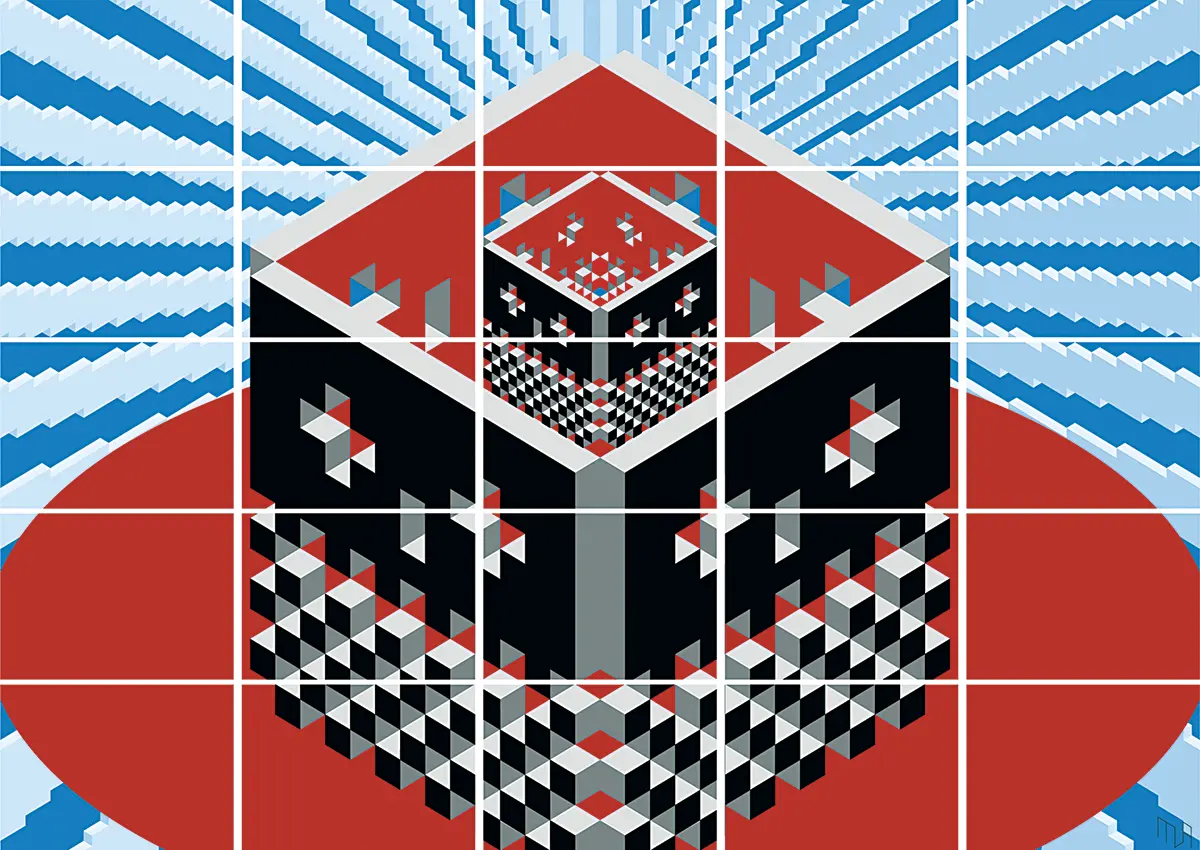
On entering the exhibition, one encounters a group of framed works – apparently in larger-than-usual formats – connected with technologically rendered images. Without attempting to describe isometric representation completely, it is only noteworthy that this is a two-dimensional visual representation of a tri-dimensional object. This aspect is very present in each of Marco Arce’s works; those that establish a duality between depth and surface are not mindful of the proportions or traditional rules of proportional reductions of size according to distance. Each piece possesses continuous guardians of small works such as those Arce create formerly, as in the case in Cabezas Cruz, the work that least refers to death but that which is best suited for small-scale reproduction. These framed polyptychs measuring 40” × 45” and 60” × 43” entirely convey visual-digital as well as pictorial sensations. The surprise mentioned at the beginning of this text lies in the process: the cell phone snapshots – with very poor definition – are worked through vectors and colors, are printed on letter-size paper, and are then traced on vellum to be drawn and painted subsequently on 300-gram Fabriano paper. Arce reasserts himself as an organic autobiographical painter, despite his use of digital technology.
GRACIELA KARTOFEL