
The retrospective exhibition Modernismo Anacrónico (Anachronistic Modernism) of works by the Venezuelan artist Muu Blanco absorbed, reflected and regrouped Blanco’s artistic production of the last several years. This solo exhibit was carefully installed at the Sicart Gallery in Barcelona, and some of the assembled works were exhibited concurrently this past May at the International Contemporary Art Fair Barcelona (or SWAB, its acronym in Spanish), with Blanco as the only Latin-American artist participating.
During the past year, Blanco’s work has been exhibited in important art fairs such as ARTEBA’08 in Buenos Aires, Argentina, MIART’08 in Milan, Photo L.A. in Los Angeles, Bridge Art Fair in New York, and CIRCA in San Juan Puerto Rico, as well as in several individual exhibits in Caracas, Venezuela. Blanco confesses that he thought he had ended his creative endeavor centered on Anachronistic Modernism with the 2007 Bello Horizonte Caracas exhibit. Nevertheless, the series unexpectedly gained new strength and longevity due to the great interest it had generated abroad. For the Barcelona show, the artist had time to think about how his exquisite and absurdly hybrid characters have evolved, and he presented and reinterpreted them in three specially assembled installations and in large-format photographs that endowed them with an air of distinction, as beings who have reached a status that suspends perpetuates, and renders them independent.
What is Anachronistic Modernism? Blanco heuristically coined this concept to structure his aesthetic narrative, to define the basis of his work, and to determine the extent to which understanding the work defines it. In this manner, language becomes the structure for assimilating new knowledge and, as Bertolt Brecht stated, for containing materiality full of meanings. Let us not forget that with the arrival of modernism arose the problem of fitting this movement into conventional history; thus, the need for terminology that conveyed a new kind of perception. In this regard, Roger Fry, in Words Wanted in Connection with Art (1928), laid down his “subversion glossary,” in which new terms were found. Similarly, it is important to understand modernism as a translation of modern art, whose main characteristic is an exacerbated self-criticism.
Modernism as a concept of history was succeeded by postmodernism; as Blanco reclaims and criticizes it, his anachronistic/ironic approach reveals his subversive artistic nature. If modernist art is based on self-criticism and if its discarded parts are immediately replaced in such a way that it rapidly loses relevance, then Blanco affirms that his work consists of anachronistically collecting all these neglected elements of modernity. He uses found objects as his raw materials with the purpose of building on top of the ruins of what was left behind. To the artist, the “aesthetic of ruins” embodies the Benjaminian idea that a historical interpretation of the past is not the same as knowing the past “as it actually was,” but rather is about absorbing its recollections through an explanatory lens. The artist sees ruins not as decay but rather as what they stopped being with the passage of time, remaining as scattered or retained pieces that are fragments of memory.
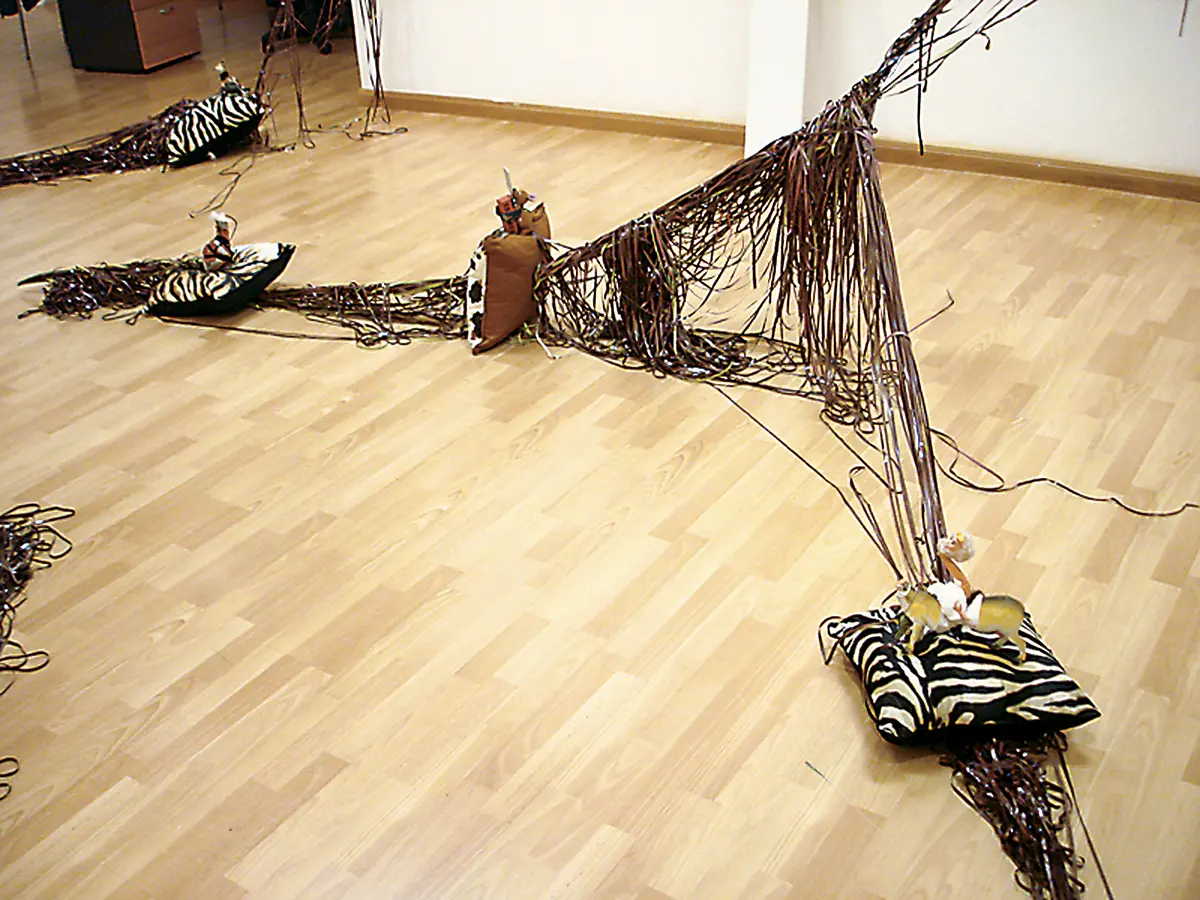
In Blanco’s work, magnetic tapes are metaphors of things that have lost their usefulness but are simultaneously charged with connotations of memory. In the digital era, recording tape is a symbol of the disappearance of the obsolete, such as tapes of music that these days can only be found on the shelves of collectors, the sounds corresponding to the memory of past experiences. Blanco affirms that, at present, magnetic tapes are archeological objects and that younger generations probably have never listened to a cassette tape. To him, as a former DJ, they remain an essential element.
Henri Focillon in The Life of Forms (1943) writes about the primacy of forms over meaning because forms are stable and meaning is always changing and responsible for the different styles of a progressive metamorphosis. Many of the forms and sculptures in Blanco’s work are plastic toys—animal or human representations dissected and revived as hybrids. They are therapeutic dolls for this artist; they exorcise his demons, like the Objetos Relacionais (Relational Objects) of the Brazilian artist Lygia Clark.
Yves-Alain Bois affirms that concepts must be extracted from the object. Thus, it becomes necessary to intimately know the object’s materiality as the only way to access its deeper structures. This aided one in understanding each of Blanco’s “objects” in the installations: a cushion alluded to reflection, disseminated the sculptures, and was pierced by magnetic tapes, which were like dendrites through which memory travels, and which Blanco calls memorias de viaje (travel memories). The artist also identified these in the horseshoes that anchored his installation, similes of the travels and transit that have taken his work to several exhibition venues.
Set to music by the artist himself, a video installation of kaleidoscopic aesthetics was at the end of the exhibition at the Sicart. It referred to recycling pornographic junk mail. This mail is a mirror of a society articulated and reconstructed in parody in Anachronistic Modernism.
ELISA RODRÍGUEZ-CAMPO