
Three monumental oil, charcoal, and glossy paint drawings on canvas, created in 2007, along with an installation, constitute the Oscuro y Verde Ajeno (Dark and Extraneous Green) exhibit by Miami-based Argentine artist Nicolás Leiva. The wall installation of in excess of one hundred elements – initiated last year and completed at the beginning of this current year – was created with ceramics (tiles with platinum) and circumscribed with a delineation outlined in red and traced directly on the wall. Space welcomes the spectator with an overwhelming ritualistic and ludic sensation. One appears to penetrate and become part of the movements of an ocean visited by pirate ships, or of the vision of a strange forest as observed from a building rooftop, or one can also appear to confront the surreal enlargement of tortuous chimneys or to possess the power of visualizing a city, a castle’s exterior, or the interior of a home. Coincidentally, it was a home’s interior that generated this exhibit.
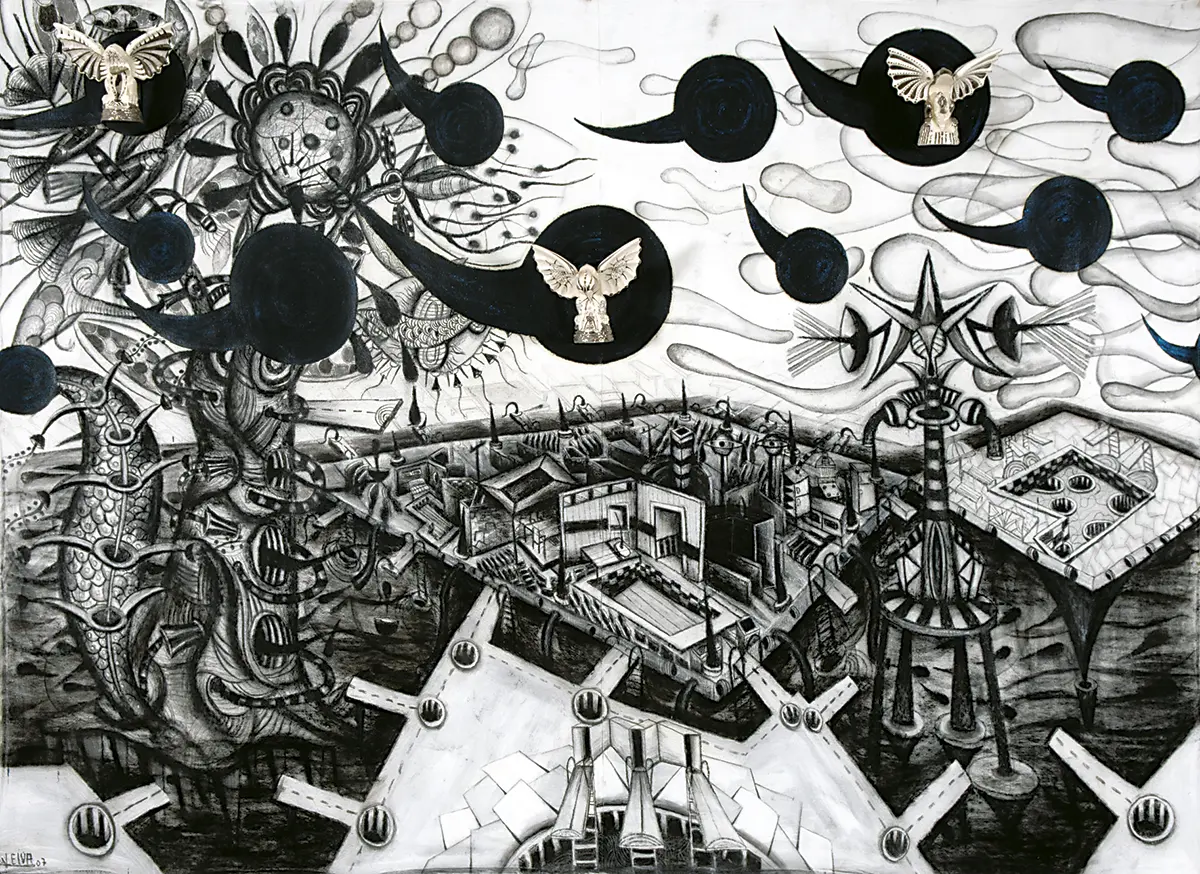
Leiva began creating ceramic objects that were associated with different spaces in his home workshop. He represented these by conceiving of complementary forms and signs belonging to each specific area of his habitat. Likewise, the theme of the home is also addressed in certain sectors of these monumental drawing-paintings. In this manner, we are able to make references among the subtle connecting points unifying the works for the benefit of those who have not seen the exhibit. In one drawing, the house is viewed from above, fore-shortened. To link the drawing-paintings with the sculpture, a relationship can be established between the lineal perimeters of the architectonic cut in the paintings and their commonality with the installation’s red line. With these two components as manifested in diverse materials and techniques, Leiva renders a surrealist and personal narrative dynamic involves the spectator in the exterior and interior of a workspace, and interconnects imaginary elements. Real architecture, organic architecture, architecture full of connecting tubes, and finishing touches such as horns, satellites, and horseshoes, serve an inventive purpose at the same time that it contains an organic forest with gigantic, harmless beings with practically no similarities to humans, except in the rhythmic movements that appear to be dancing to the beat of an Afro-Caribbean son.
Each canvas measures 9 × 13 feet – they nearly cover the entire distance from the floor to the ceiling. A bubbling forth of images inhabits the surface of these canvases intensely, in a sui generis horror vacuis. These works are warm, even though expressed in a white-and-black palette scale, with only the occasional element of color. The forms and movements are what invest the works with their lively vibrations. It is this multitude of bodies and forms, filaments, and finishing touches that lead us to entertain the expectation that this visual pandemonium could only be rendered in intense and assorted colors. Nevertheless, the movement and the different visual textures are drawn provoke our imaginations to visualize a resonant and coloristic effect. The commas painted in saturated blacks are like vessels transporting semi-occult blues and angels of diverse orders in complementary sandy-pink tones.
The compositions of the gigantic canvases include ample pathways or magical carpets that appear to beckon to the spectator to enter them. The symmetry is evident. In the curving and expanding, there are parallelepipeds “dressed” with narrower or wider black-and-white stripes, alternating with other “beings” with tubular bodies with hanging ornaments, “arms,” and numerous tribal add-ons. In two of the works, a sort of elevated fence separates the interior world, the latter also rendered in great detail. High walls bordering the houses entirely can be observed…; as it is frequent (in Cuernavaca), these high walls surround the houses and prevent a view of the homes’ interiors. Another of the configurations constituting Leiva’s esthetic approach is the artist’s use of a geometry that becomes progressively more synthetic.
GRACIELA KARTOFEL