
The presentation of recent works by Argentine artist Nicolás Robbio at Galería Nueve Ochenta in Bogotá opens the scene, through an excellent personal exhibition, to a necessary dialog between young artists from Latin America and other latitudes who share an interest in representational forms in which the real is understood as an uncertain universe, and, as such, one rich in abstract content.
In this way, new visions that reveal the exhaustion of many critical lines marked by the strength of the documentary begins to connect in Colombia, and, in consequence, our attention is directed towards the authors of other interpretative processes where the concrete and verifiable elements of the visible world are subjected to profound interrogation. The importance of such propositions resides in the fact that they foster the maturation of the types of questions that need to arise before new perceptual forms are developed, and with the broader notions of reality capable of including orders that up to this point remain out of focus, unacknowledged, excluded by the majority of current systems.
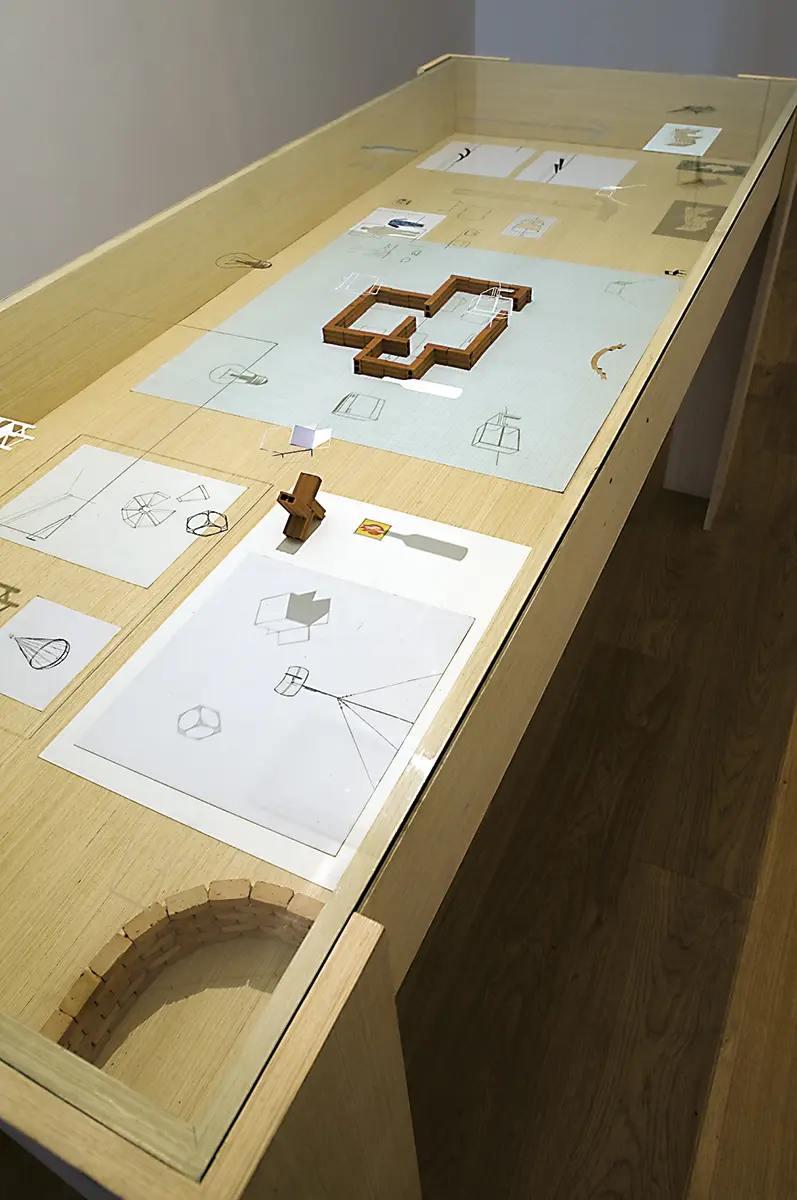
In the proposal presented by Nicolás Robbio, as in those of some young Colombian artists —among which we can note Mateo López and Nicolás París—, the most delicate expression of drawing constitutes an essential expressive tool in the generation of an unstable idea of the apparent and in pushing the viewer towards the forgotten problems of vision and perspective. In that sense, these elements also result in a reconsideration of the poetics of the image, which has been displaced and even discredited by the popularization of photography and video, as well as by the insistent affirmation of a media-centered conception of reality.
For this very reason, it is of note that in the work of these artists we see the re-emergence of classical or pre-photographic issues of perception, which in the complexity of the current moment possess the amplified potency and the magic of the thinker who knows how to deconstruct and de-cosify a world that organizes, flattens, and condenses any form of representation, such as photography. In that sense, the preeminence given in the work of these artists to the expression of the spirit of the visible, this is to say, of the essence that anchors the formation of an image or an idea, is also significant.
In the specific instance of Nicolás Robbio’s work, where very often the image is an intangible matter, the expression of the essential can be recognized in every one of his expressive concerns, at the philosophical and material levels.
The images with which this artist confronts his viewers are fundamentally structured on the basis of the encounter of light and shadow, of the represented (the drawing) and the real (the object, but also light and shadow.) Generally, Nicolás Robbio’s visual creations are a combination of that which is recognizable to all with that which is fleeting and abstract and only becomes perceptible in the eyes of an artist, who then emphasizes it. The clearest example of this procedure is Robbio’s “accidental geometries,” geometric configurations detected by the artist in any dynamic of public life, like the haphazard paths traced by pedestrians in any given street.
In the video recording of any random view of people walking on an everyday street, the artist makes mobile connections from one pedestrian to another and based on these connections we see the emergence of triangulations and other basic structures that design something like an astronomical map, one that appears spontaneously and then vanishes in the same streets where it arose.
This moment after a moment, amidst the activity of many anonymous subjects and the continued shift in the circumstances in which they move.
This logic also contributes to interpreting the imperceptible details with which the artist intervenes the exhibition spaces where he works, understood now as profoundly meaningful minimal connectors. The same occurs with the drawings and objectual propositions that Robbio organizes in the table-boxes he builds. Those images cannot be deciphered without the activation of lights that are strategically arranged by the artist to traverse them. The true universe created by the artist, on the basis of the traces and volumes generated by the shadows, appears only when the light is turned on.
Without light’s power, the stage is merely disposed to be activated, its meaning awaiting the interlocutor that will grant it meaning. Thus, with an admirable economy of elements, the artist gives diaphanous voice to the mutually transforming conversation between the immanent world and the corporeal or material one.
With these minimal mechanisms, the artist takes the viewer through the circuits in which the secrets of the world of forms move. These, despite the simplicity of the structures used by Robbio, are in no way lost in the simplistic pathways of the explicit. On the contrary, they retain their expressiveness in a slight, suspended feeling.
MARÍA IOVINO